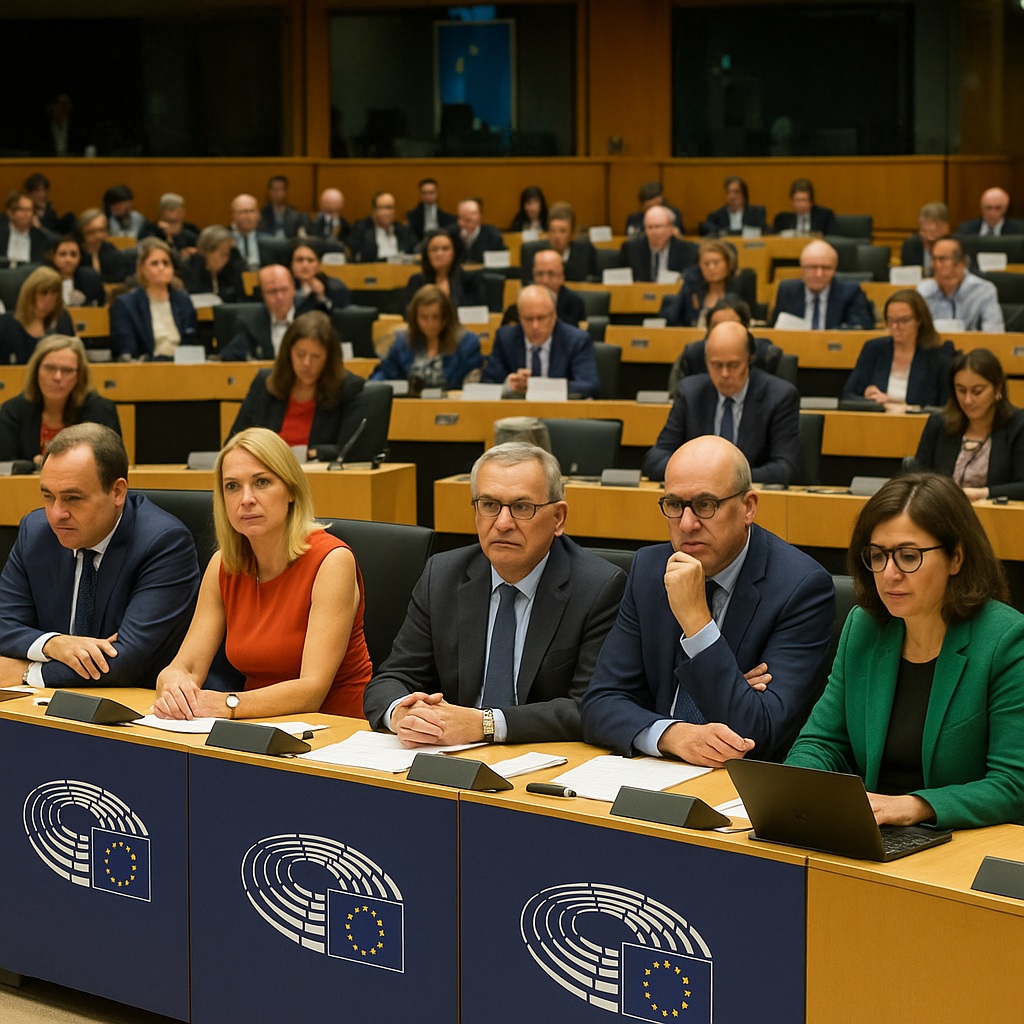
As the European Parliament Committee on Budgets meets this week in Brussels, a €16 million shuffle among flagship programmes underscores the bloc’s evolving political direction.
Brussels — This week, the European Parliament’s Committee on Budgets convenes for a pivotal two‑day session, tasked with approving transfers of roughly €16 million between major programmes — a modest figure in the context of the EU’s multibillion‑euro budget, but significant as a marker of shifting political priorities.
The meeting, scheduled over two days at the seat of the Parliament in Brussels, sees members of the Committee on Budgets (BUDG) examine a series of internal budgetary reallocations. According to the committee’s newsletter, one of the key items on the agenda is a transfer request under the Commission budget (Section III) covering a range of expenditure lines: from flagship initiatives such as the Digital Europe programme to the Ukraine Facility, the Single Market Programme, the European Space Programme, the LIFE programme, EU4Health, Creative Europe and more.
While the transfers — amounting to some €16 million — are relatively limited in scale compared to the EU’s wider budget, their distribution is drawing attention. The move signals both a tightening of oversight by the Parliament’s budgetary arm and a willingness to re‑align funding around newer priorities, especially those linked to digital transition, resilience in the face of geopolitical upheaval, and EU strategic autonomy.
Shifting budgetary winds
The fact that the Committee is focusing on transfers within existing programmes rather than fresh money is itself telling: it points to constraints in the current multi‑annual financial framework (MFF) and to the need for flexibility in shifting resources to where they are most needed. The Committee’s agenda includes exchanges of views with the Commissioner for Budget, Anti‑Fraud and Public Administration, who will address the MFF Regulation, the Inter‑Institutional Agreement and the Own‑Resources Decision.
In practical terms, the transfers will take money from administrative support lines and under‑used operating expenditure chapters and redirect it into operational lines in programmes closer to the EU’s emerging agenda. For example, the translation centre budget is proposed to receive a reinforcement of €3.4 million under one of the transfer decisions.
Observers note that this modest exercise of fiscal shift highlights two underlying dynamics: one, the growing importance of newer “horizontal” programmes that cut across traditional domains (digital, space, health, resilience); and two, the parliamentary desire for stronger political oversight over how EU funds are deployed — even if the sums are small.
Political undertones
At a time when the EU is grappling with multiple challenges — from Russia’s war in Ukraine and the need to shore up the Ukraine Facility, to the twin green and digital transitions, and to reinforcement of resilience in supply chains — budgetary signals matter. The Committee’s scrutiny of transfers sends a message that even small reallocations are subject to political judgement. It underlines that the Parliament is not simply rubber‑stamping the Commission’s budgetary plans, but actively steering them.
It is also worth noting that the Committee’s meeting comes against a backdrop of heightened pressure on the EU’s longer term budget cycle. The Parliament has set an ultimatum for the bloc’s next seven‑year budget, signalling impatience with delay and a strong desire to see structural change.
In this sense, the current exercise is more than administrative housekeeping: it is a rehearsal for budget politics in a more constrained and consequential environment.
The agenda in focus
During the first day of the meeting, members will vote on the requested transfers under the 2025 Commission budget. Later, they will hold an exchange of views with the Commissioner on the MFF and own‑resources decision, signalling that the committee sees its role as both reviewer and agenda‑setter.
On the second day, the focus will shift to other profile topics such as gender‑budgeting in the next MFF and the continuing implementation of the Technical Support Instrument — both themes with broader policy resonance.
Implications and outlook
Although €16 million is not a game‑changer in budgetary terms, the pattern matters. It reflects a re‑prioritisation toward digital capacity, strategic resilience and external policy instruments. For stakeholders within the Parliament and the Commission, the message is clear: flexibility and political oversight are becoming central features of EU budget governance.
For programme beneficiaries and national authorities, the transfers are a reminder that funding discipline and alignment with broader EU priorities matter. As one budget official put it, “In this cycle, every euro has to prove it is directed to the right priority.”
Looking ahead, this meeting will be closely watched not for its headline numbers but for its tone and the parliamentary direction it signals. The real test will come when the next full MFF is negotiated and when the Parliament exercises its oversight role at a deeper level.
In short: this week’s budget committee meeting may not change the EU’s budget landscape overnight, but it provides a clear marker of where political momentum is headed.

 The Tower Post