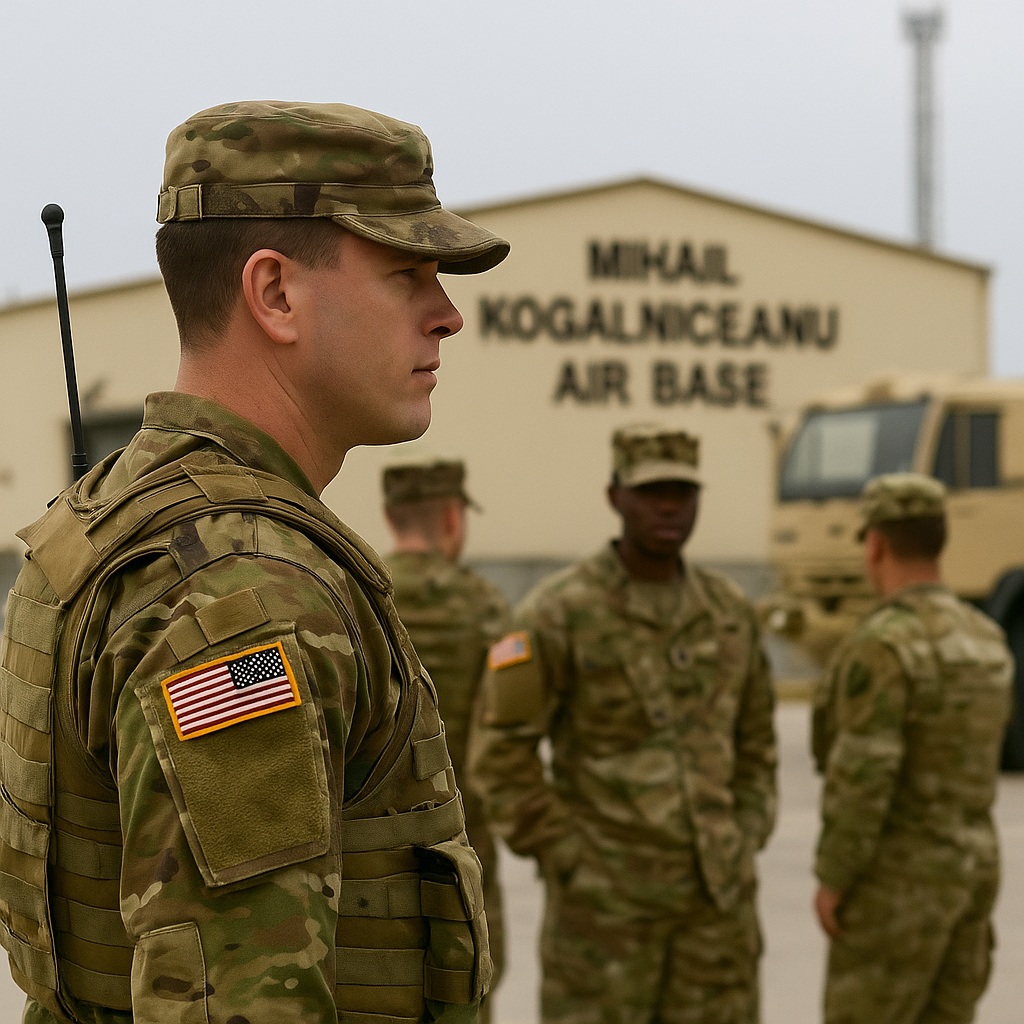
As Washington moves forces amid the Russia–Ukraine war, Bucharest warns of a growing security gap in the Black Sea region
ROU‑BRĂILA — The decision by the United States Department of Defense (DoD) to scale back forward‑deployed U.S. forces in eastern Europe has triggered a ripple of concern through Romania and across the eastern flank of NATO. While Washington asserts the movement is part of a strategic realignment, Romanian officials say the partial reduction in the U.S. presence at critical Black Sea‑adjacent posts comes at a fraught moment — with the war in Ukraine entering a grueling phase and Russian military pressure increasing.
An announcement that startled allies
In late October, the U.S. announced that a brigade of the 101st Airborne Division that had operated regionally will be withdrawn from rotation and not replaced. For its part, the Romanian Defence Ministry confirmed that some U.S. troops will remain — but pointed out that the adjustment reduces the buffer of American manpower at bases bordering Ukraine. The Pentagon, meanwhile, emphasises that this change does not signal a reduced American commitment to NATO or to Romanian defence.
Why Romania is sounding the alarm
Romania occupies a strategic position on NATO’s eastern edge. It shares a common land frontier with Ukraine and hosts major allied infrastructure — including the Mihail Kogălniceanu Air Base near Constanța, used as a logistics hub for U.S. and allied forces since the 2022 full‑scale Russian invasion of Ukraine. The reduction of a U.S. brigade rotation underscores concerns that the eastern flank could become more vulnerable if deterrence posture is perceived to be eroding.
Analysts and Romanian officials assert that the timing is particularly precarious. Moscow’s campaign in Ukraine is still ongoing, and the Black Sea theatre remains poised for escalation. As one expert put it, the move is “at the wrong time, in the wrong place.”
Washington’s rationale: Strategy shift, not retreat
U.S. officials describe the draw‑down as part of a broader “force posture review” shifting attention to the Indo‑Pacific region and distributing defence responsibilities more fully among European allies. The U.S. Army Europe and Africa command issued a statement stating the change is “not an American withdrawal from Europe or a signal of lessened commitment to NATO and Article 5.”
They point out that U.S. troop levels in Europe remain “larger than many years,” and that this adjustment involves withdrawing rotating forces rather than core enablers like intelligence, missile defence or strategic strike assets.
Allies respond with caution
Despite Washington’s reassurances, reaction among NATO’s eastern members has been cautious. The reduction is viewed by some as sending a signal of diminished will rather than mere re‑allocation. Some congressional voices in the U.S. also warned that the timing could embolden Russian aggression.
Bucharest’s public tone remains measured: officials note that Romania was informed in advance and that the remaining U.S. presence remains above pre‑2022 levels. Nonetheless, the move has triggered intensified discussions in Romania about bolstering its own national defence capacity, deepening cooperation with NATO allies, and increasing domestic military spending.
What this means for the Black Sea region
- Deterrence posture may shift – While the U.S. describes this as a rotation pause, the optics in Moscow could be interpreted as an opportunity to press harder along NATO’s southern flank, including the Black Sea and Balkan region.
- Allied burden‑sharing grows – Romania and other frontline states are being nudged to bear more of the conventional defence burden, both politically and financially. The U.S. position encourages European allies to take “primary responsibility” for their defence.
- Strategic elasticity remains – Officials emphasise NATO retains a flexible response capability; the draw‑down is not irreversible and forces could be re‑deployed rapidly if the situation escalates.
- Signal matters – With Russian drone incursions and air‑space violations reported near allied borders, the perception of allied resolve is critical. An alliance’s deterrence depends not just on force levels but on credibility.
Romania looks ahead
For Romania, the decision has accelerated domestic strategic planning. Bucharest is reportedly aiming to enhance its defence industry tie‑ups (including possible drone development programmes) and to deepen NATO collaboration. In doing so, it acknowledges that the U.S. presence alone cannot be the sole guarantor of regional security.
But for now, some in Bucharest admit to a “security gap” feeling — a recognition that while the U.S. remains engaged, the American footprint in the region is shifting. Romania is therefore stepping up its calls for allied consistency and tangible deterrence, rather than mere statements of commitment.
Final word
The U.S. draw‑down of rotating forces in Romania and along NATO’s southeastern periphery is less about immediate abandonment and more about strategic recalibration. Yet in an era defined by renewed great‑power competition and war in Ukraine, the distinction may matter little if adversaries conclude the alliance’s resolve is weakening. Romania’s warning that it is witnessing a “partial reduction” in U.S. troop presence reflects not only military realities on the ground but also the psychological dimension of deterrence: in geopolitics, how something looks may be as important as what it is.



 The Tower Post