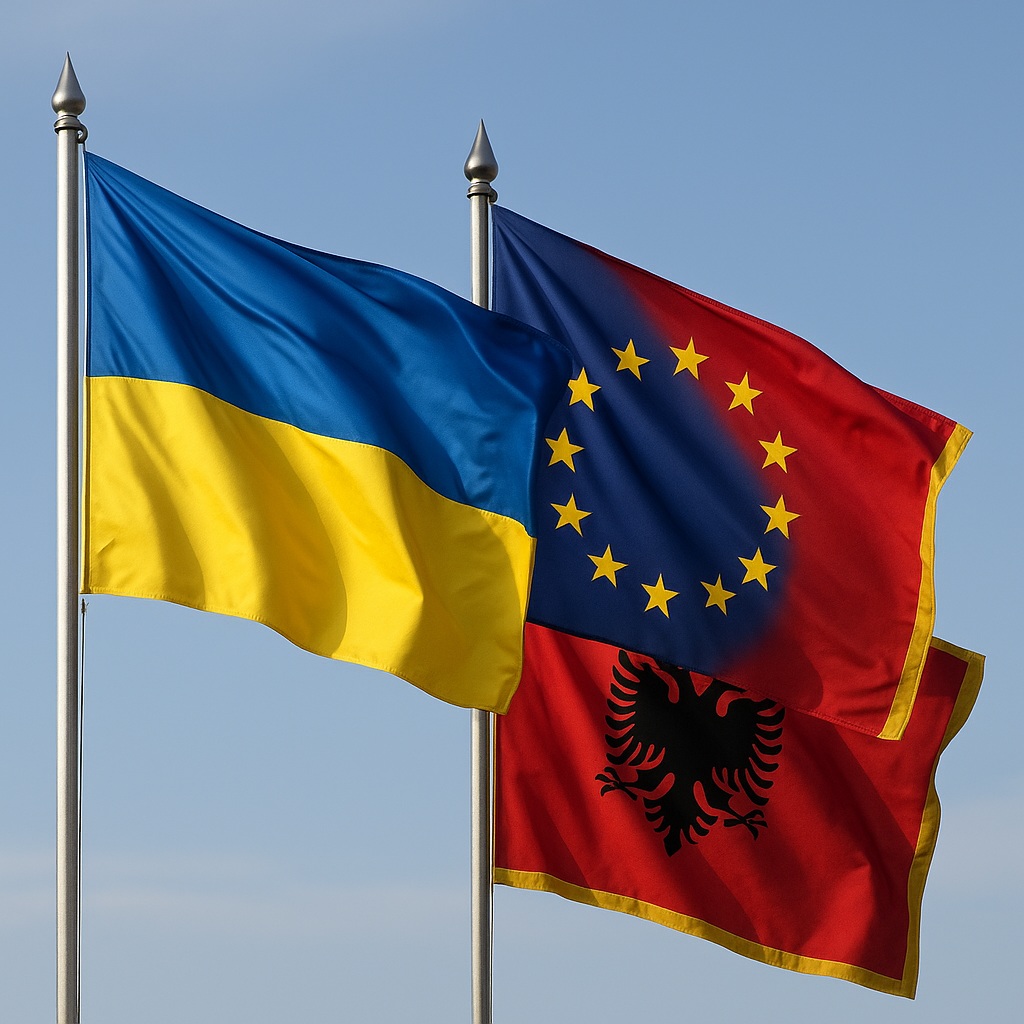
As Brussels signals a “clear‑cut” case for enlargement, the European Union prepares for potential accession by Ukraine, Montenegro and Albania — but hurdles remain.

BRUSSELS — On the eve of early November, the European Union’s foreign‑policy chief announced a bold aspiration: to admit new members by the end of the decade. Kaja Kallas, serving as the High Representative for Foreign Affairs and Security Policy and Vice‑President of the European Commission, declared that the case for enlargement is “very clear‑cut” and that bringing in countries such as Ukraine, Montenegro and Albania by 2030 is a realistic target.
Speaking in Brussels on the international stage, Kallas emphasised that enlargement is not simply a policy issue but a geopolitical necessity. “Russia’s full‑scale invasion of Ukraine and the geopolitical shifts make the case for enlargement very clear‑cut,” she said, underscoring how external threats and internal reform imperatives are driving the EU agenda.
Driving forces behind the push
Several factors lie behind the renewed momentum for enlargement:
- Geopolitical urgency. The war in Ukraine and broader East‑West tensions have heightened the strategic importance of enlarging the EU’s sphere of influence. In Kallas’s framing, admitting countries that share European values strengthens the bloc’s ability to act.
- Recent reform progress. The European Commission’s latest assessment praised Montenegro and Albania for significant advances in domestic reforms, and awarded Ukraine and Moldova recognition for keeping pace despite major challenges.
- Internal EU reflection. With the EU already at 27 members, admitting new states invites questions about institutional capacity, decision‑making, and financial burdens. But officials are increasingly framing enlargement as manageable — at least for smaller candidate countries.
Candidate countries in focus
Montenegro and Albania emerge as frontrunners. According to the Commission, Montenegro is “most advanced in the accession process.” Albania has kept pace with alignment to EU sanctions and reform frameworks.
Ukraine, at war and undergoing immense reconstruction, presents both opportunity and challenge. While its inclusion would mark a historic expansion, the scale of the task — both politically and economically — remains daunting. Kallas emphasised no shortcuts will be given.
Moldova also features in the list of prepared states, although it may receive less public attention than the front‑runners.
Meanwhile, Georgia and Serbia faced critical assessments. Georgia was judged to be “a candidate in name only,” citing serious democratic backsliding; Serbia was cited for slowing reform momentum and failing to clarify its strategic direction.
Why the 2030 target?
Setting a concrete end‑of‑decade target signals urgency and creates a planning horizon for both Brussels and candidate states. Kallas explicitly described 2030 as a “realistic goal.”
Yet the timeline is ambitious: enlargement negotiations historically take years, if not decades, especially when tackling chapters such as judicial reform, rule‑of‑law alignment, and the internal market. The Commission reiterates the process will remain “fair, tough and merit‑based.”
Institutions, finances and complications
Admitting new members raises a range of operational questions for the EU:
- Institutional capacity. A larger union may struggle with decision‑making, given current reliance on unanimity in key areas such as foreign policy. Some officials advocate reforms to allow faster, more agile action.
- Financial and economic integration. For smaller countries the incremental budgetary impact may be modest; for larger entrants like Ukraine the costs of reconstruction, cohesion funding and alignment with EU systems are far greater. Brussels officials note differing levels of difficulty depending on the candidate country.
- Political unity. Every one of the current 27 member states must agree to admit a new candidate. That unanimity requirement gives any single member significant leverage over the process.
Risks and caveats
While the ambition is clear, several risks could derail or delay the plan:
- Domestic reform fatigue. Candidate countries must maintain steady progress on reform. Any back‑sliding could halt the process.
- EU internal dissent. Opposition from one or more member states could block accession rounds, especially if domestic voters in existing members balk at enlargement costs.
- Geopolitical volatility. External shocks — economic instability, further regional conflicts, or major power rivalries — could shift priorities away from enlargement.
- Public perception. Citizens in both current and prospective member states may question the benefits of rapid enlargement if visible gains are slow or uneven.
Outlook and significance
For Ukraine and the Western Balkans, the message from Brussels is unequivocal: the door is open — provided reforms are delivered. For the EU, enlargement offers an opportunity to cement its values and strengthen its presence on the world stage.
As the 2030 horizon approaches, all eyes will be on how fast candidate states move — and how decisively the EU reforms itself to absorb them. As the foreign‑policy chief put it, “enlargement is not a nice‑to‑have; it is a necessity if we want the EU to be a stronger player on the world stage.”
In the months ahead, the combination of reform deadlines, inter‑member negotiations and public scrutiny will determine whether this ambitious enlargement phase becomes reality — or simply a bold statement of intent.


 The Tower Post