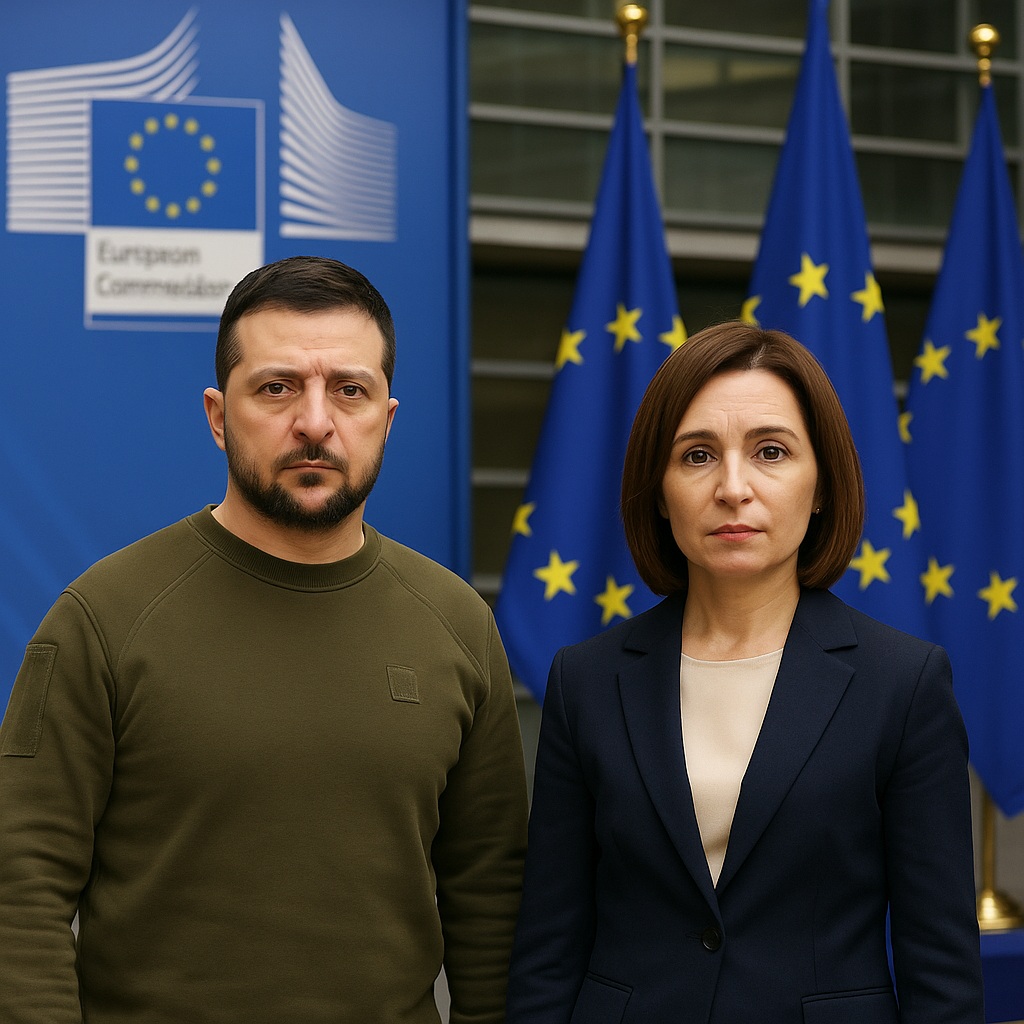
Ukrainian and Moldovan presidents urge the European Commission to speed up accession talks as reform gaps remain a hurdle for entry into Europe.
In a high‑stakes diplomatic push, Volodymyr Zelenskyy of Ukraine and Maia Sandu of Moldova jointly urged the European Commission to accelerate their countries’ accession to the European Union, setting an ambitious goal of membership by 2030. Addressing EU decision‑makers ahead of the bloc’s enlargement event, the two leaders stressed the strategic urgency of integrating their nations into Europe — as a matter of peace, reform and geopolitical stability.
Zelenskyy, speaking at Brussels, reaffirmed Ukraine’s conviction that its future lies in full EU membership. “We are defending not only our land but the European project,” he stated, adding that membership before 2030 may sound “like science fiction,” but must be pursued “in a fair way and when the war is over.” Meanwhile Sandu appealed for a rapid opening of all negotiation clusters for Moldova, emphasising that her country has already undertaken deep reforms in judiciary and energy — and now expects Brussels to respond accordingly.
On its side, the European Commission praised the progress of both nations in its latest annual enlargement review. The Commission acknowledged Ukraine’s “remarkable commitment” and Moldova’s “rapid reform pace” as positive signals. However, the assessment came with a clear caveat: deep‑rooted issues in rule of law and corruption remain major obstacles. In Ukraine’s case, the Commission warned that without an acceleration of reforms in fundamentals such as the judiciary and anti‑corruption structures, any realistic target date will remain out of reach.
The stakes and the push
For Ukraine, still engaged in conflict, accession to the EU carries beyond symbolism: it promises security, economic integration, and a signal that Europe is ready to bind its eastern flank into its institutional framework. Zelenskyy linked the membership goal directly to the war effort, framing EU accession as part of Ukraine’s defence of European values.
Moldova’s case holds a different flavour. A smaller nation sandwiched between larger neighbours, it has already constitutionally enshrined EU accession as a national objective. Sandu now presses Brussels to reward her government’s reform drive with tangible progress toward accession talks — especially since delays risk stalling momentum and opening the door to external influence.
Brussels’ balancing act
The Commission is walking a fine line. On one hand, recognition of Ukraine’s and Moldova’s forward motion aligns with a strategic desire to strengthen EU’s eastern dimension. On the other hand, Brussels is clear that membership cannot be mere formality. A key quote in the review: for Ukraine to even provisionally close negotiations by end‑2028, “an acceleration of the pace of reforms is required, notably with regards to the fundamentals, in particular rule of law.”
For Moldova, the Commission termed a 2028 ambition “ambitious but achievable, provided Moldova accelerates the current pace of reforms.” Moreover, the EU is considering new mechanisms — including “probation” periods for new members and safeguards against democratic back‑sliding — underscoring that accession today goes beyond simple paperwork to deeper structural alignment.
Risks ahead
Several risks loom for both countries. Ukraine’s war and security situation complicate the usual accession framework. Moldova’s reliance on external energy supplies and the influence of the break‑away region in Transnistria make it vulnerable to external pressure. Brussels is mindful of letting geopolitical urgency trump institutional readiness — hence the repeated emphasis on rule of law and anti‑corruption.
Additionally, EU member states themselves remain split over enlargement, how fast, and under what conditions. The role of vetoes and unanimous decisions in the accession path remains a source of friction.
Outlook
With both Zelenskyy and Sandu publicly aiming for 2030 membership — and possibly earlier provisional integration steps — the coming months will test whether the EU is willing and able to match rhetoric with rapid movement. The Commission’s message is clear: time is ripe, but reforms cannot wait.
If Ukraine and Moldova succeed in meeting the reform benchmarks and in navigating internal EU politics, they could join the bloc in the next half‑decade, marking one of the most significant expansions in EU history. For now, the push remains on — and Brussels holds the throttle.
 The Tower Post