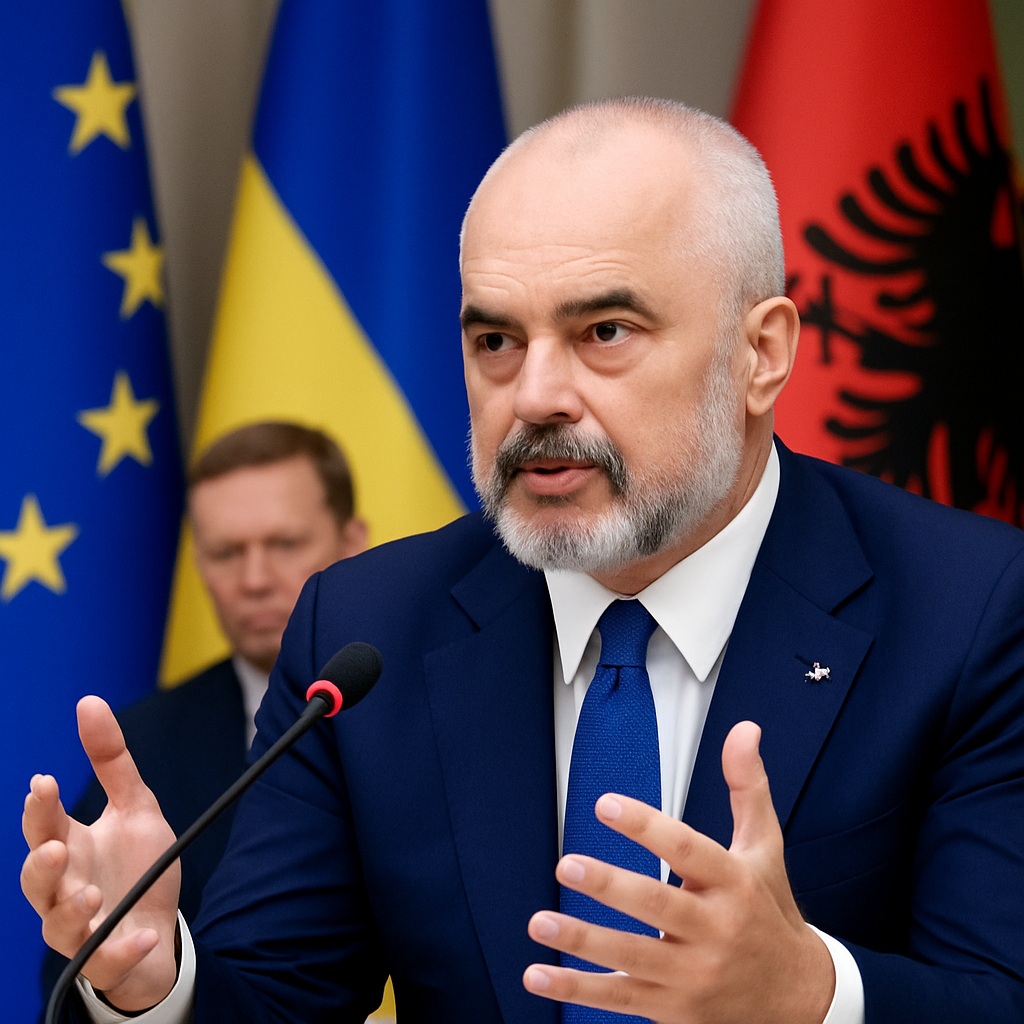
In a bold assertion ahead of renewed EU‑Ukraine peace efforts, Prime Minister Edi Rama urges Brussels to craft a concrete plan while dismissing fears of further Russian offensives in Europe.
In an exclusive interview, Albanian Prime Minister Edi Rama offered a striking message to European capitals: despite simmering concerns over spill‑over from the war in Ukraine, Moscow is not preparing to strike other European states. As he spoke on the cusp of a new phase of diplomacy, Mr Rama also pressed the European Union to adopt a clear and actionable peace plan for Ukraine, arguing that uncertainty benefits only the aggressor.
No new battlefield beyond Ukraine
Speaking on the sidelines of a global security forum, Prime Minister Rama made his position blunt. “Russia will not attack Albania and Russia will not attack any other European country,” he asserted. His reasoning? A strong belief in the deterrent offered by the North Atlantic Treaty Organization (NATO). “NATO is ready for any kind of aggression… it is the strongest army in the world so far,” he said.
He described the notion of a Russian strike on a European state outside Ukraine as “completely foolish”, arguing that abandoning the war’s focus would undermine Russia’s core objective: extending its control in Ukraine rather than engaging multiple fronts.
By voicing such confidence, Mr Rama sought to calm anxiety in smaller NATO and EU‑adjacent states, particularly in the Western Balkans, many of which watch Russian drone probes, energy pressure and influence campaigns with concern.
From deterrence to diplomacy: a peace plan for Ukraine
But while he dismissed an imminent attack beyond Ukraine, the prime minister’s broader message was a call for action. He urged the European Union to adopt a defined and credible peace roadmap for Ukraine—and fast. In his view, allowing the conflict to drift without a plan risks giving Moscow the initiative and prolonging suffering.
“Europe must move from reaction to proposition,” he argued. “We have the military defence architecture in place. Now we need a political instrument.” Though he did not publish a detailed blueprint in the interview, he referenced the momentum building behind talks and the need for the EU to step up leadership—beyond just financial and military support.
His appeal comes as European capitals weigh how to balance ongoing support for Ukraine with managing risks of escalation—from hybrid threats to strategic fatigue. Mr Rama contended that a fixed horizon and guarantee mechanism would help stabilise the theatre and deter any temptation for Moscow to test allied resolve.
In particular, he stressed that the EU’s role cannot be limited to sanctions, armaments and rhetoric. “If we stop at sanctions and arms,” he noted, “we give the enemy the luxury of running down time.” He called for the bloc to be ready to match its words with a formal peace architecture—encompassing reconstruction, security guarantees, political inclusion and a pathway to normalisation.
The Western Balkans lens
As leader of a candidate EU country, Mr Rama’s perspective is shaped by the dual pressures of regional stability and European integration. His country, Albania, has repeatedly affirmed its solidarity with Ukraine and alignment with Western defence and foreign‑policy positions.
By taking this stance now, he positions Albania as a credible regional actor, underscores its relevance in the European security architecture, and implicitly reminds Brussels that the Western Balkans remain geopolitically meaningful. The prime minister’s statements may also reflect an attempt to ensure that his country’s accession process and security partnership stay alive amid an era of distractions.
Caveats and counterpoints
Despite the confidence conveyed, analysts note several caveats. One, the fluidity of Russia’s tactics—including drone incursions, cyber‑attacks and proxies—means the absence of a full‑scale invasion elsewhere is not the same as zero threat. Indeed, Mr Rama acknowledged provocations.
Two, his call for an EU peace plan implicitly recognises that the military‑only approach may not suffice—the war might not end simply through battlefield stalemate. A plan, therefore, would require political risk, investment and long‑term commitment—elements Europeans have often struggled to mobilise.
Three, smaller states in Europe might still feel vulnerable even if large‑scale attack is unlikely; asymmetric warfare, election interference or hybrid threats remain on the agenda. The prime minister’s dismissal of new attacks may reassure some, but for others it may underplay emerging risks.
Implications for Europe and NATO
The prime minister’s messaging carries three clear signals:
- For Brussels: the burden is shifting from reactive defence postures to proactive peace‑building.
- For Moscow: the deterrent architecture remains intact—and the window of opportunity for broader escalation may be narrowing.
- For NATO’s smaller members: reassurance is available, but so is a reminder that security remains non‑automatic and must be backed by political will.
As Europe approaches yet another winter of high geopolitical tension, Mr Rama’s insistence that the worst may not come even if the war drags on gives both relief and a challenge. Relief, because new frontlines may be avoided; challenge, because avoiding them does not equate to ending the war.
In effect, Albania’s Prime Minister is telling Europe: hold the line—not just with guns, but with a plan. The moment to craft it is now.

 The Tower Post