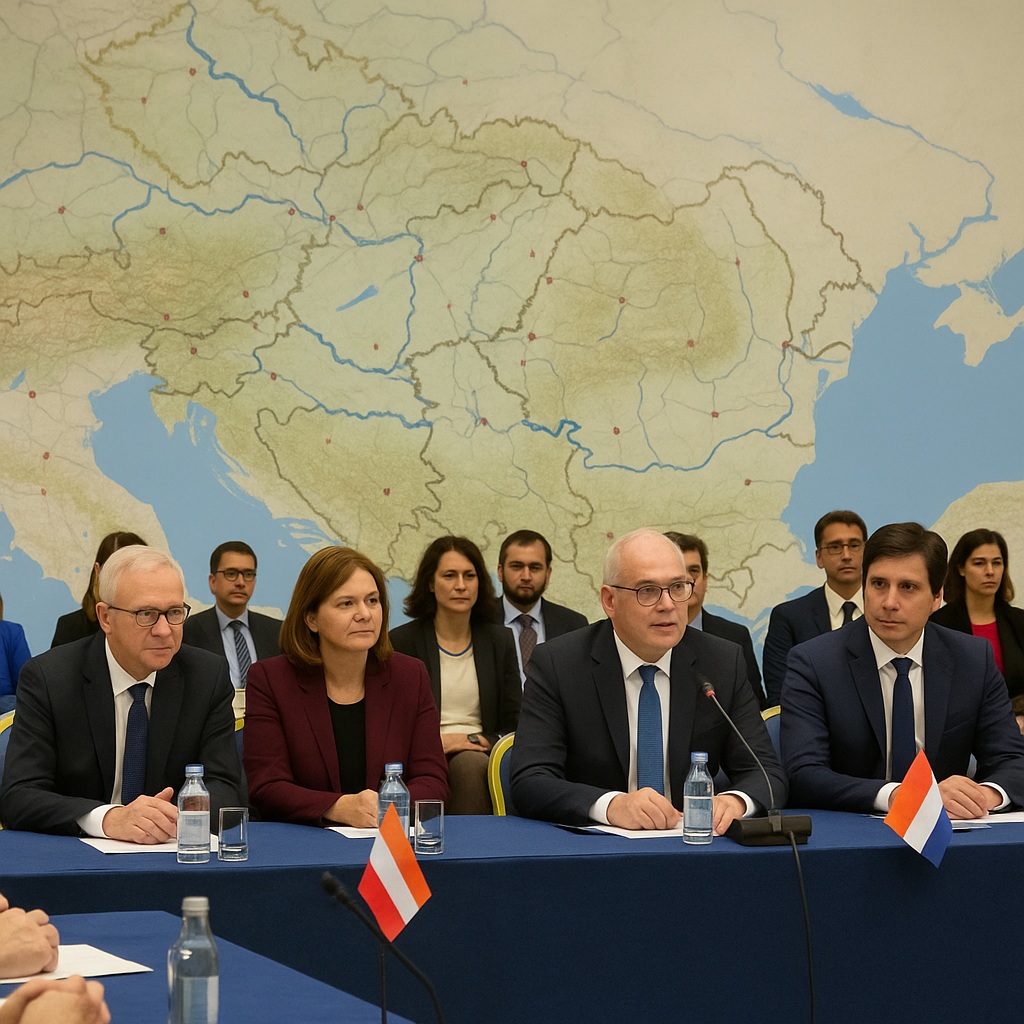
At the 14th Annual Forum of the EU Strategy for the Danube Region in Sarajevo, stakeholders pledge deeper collaboration to uphold legal frameworks, advance development and secure future resilience.
In the historic heart of Sarajevo, just as autumn shadows lengthen along the Danube’s tributaries, representatives from across the Danube macro‑region gathered to reaffirm a crucial commitment: that cooperation, anchored in respect for rule of law and democratic governance, is the foundation of stability, growth and security in a rapidly shifting Europe.
Over two intensive days of dialogue and deliberation, the 14th Annual Forum of the EU Strategy for the Danube Region (EUSDR) produced what has come to be known as the Sarajevo Declaration—a document setting out renewed priorities from Bratislava to the Black Sea.
A strategic partnership under pressure
The Danube Region—a transnational stretch of countries spanning from Germany and Austria through the Czech Republic, Slovakia, Hungary, Slovenia, Croatia, Romania and Bulgaria, and extending to Bosnia‑Herzegovina, Serbia, Montenegro, Moldova and Ukraine—continues to face structural and geopolitical stress.
Demographic shifts such as emigration of young people, brain drain, aging populations and widening skills gaps are layered on top of external pressures: the strategic implications of war on Europe’s eastern flank, supply‑chain disruptions, and the urgent need for digital and green transition.
In this context the Sarajevo Declaration underscores that the rule of law, credible governance and transparent institutions are no longer optional—they are the sine qua non of a resilient and integrated region. As one key statement puts it: “The EU enlargement is an investment in the security, stability and prosperity of our region.”
Key pillars of the Declaration
The Declaration outlines several anchored commitments:
- To intensify support for candidate countries and deepen their engagement in reforms that sustain rule‑based systems and institutional quality.
- To mobilise regional cooperation as a bulwark against external shocks and instability—whether demographic, economic or geopolitical.
- To integrate the EUSDR more fully into broader EU policies, ensuring that macro‑regional strategies serve as real levers of change on the ground.
- To promote infrastructure connectivity (notably the Danube–Black Sea axis), transport corridors and digital and green transition as pillars of resilience and cohesion.
Why rule of law is central
The rule of law is repeatedly emphasised at the Forum for a simple reason: it sets the conditions for public trust, effective investment, mobility and cross‑border cooperation. Without it, the very fabric of macro‑regional strategies—shared policies, mutual accountability, transnational projects—becomes brittle. The Sarajevo Declaration frames the rule of law not only as a normative imperative but as a practical tool for regional development.
For example, when national legal frameworks are inconsistent or enforcement is weak, cross‑border transport, environmental protection, youth mobility and digital innovation all suffer. In the Danube context, where water management, basin preservation and climate resilience are shared concerns, rule‑of‑law gaps become systemic risks.
From words to action: What happens next?
Participants in Sarajevo emphasised the need to convert commitments into tangible programmes. The Declaration is backed by a call for intensified use of instruments like the Danube Region Programme (DRP) and other EU‑funded transnational cooperation tools.
Member states and candidate countries alike now face the task of aligning national reforms with the shared agenda. Priority areas include:
- Reforming judicial systems and improving administrative capacity;
- Strengthening anti‑corruption mechanisms;
- Enhancing vocational education and mobility to counter demographic decline;
- Developing transport, energy and digital corridors that link the region internally and with the broader European Union.
The broader geopolitical lens
The Danube Region today sits at a crossroads. With the region’s eastern flank exposed to external aggression and its western flank confronting structural transition (industrial change, demographics, climate), the internal coherence of the region becomes a strategic asset. The Forum thus underscored that regional cooperation is not just “nice to have” but a key pillar of European security architecture. The Sarajevo Declaration makes explicit this connection between regional rule‑based cooperation and macro‑regional stability.
Challenges ahead
Yet translating the Declaration into measurable outcomes will not be trivial. Among the obstacles:
- Uneven levels of institutional readiness across countries.
- The risk that rule‑of‑law commitments remain declaratory unless backed by measurable benchmarks and political follow‑through.
- The need to ensure that funding and projects reach local and regional levels—not just national capitals.
- Demographic headwinds that cannot be addressed purely through policy statements: unless young people see genuine opportunities, the brain‑drain will continue, undermining long‑term prospects.
Looking ahead
The meeting in Sarajevo and the adoption of the Declaration signal that the EUSDR is adapting to the moment: its focus is now clearly not only on connectivity and environment, but also on the institutional and governance foundations that make cooperation meaningful. The regions along the Danube are saying, in effect: “We cannot simply flow downstream; we must build the channel that sustains us.”
For citizens in the region, the promise is one of increased stability, better infrastructure, more mobility and a stronger place in Europe’s future. For policymakers, the test will come in the next months: will the words align with budgets, reforms and outcomes?
In the days ahead, monitoring mechanisms will be pivotal. The Declaration identifies that the next phase must see concrete benchmarks and indicators of progress on rule‑of‑law reform, connectivity, and demographic resilience. And while the Forum gathered high‑level ministers and experts, the real work lies with regional and local authorities, civil society and young professionals whose decisions will shape the Danube Region’s future.
As the Danube itself winds through valleys, across borders and into larger waters, so too does the region’s path towards a strengthened rule of law and shared prosperity—if cooperation holds steady, the currents may yet carry this region into a more integrated, resilient and democratic future.




 The Tower Post