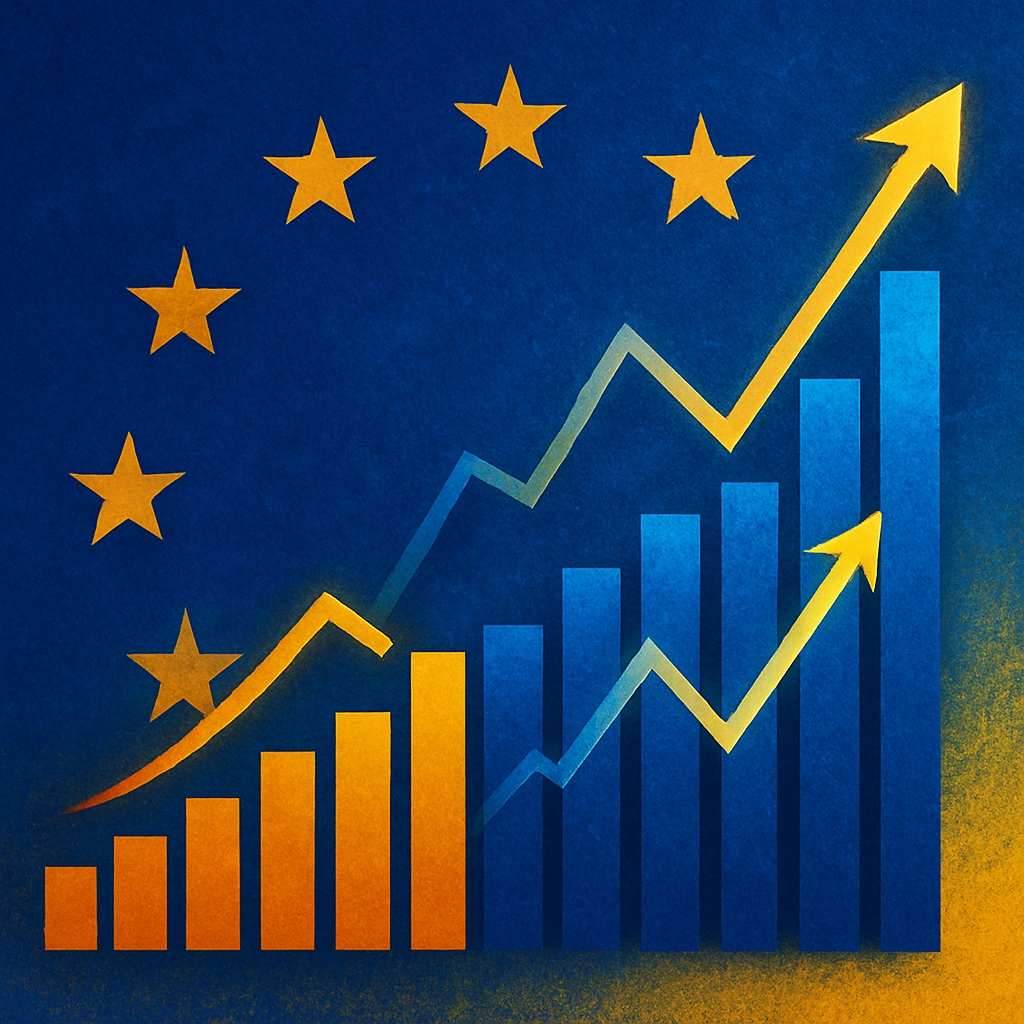
As the IMF cautions that recent economic tailwinds may soon fade, the euro area confronts a difficult question: how to pay for what it cannot afford?

European policymakers found themselves once again at a crossroads. An unexpectedly mild improvement in the euro-area outlook for 2025, flagged last week by the International Monetary Fund, has provided a brief sense of relief—a momentary bright spot in an otherwise cloudy horizon. But the Fund’s message is unambiguous: the good news is unlikely to last. Europe’s export-driven lift could evaporate as quickly as it arrived, with 2026 shaping up to be another test of the bloc’s ability to finance its ambitions.
For many EU governments, the problem is not merely budgetary discipline but the long-delayed confrontation with rising structural costs. Ageing populations, high energy prices, and the cumulative burden of industrial policy have collided with a long period of sluggish growth. Even with the IMF’s small upgrade, the euro area is expected to rely on external demand more than it would prefer—a vulnerability exposed brutally over the past four years.
The looming question now is how Europe will pay for what citizens and governments increasingly feel they cannot do without: strategic autonomy, climate transition, and resilient social systems. The options are few, politically fraught, and economically constrained.
Across Berlin, Paris, Madrid, and Rome, policymakers speak in different languages but face the same arithmetic. The era of cheap money is over. Bond markets have become less forgiving, and the risk of crowding out private investment is rising. Several governments have revived discussions of EU-wide fiscal tools—not quite a repeat of the pandemic-era recovery fund, but something broader and more permanent. The idea remains divisive. Northern capitals warn of “fiscal moral hazard,” while southern ones argue that the scale of Europe’s challenges requires collective financing.
The IMF stops short of endorsing a new shared debt instrument but hints that Europe’s piecemeal approach may no longer be sufficient. Without coordinated investment, it warns, Europe could fall behind in critical technologies, deepen existing inequalities among member states, and lose competitiveness to the United States and emerging economies. The forecast improvement for 2025, the Fund notes, is powered partly by strong demand for European machinery, pharmaceuticals, and luxury goods abroad—demand that could falter if global conditions tighten again.
Meanwhile, households across the continent feel the pinch of high living costs. Governments face growing pressure to increase social spending, even as fiscal rules return. The debate over these rules—long criticized as too rigid for the complexities of a modern economy—has intensified. Economists propose more flexibility for green and digital investment, arguing that Europe cannot afford not to spend. Critics counter that without credible limits, markets may force far harsher discipline.
The question of affordability may ultimately hinge on Europe’s political ability to make choices, not only its economic capacity to raise funds. Some analysts argue that the continent must rethink subsidies, streamline regulation, and prioritize high-impact projects rather than spreading resources thinly across multiple initiatives. Others push for new revenue sources: digital levies, carbon border taxes, or harmonized corporate taxation. These debates, slow-moving and contentious, stand in tension with the urgency of the moment.
As Europe looks ahead to 2026, one truth is increasingly difficult to ignore: the continent’s ambitions remain high, but its growth engine is sputtering. Whether through shared fiscal frameworks, targeted investments, or politically painful reforms, the bill for Europe’s future is coming due. The IMF’s warning is less a forecast than an invitation for Europe to prepare—before favorable winds shift once more.
For now, the continent enjoys a brief reprieve. What it does with that time may determine whether future warnings sound less dire, or more like a reckoning.



 The Tower Post