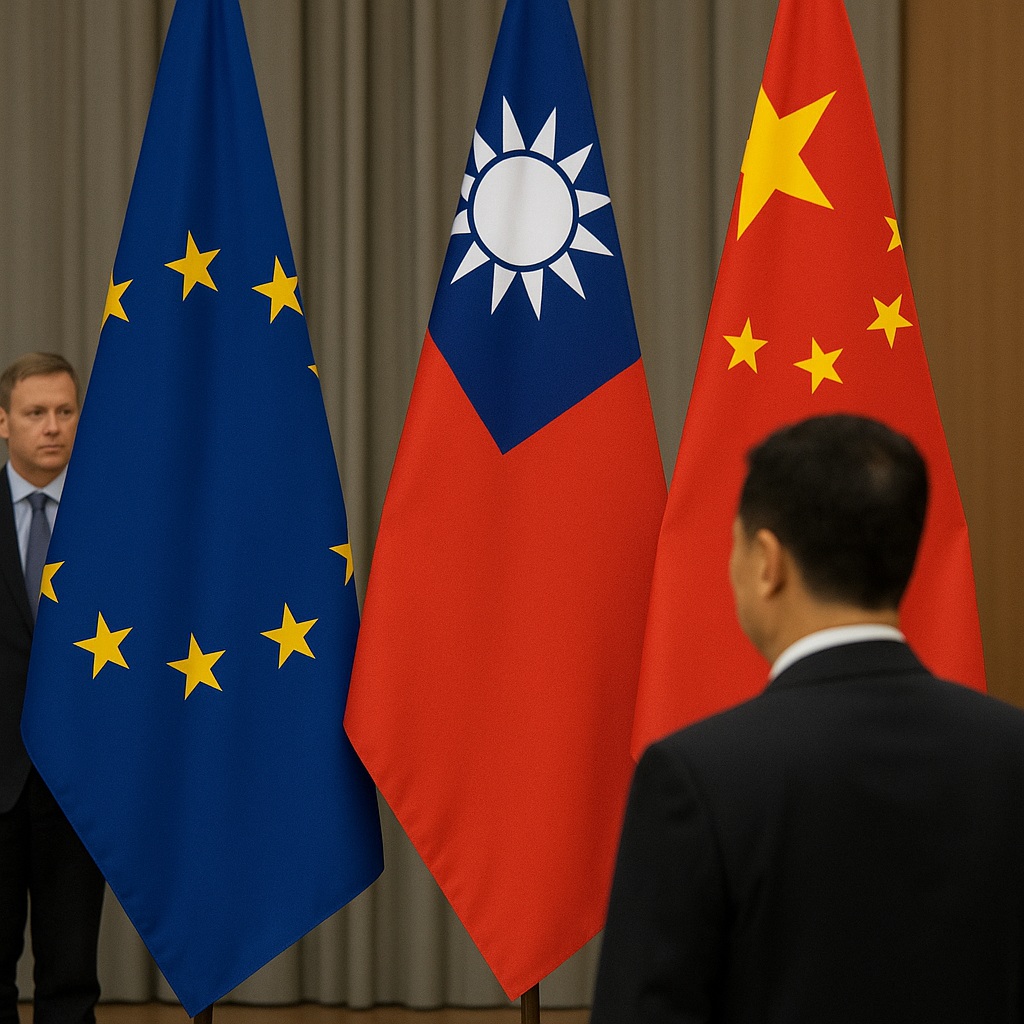
Beijing lodges diplomatic protest as Brussels navigates a hardening China policy and Taiwan expands its international footprint
China has issued a forceful diplomatic protest after a high‑level meeting between senior European Union representatives and a visiting Taiwanese political delegation, sharply accusing Brussels of “interference in China’s internal affairs” and undermining regional stability. The exchange, which unfolded in recent days, marks a new flashpoint in Europe’s increasingly fraught relationship with Beijing and underscores Taiwan’s widening international outreach amid ongoing pressure from the mainland.
Although neither side disclosed extensive details of the meeting, EU officials confirmed it involved discussions on economic cooperation, democratic resilience, and technology partnerships—areas where Brussels has intensified engagement with Indo‑Pacific partners as part of its broader strategic diversification. For Beijing, however, the optics alone were sufficient to trigger a swift and public condemnation.
A spokesperson for China’s Ministry of Foreign Affairs criticized the encounter as “a violation of the political commitments made by the European side” and warned that any gesture interpreted as support for Taiwanese autonomy risked damaging already fragile EU‑China relations. Chinese diplomats delivered a formal démarche to EU officials, demanding “corrective action” and insisting that Europe adhere strictly to the One‑China principle.
Officials in Brussels responded cautiously, reaffirming that the EU’s long‑standing policy on China and Taiwan remains unchanged while emphasizing that Europe retains the right to engage with democratic partners. One senior EU official, speaking on background, characterized the Chinese reaction as “predictable, but disproportionate,” noting that parliamentary and technical exchanges with Taiwan have occurred for years without provoking such a dramatic response.
The episode unfolds against a backdrop of shifting geopolitical tectonics. Within the EU, views on China have hardened considerably, driven by concerns over economic coercion, trade imbalances, and Beijing’s alignment with Moscow. Several major member states have advocated stronger scrutiny of Chinese investment, more assertive export controls, and enhanced support for partners across the Indo‑Pacific. This internal recalibration has simultaneously increased the political visibility of Taiwan, whose democratic governance and advanced semiconductor industry have garnered heightened interest from European capitals.
Taiwan’s foreign ministry welcomed the EU meeting, describing it as part of a deliberate strategy to build deeper ties with like‑minded democracies while resisting Beijing’s efforts to curtail its international presence. In a statement, Taiwanese officials argued that constructive engagement between Taipei and Brussels contributes to global economic stability and democratic resilience. They dismissed Beijing’s protest as an attempt to intimidate European institutions and stifle legitimate dialogue.
Analysts say China’s sharper tone reflects unease over Europe’s evolving approach. Despite robust commercial ties, the relationship between the EU and China has grown markedly more complex. Brussels has launched investigations into alleged Chinese industrial subsidies, advanced new instruments to counter economic pressure, and signaled firmer alignment with U.S. positions on safeguarding critical technologies. Beijing, for its part, has repeatedly warned Europe against “taking sides” in what it frames as a Sino‑American contest.
The Taiwan question remains one of the most sensitive issues in China’s foreign policy. Beijing views any international engagement with Taiwan’s government as a step toward formalizing its political identity separate from the mainland. In recent months, Chinese authorities have intensified military activity around the island, conducted large‑scale naval drills, and issued forceful diplomatic statements aimed at deterring third‑party involvement.
Within Europe, reactions to China’s protest have varied. Some member states—particularly those with significant trade exposure to the Chinese market—have urged caution, stressing the need to avoid unnecessary escalation. Others, especially in Northern and Eastern Europe, have advocated a more principled stance, arguing that democratic engagement should not be subordinated to pressure from authoritarian governments.
The European Parliament has consistently taken one of the bloc’s most supportive positions toward Taiwan, passing resolutions that call for deeper political and economic ties. While these resolutions are
nonbinding, they have contributed to a gradual broadening of EU‑Taiwan exchanges. The latest meeting, however, appears to have crossed one of Beijing’s red lines, prompting a reaction that EU diplomats say is intended as much for domestic Chinese audiences as for European policymakers.
Strategic analysts view the incident as emblematic of the broader challenge Europe faces in managing relations with both Taiwan and China: balancing economic interests, geopolitical realities, and democratic values in an environment of mounting global competition. Some argue that Europe’s attempts to maintain a middle course—upholding the One‑China policy while expanding practical cooperation with Taiwan—are becoming increasingly difficult as tensions rise across the Indo‑Pacific.
For Taiwan, the episode underscores the stakes of its international engagement strategy. While Taipei continues to seek broader global recognition, it also faces persistent risks associated with provoking
Beijing’s ire. The island’s leaders have emphasized that deepening ties with Europe is crucial for economic diversification and political security, especially as international debates over supply chain resilience and critical technology security intensify.
Despite Beijing’s protest, there is little indication that Brussels intends to scale back its contact with Taipei. EU officials assert that cooperation with Taiwan will continue in areas such as trade facilitation, digital governance, public health, and academic exchange. At the same time, they stress that the EU remains committed to preserving peace and stability across the Taiwan Strait, a message echoed by several member states in recent public statements.
As geopolitical tensions continue to reshape Europe’s foreign policy landscape, the latest dispute highlights the delicate diplomatic calculus at play. Both Brussels and Beijing appear determined to defend their positions, while Taiwan seeks to expand its global footprint without triggering further instability. The coming months are expected to bring additional scrutiny of Europe’s China strategy, with policymakers weighing how best to navigate the competing pressures of security, economic interdependence, and democratic alignment.
The fallout from the EU‑Taiwan meeting is unlikely to be the final chapter in this ongoing diplomatic story. What remains clear is that the balance of interests, values, and strategic priorities will continue to evolve as Europe recalibrates its role in an increasingly multipolar world.

 The Tower Post