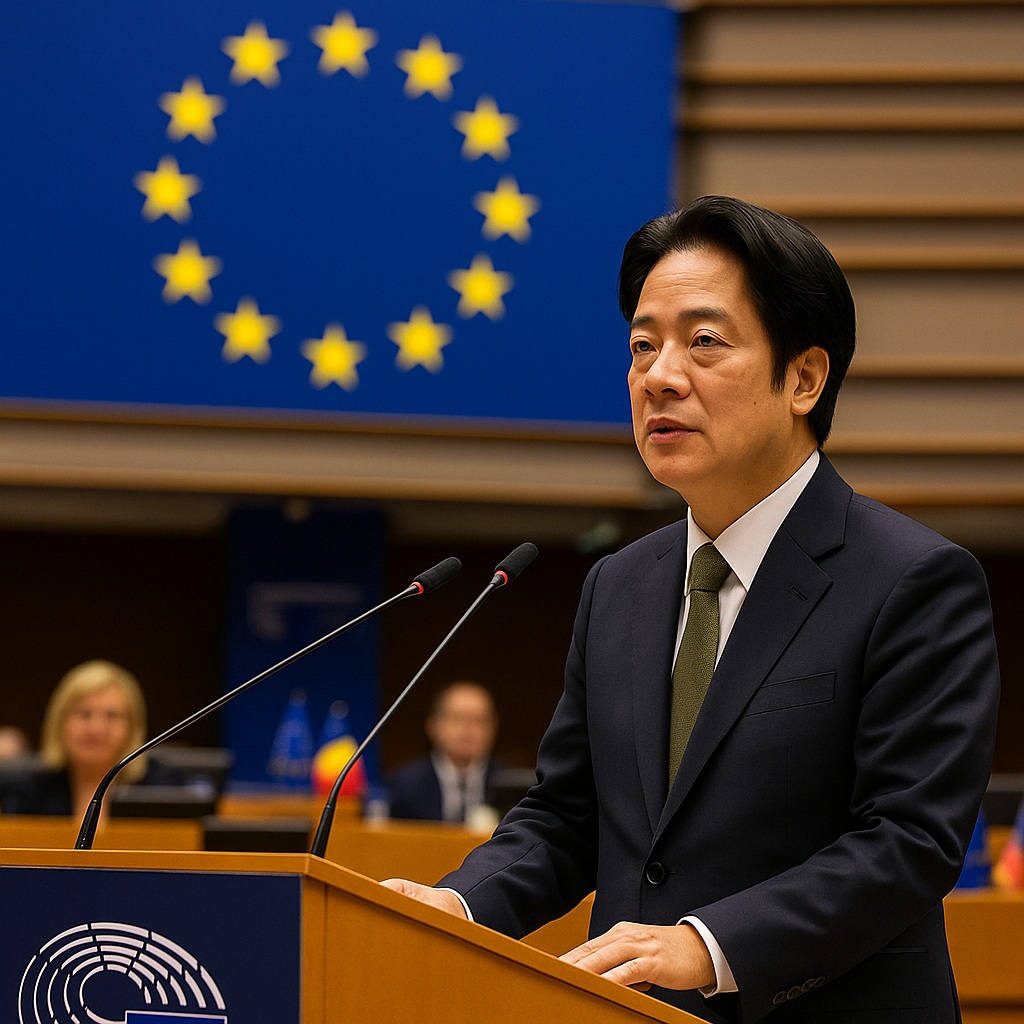
A rare parliamentary address underscores a shifting geopolitical calculus in Europe and a recalibrated outreach strategy from Taipei amid intensified cross-Strait frictions.
Taiwan’s vice-president arrived in Brussels this week to deliver an address inside the European Parliament—an appearance that, while unpublicized in advance, has already reverberated across diplomatic circles from Taipei to Beijing. The visit marks one of the most visible attempts in recent years by Taiwan’s leadership to engage European lawmakers directly, signalling a notable evolution in Europe’s willingness to entertain high-level political contact with Taipei despite the predictable backlash from Beijing.
Although Taiwan has long maintained an active presence in Europe through cultural missions, trade offices, and parliamentary exchanges, direct appearances by senior Taiwanese officials at the European Parliament have been extremely rare. The vice-president’s decision to travel to Brussels reflects a more assertive diplomatic posture adopted by Taipei as cross-Strait relations grow more volatile and as democratic societies worldwide reassess their engagement with China.
In his speech to a cross-party gathering of members of the European Parliament (MEPs), the vice-president emphasized shared democratic values, economic interdependence, and the strategic importance of maintaining peace and stability across the Taiwan Strait. Without invoking specific timelines, he stressed that recent years have demonstrated the vulnerability of global supply chains—especially in the semiconductor sector—in the face of geopolitical risk. Taipei, he argued, is prepared to work more closely with Europe to diversify supply routes, protect advanced manufacturing capabilities, and bolster resilience against coercive tactics from authoritarian states.
The address also underscored Taipei’s commitment to multilateralism at a moment when traditional diplomatic channels are increasingly strained. The vice-president framed Taiwan as a responsible stakeholder seeking deeper cooperation on trade, technology, and security dialogues. He reiterated that Taiwan’s position is neither provocative nor separatist but grounded in the need to preserve its democratic institutions and its de facto autonomy in the face of escalating pressure.
European lawmakers responded with a combination of caution and quiet conviction. Several MEPs acknowledged that Europe’s posture toward China has evolved significantly. While most European capitals continue to follow a “One China” policy, the definition of the policy’s boundaries—particularly regarding unofficial political engagement—has become more flexible. In private conversations, multiple officials suggested that Beijing’s assertive diplomatic and military actions have narrowed Europe’s room for strategic ambiguity, compelling the bloc to show greater solidarity with democratic partners.
The vice-president’s visit also occurs against the backdrop of Europe’s broader strategic realignment. With the transatlantic relationship recalibrating and the Indo-Pacific becoming an arena of both economic opportunity and security concern, the European Union has been wrestling with the challenge of balancing its economic dependence on China with its values-driven foreign policy commitments. Taiwan, as a technologically advanced democracy and a key node in global innovation networks, has increasingly factored into Brussels’ long-term thinking.
Security analysts noted that while the visit does not represent a formal shift in Europe’s policy architecture, it sends an unmistakable signal: Taiwan is no longer treated solely as an economic partner but as a political actor whose fate carries geopolitical consequences for Europe itself. The evolving recognition of those stakes—ranging from supply chain continuity to potential conflict in the region—has prompted European institutions to adopt a more proactive stance.
Beijing, as expected, issued standard condemnations of what it labeled “separatist activities” and pressed European officials to avoid any form of “official contact” with Taiwan’s government. Yet early indications suggest that the European Parliament intends to continue expanding its dialogue with Taipei, with several committee leaders calling for structured channels on technology cooperation, human rights, and trade policy. European Commission officials, while more cautious, are privately acknowledging that the political costs of engagement with Taiwan are no longer as prohibitive as they once were.
For Taipei, the Brussels appearance is part of a longer-term strategy aimed at broadening international partnerships and reducing over-reliance on a small group of allies. In recent months, Taiwanese diplomats have amplified their engagement with European think tanks, civil society groups, and industry coalitions, seeking to frame Taiwan’s security as integral to global economic stability. The vice-president’s speech in the European Parliament represents the most visible success to date in this diplomatic push.
Whether Europe will meaningfully recalibrate its China strategy remains to be seen. For now, the Brussels address stands as a symbolic milestone—one that captures the gradual but perceptible shift in the geopolitical landscape. As cross-Strait tensions rise and global polarization intensifies, Taipei’s outreach to Europe appears poised to become a defining feature of regional diplomacy. The vice-president’s rare appearance in Brussels may ultimately be remembered as an early indicator of a deeper strategic convergence between Europe and Taiwan, driven less by ideology than by shared interests and the pragmatic realities of an increasingly contested international order.


 The Tower Post