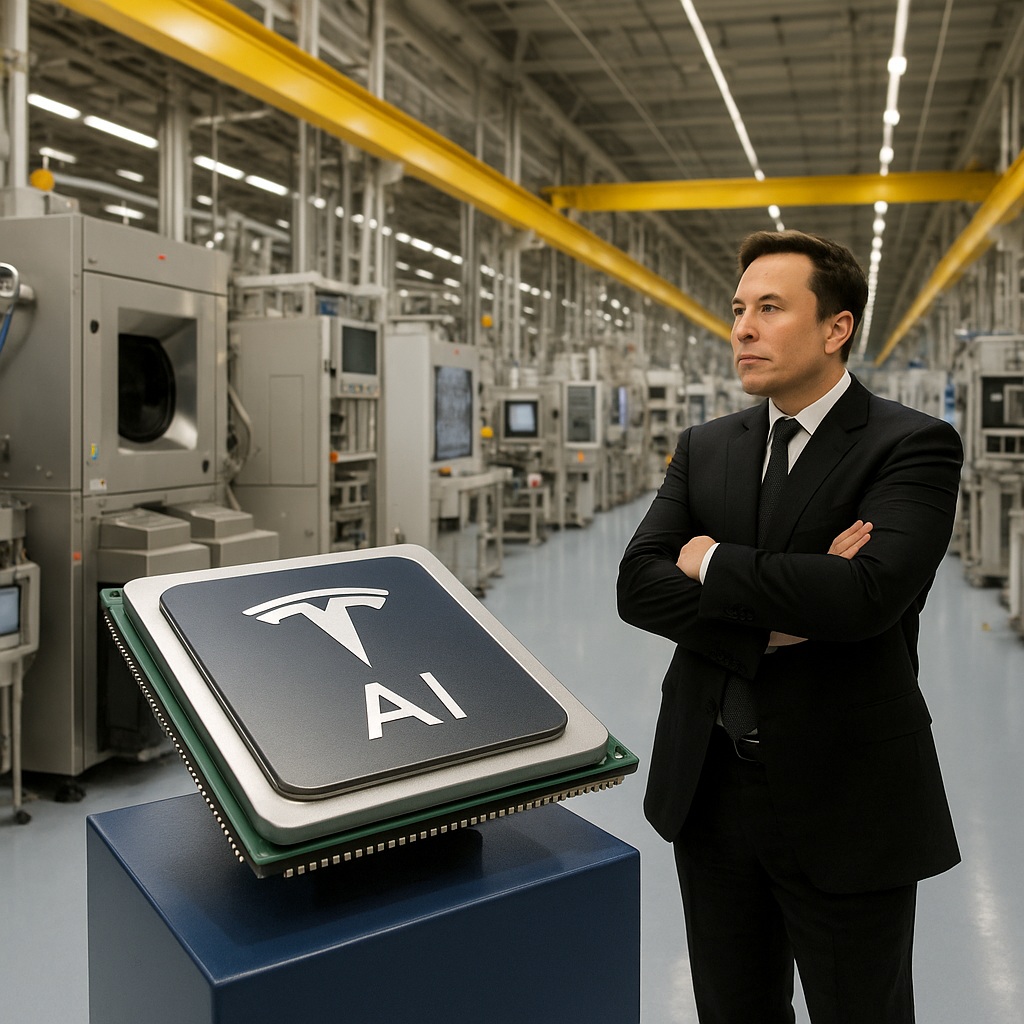
As Tesla accelerates development of its fifth-generation AI chip, the company signals a strategic shift toward becoming a full-stack artificial intelligence and semiconductor powerhouse.
In a moment that underscores the tightening fusion of the electric-vehicle sector with advanced artificial intelligence, Tesla is making a decisive push into semiconductor manufacturing. The company is designing its fifth-generation AI processor and is weighing whether to construct what CEO Elon Musk has called a “giant chip fab” or pursue a strategic foundry partnership with Intel to scale production. The initiative highlights Tesla’s ongoing transition from an EV maker to a vertically integrated technology enterprise. The fifth-generation chip is emerging as the connective tissue across Tesla’s vehicles, robotics efforts, and expanding AI infrastructure.
Tesla’s chip lineage began with processors optimized for onboard autonomous-driving inference. Later generations evolved into higher-throughput platforms tailored for neural-network training within Tesla’s compute clusters. The forthcoming chip appears designed for a far broader role, powering autonomy systems, the Optimus humanoid robot, and Tesla’s internal AI cloud, granting the company deeper control over its technology stack.
The consideration of an in-house semiconductor fabrication plant marks a significant escalation. Chip fabs are among the most capital-intensive industrial operations in existence, requiring specialized supply chains and years of refinement. For Tesla, the logic is rooted in ensuring long-term compute scalability. A custom fab could secure access to advanced process nodes and insulate Tesla from global foundry bottlenecks.
At the same time, Tesla is openly evaluating a strategic partnership with Intel. Such an alignment could accelerate access to manufacturing capacity, reduce ramp-up risk, and strengthen Intel’s position as it seeks relevance in the AI foundry market. Tesla, meanwhile, would gain a faster and potentially more cost-effective path to volume chip production.
Analysts see Tesla’s shift as part of a larger trend: leading EV manufacturers increasingly operate like hyperscale computing companies. As autonomy and robotics demand exponential compute growth, custom silicon becomes a core competency rather than a component. Tesla’s fifth-generation chip strategy echoes the philosophies of firms such as Apple and major cloud providers, both of which design proprietary chips tightly aligned with their software ecosystems.
Despite the operational risks associated with semiconductor expansion, Tesla’s approach reflects a long-range view. The company is betting that the next decade of value creation will come not only from vehicles but from intelligence, automation, and the compute platforms that support them.
Whether Tesla builds its own fab or partners with a semiconductor powerhouse, its trajectory is clear. The company is positioning itself as a full-stack AI and technology enterprise with ambitions that extend across silicon, systems, and autonomous platforms.



 The Tower Post