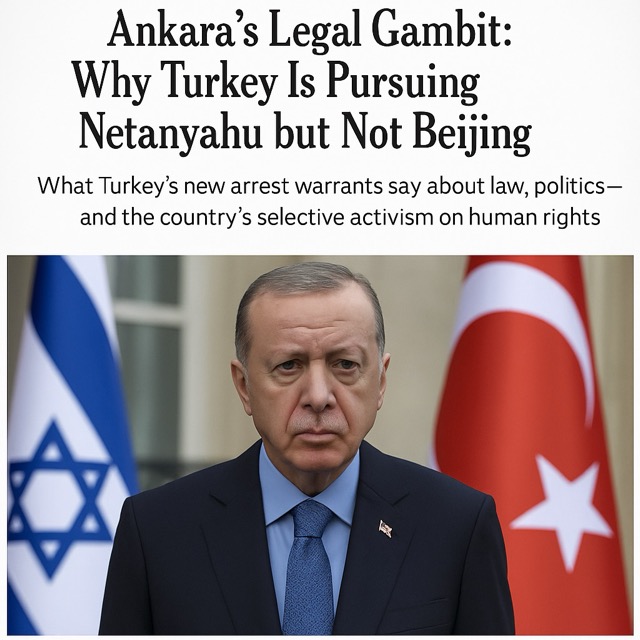
What Turkey’s new arrest warrants say about law, politics—and the country’s selective activism on human rights.
London — When Istanbul prosecutors issued arrest warrants this month for 37 senior Israeli political and military figures—including Prime Minister Benjamin Netanyahu—Turkey vaulted into the front rank of states using domestic courts to police atrocities abroad. The warrants cite genocide and crimes against humanity tied to Israel’s campaign in Gaza, a move that instantly resonated with President Recep Tayyip Erdoğan’s base and jolted already‑fractious regional diplomacy.
The question dogging Ankara now is not only whether the warrants have any practical bite, but why the same legal energy has not been marshaled toward Beijing over the mass abuses documented against China’s Uyghur minority—an ethnolinguistic cousin to the Turks—despite years of reports by the United Nations and independent investigators.
A legal move with explicit political charge
On paper, the warrants rest on a straightforward foundation in Turkish criminal law. Genocide and crimes against humanity are codified in Articles 76 and 77 of the Turkish Penal Code (TPC), and Article 13 gives Turkish courts “absolute” extraterritorial jurisdiction over certain grave offenses regardless of where they occur or who commits them. In practice, there’s an additional political choke point: for most offenses listed under Article 13, prosecutors can proceed only with the Justice Ministry’s approval, a provision that makes high‑profile universal‑jurisdiction cases inherently political.
Ankara’s message is equally plain. Turkey has already sought to influence the Gaza war through law and policy: halting all trade with Israel in May 2024 “until humanitarian aid flows freely” to Gaza, and filing a declaration to intervene at the International Court of Justice in South Africa’s genocide case against Israel. The arrest warrants extend that legal‑political playbook.
Inside the file: a hospital, a flotilla, and a theory of the case
People familiar with the case say the Istanbul dossier draws on incidents that cut directly across Turkish interests and optics.
One is the destruction of the Turkish‑Palestinian Friendship Hospital in Gaza, the enclave’s only dedicated oncology facility, which Turkish officials say was leveled by Israeli action in March 2025; Ankara publicly condemned the strike and has repeatedly highlighted it as a violation of international humanitarian law.
Another strand points to this year’s Global Sumud Flotilla, a multi‑vessel effort to deliver relief supplies by sea. Israel intercepted all 42 boats in late September and early October; activists—including lawmakers from several countries—were detained and deported. Turkish officials denounced the interdictions. In the Istanbul case file, lawyers argue the flotilla episodes help establish a wider pattern of unlawful acts against civilians and humanitarian efforts.
However sweeping the Turkish warrants, enforcement power will be limited outside Turkey absent cooperation from third countries. That hardly makes them symbolic. Arrest warrants can complicate foreign travel, increase diplomatic costs, and, crucially for Ankara, signal that Turkey is willing to operationalize universal jurisdiction when the politics align.
Lawfare as foreign policy
The warrants also fit a broader pattern: Turkey’s use of coercive economic and legal tools to frame itself as a defender of Palestinians. The 2024 trade halt was framed as leverage for humanitarian access; while Israel’s central bank later said the economic impact on Israel was limited, the move landed politically at home. The ICJ filing allowed Ankara to join a marquee case with global salience. The warrants deliver a dramatic domestic headline at comparatively low financial cost.
This is politics as much as jurisprudence—and that’s precisely why the Uyghur question keeps surfacing.
The other test case: Xinjiang’s Uyghurs
Since 2017, UN human‑rights investigators and a raft of NGOs have documented mass detentions, torture, sexual violence, forced labor transfers and policies to suppress births among Uyghurs and other Turkic Muslims in China’s Xinjiang region. The UN rights office concluded in 2022 that abuses “may constitute international crimes, in particular crimes against humanity.” Beijing denies systematic abuses, calling its policies counter‑extremism measures.
Uyghurs are a Turkic people with strong cultural and linguistic ties to Turkey; Istanbul hosts the world’s largest Uyghur diaspora outside Central Asia. Activists there have filed criminal complaints under Turkey’s universal‑jurisdiction statutes, attempting to trigger investigations of Chinese officials for genocide, torture, rape and other atrocity crimes. Those petitions underscored that Turkish law, on its face, permits such cases. Yet they have not yielded the kind of public prosecutorial push seen in the Israel file.
What the London Uyghur Tribunal found
Into that vacuum stepped a civil‑society mechanism: the Uyghur Tribunal, a London‑based people’s tribunal chaired by Sir Geoffrey Nice (the former lead prosecutor in the Milosevic case). After public hearings and a review of documentary evidence, the panel issued a detailed judgment on 9 December 2021. Its central findings:
• Genocide — beyond a reasonable doubt, the People’s Republic of China committed genocide by imposing measures intended to prevent births within the Uyghur group, with the intent to destroy a significant part of it.
• Crimes against humanity — also proven beyond a reasonable doubt, including imprisonment or severe deprivation of liberty, torture, rape and sexual violence, enforced sterilization, persecution, enforced disappearance, deportation or forcible transfer, and other inhumane acts.
The Tribunal’s judgment is not legally binding on states. But its methodology—a transparent hearing record and a long, reasoned decision—has been influential in advocacy and parliamentary debates. For Turkey, which has hosted and often championed Uyghur voices, the tribunal’s conclusions sharpen the contrast with Ankara’s current legal posture.
Why no Turkish warrants for Chinese officials?
Economics and exposure. China is Turkey’s largest source of imports and a pivotal partner across energy, manufacturing inputs, consumer goods and— increasingly—investment. Turkish data show China consistently sits at or near the top of Ankara’s import ledger; senior Turkish officials have sought to expand agricultural exports to China and woo Chinese capital, including in autos and energy. Picking a high‑stakes legal fight with Beijing would carry clear commercial risks.
Evidence barriers. Building individual criminal cases requires access to witnesses, documents and crime scenes. Xinjiang remains tightly controlled; the UN’s own assessment flagged constraints on access and intimidation concerns. Even with extensive open‑source troves, translating state policies into indictable acts against named officials—without cooperation from Chinese authorities—poses a formidable evidentiary challenge.
Gatekeeping at home. As noted, Article 13 cases typically require the Justice Ministry’s green light. That is a political decision, and the strategic calculus is straightforward: against Israel—where Turkey has already suspended trade, taken a stand at the ICJ and spotlights attacks implicating Turkish interests—the domestic upside is high and the economic downside limited. Against China, the risk‑reward curve points the other way.
A shifting rhetorical line. Erdoğan himself once described the 2009 violence in Xinjiang as “genocide,” triggering a diplomatic rift with Beijing. In recent years, Turkish officials have adopted a more calibrated tone even as they occasionally raise Uyghur cultural rights in meetings with Chinese counterparts. The priority has been to stabilize the economy and diversify partnerships—an imperative that trims the sails of universal‑jurisdiction zeal.
The credibility gap—and what consistency could look like
None of this negates the legal case Turkey is now pressing against Israeli officials. The ICC itself has pursued warrants related to the Gaza conflict; Turkey’s move, however controversial, falls within a broader surge of accountability efforts through courts national and international. It also channels genuine public sentiment: the Gaza war is viscerally felt in Turkey, and the flattening of a Turkish‑funded hospital was a galvanizing event.
But selectivity has a cost. Uyghur activists in Istanbul, already wary of transnational repression, say Ankara’s silence on prosecutions undercuts its self‑portrait as a principled defender of oppressed Muslims. Rights researchers note that the mere opening of a structured, well‑resourced exploratory file—systematically taking testimony from the diaspora, securing digital evidence and publicly reporting on investigatory steps—would signal parity of concern even if it never culminates in warrants.
There is a path to greater consistency that doesn’t require Turkey to pick a head‑on fight with Beijing tomorrow:
• Open a standing Xinjiang desk within the Istanbul Chief Public Prosecutor’s Office to receive and preserve evidence from the Uyghur diaspora, with clear victim‑protection protocols.
• Commission an independent legal review—as was effectively done by the Uyghur Tribunal—mapping alleged crimes to Turkish statutes (Articles 76–77) and clarifying the threshold for individual culpability.
• Use diplomatic channels to press for monitored access and information‑sharing on missing Turkish nationals or permanent residents with Uyghur roots, while coordinating with like‑minded states at the UN Human Rights Council.
• Report annually on progress and obstacles—what evidence is gathered, what can’t be obtained, and why.
Even limited steps along these lines would narrow the gap between rhetoric and reality. They would also strengthen Turkey’s hand in arguing that universal jurisdiction is not a cudgel applied only when geopolitically convenient.
The stakes for Ankara
Foreign policy in Ankara has long mixed principle and pragmatism. The new warrants underscore how readily Turkish law can be mobilized when both align. The Uyghur file tests whether Ankara is willing to accept higher costs—or at least incur the lower‑grade costs of opening exploratory cases—in defense of communities with whom Turks share language, history and faith.
For now, Turkey’s arrest warrants against Israelis are both a legal salvo and a political signal. To many Uyghurs in Istanbul, the silence on Beijing feels like the louder message. Whether that changes will tell us as much about Turkey’s economic strategy as it does about its moral compass.
Key sources
Turkey’s arrest warrants for 37 Israeli officials: The Guardian; Anadolu Agency; Times of Israel.
Turkish Penal Code (Articles 76, 77, 13) and Justice Ministry gatekeeping: Council of Europe Venice Commission (English translation).
Turkey’s trade halt with Israel; ICJ intervention filing: AP; International Court of Justice.
Turkish‑Palestinian Friendship Hospital strike; Global Sumud Flotilla interceptions: Turkish MFA; Al Jazeera; Times of India.
UN/OHCHR assessment on Xinjiang; summary of “international crimes” language: OHCHR; Axios.
Uyghur Tribunal judgment (Chair: Sir Geoffrey Nice): Summary judgment (Dec. 9, 2021).
Erdoğan’s 2009 “genocide” comment on Xinjiang unrest; recent calibrated tone toward Beijing: Reuters.
Uyghur complaints filed in Istanbul invoking universal jurisdiction: Reuters.
Transnational-repression concerns among Uyghurs in Turkey: Freedom House.


 The Tower Post