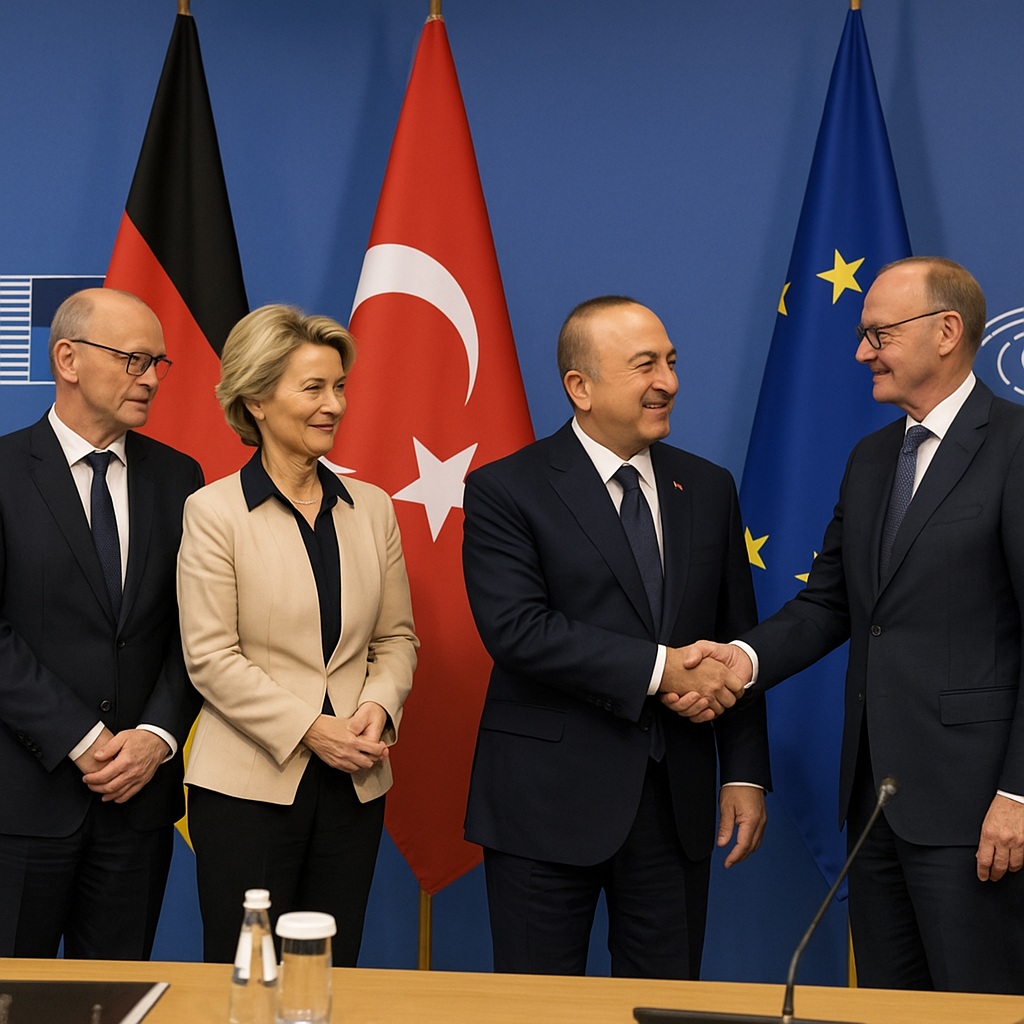
Germany pushes for Türkiye’s deeper integration into EU security and defence structures, reflecting a shifting continental calculus
In an increasingly volatile geopolitical landscape, Germany is signaling that the European Union must dramatically recalibrate its security architecture—and that Türkiye should be part of that recalibration. A senior aide to German Chancellor Friedrich Merz confirmed that Berlin is actively encouraging greater Turkish involvement in EU-level defence and security frameworks, framing Ankara as an indispensable partner for a stable Europe.
The comments, made during policy discussions with European and transatlantic stakeholders, underscore how Germany’s evolving security doctrine is intersecting with long-standing debates about the EU’s relationship with Türkiye. While full EU membership remains politically fraught, Germany is now openly advocating a functional integration of Türkiye into strategic decision-making bodies that shape Europe’s defence posture. This reflects a more pragmatic approach in Berlin and a recognition that the continent’s security challenges extend far beyond its formal borders.
According to the senior aide, Germany sees Türkiye’s geographic position, military capabilities, intelligence assets, and diplomatic network as vital elements in shaping a credible and cohesive European security strategy. The aide emphasized that Türkiye’s engagement is no longer viewed as optional or symbolic, but as structurally necessary.
This represents a notable shift for both Berlin and Brussels. Historically, EU member states have struggled to articulate a unified vision for cooperation with Türkiye. The country’s candidacy has been effectively frozen for years due to political disagreements, human rights concerns, and periodic diplomatic rifts. Yet the Merz government appears intent on moving beyond the stalemate by re-focusing the conversation around concrete security imperatives rather than long-standing political grievances.
Germany’s renewed push is also shaped by broader global dynamics. Europe is reassessing its defence readiness, funding models, and industrial capabilities as geopolitical competition intensifies. Within this context, Türkiye stands out as a NATO heavyweight with one of the largest militaries in the alliance, as well as a proven capacity for rapid operational deployment.
Germany argues that drawing Türkiye closer into the EU’s defence infrastructure would help bridge the operational gap that continues to hamper European security initiatives. Such integration could include deeper coordination with the EU’s Common Security and Defence Policy missions, more structured participation in joint capability development programs, and a more formalized role in emerging EU crisis-response frameworks.
The Merz government’s stance appears to have growing support among certain EU institutions that see Türkiye as central to energy security, migration management, counterterrorism, and Black Sea stability. However, several member states remain cautious, wary of political friction and concerned about the broader implications of opening new institutional avenues to Ankara. For these governments, any long-term alignment must be accompanied by sustained political dialogue and assurances that democratic norms will remain a core expectation.
Still, Berlin insists that strategic realities demand a more flexible and inclusive security structure. The senior aide suggested that Germany is prepared to champion a multi-tiered model of cooperation, one that allows for varying levels of engagement without reopening debates over formal accession. This modular approach would allow the EU to expand its strategic partnerships more pragmatically, especially in the face of expanding global threats.
Turkey, for its part, has welcomed signals of closer cooperation, particularly in areas such as defence industrial collaboration, intelligence sharing, and joint operations planning. Ankara has consistently argued that Europe’s security is inseparable from its own and that existing formats do not adequately reflect Türkiye’s role. Enhanced engagement through EU mechanisms would allow Türkiye to shape, rather than simply react to, European security policies that affect its region.
Beyond immediate military and intelligence considerations, Germany’s initiative also reflects a broader policy realignment. Berlin is increasingly focused on building a Europe that is resilient not only in defence terms but also economically and technologically. Closer ties with Türkiye could contribute to supply chain diversification, energy corridor stability, and the development of new industrial ecosystems that support defence innovation.
Critics within the EU, however, warn that rapid integration without parallel political reform could weaken the coherence of European institutions. They argue that security cooperation cannot be entirely isolated from values-based frameworks. Nonetheless, the Merz government appears committed to the view that security policy must operate on timelines dictated by strategic necessity rather than by protracted political negotiations.
Diplomats familiar with the discussions report that Germany is already engaging with several EU partners to develop pilot programs that could serve as proof-of-concept initiatives. These may include joint maritime security operations, enhanced cyber cooperation, and coordinated defence technology investments. If successful, such initiatives could lay the basis for more formalized long-term structures.
As Europe confronts a rapidly shifting global environment, Germany’s call to include Türkiye more deeply in EU security and defence structures marks an important departure from past approaches. It signals recognition that addressing complex regional and global challenges requires a broader coalition of capable partners. Whether Europe will fully embrace this shift remains uncertain, but Berlin’s position indicates that the debate is moving in a new direction—one driven less by historic political tensions and more by the practical demands of European security.




 The Tower Post