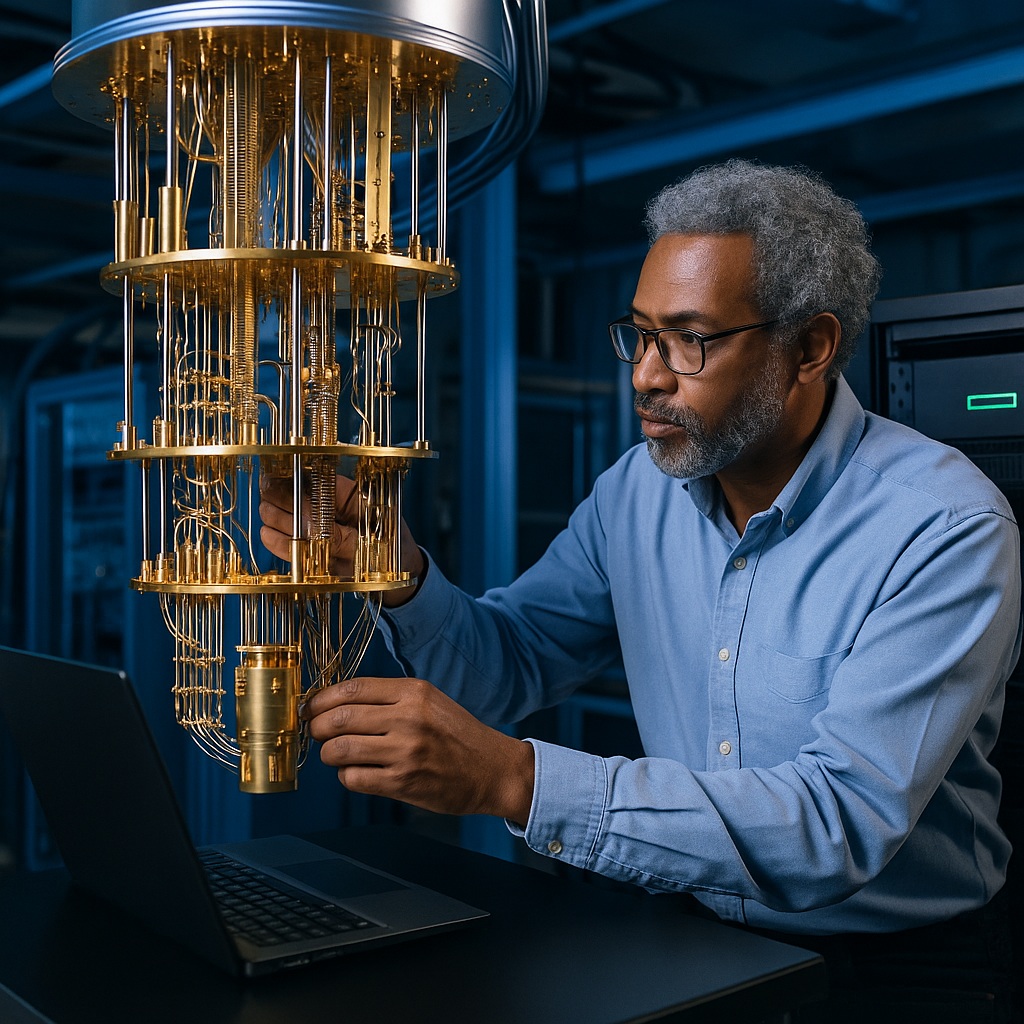
A groundbreaking collaboration between elite researchers, Hewlett Packard Enterprise, and leading chip manufacturers aims to accelerate quantum computing into commercial reality

In a landmark effort that signals a new phase in quantum technology, a Nobel Prize–winning physicist has joined forces with Hewlett Packard Enterprise (HPE) and a consortium of advanced semiconductor firms to develop what could become the first commercially viable quantum supercomputer. The partnership reflects a coordinated push to bridge the gap between experimental physics and scalable enterprise systems.
The initiative brings together scientific authority and industry engineering capability. The Nobel laureate, whose foundational work in quantum information science shaped the discipline, is working directly with HPE’s Quantum Engineering Lab to architect a system capable of both unprecedented coherence and modular expansion. Meanwhile, chip industry partners are contributing fabrication techniques, cryogenic packaging innovations, and fault-tolerant qubit architectures designed to withstand operational stresses that have historically limited quantum scale-up.
HPE executives describe the collaboration as a decisive shift from exploratory research toward a production-oriented model. Instead of relying on laboratory-grade hardware, the project aims to establish a manufacturing pipeline for quantum processors, interconnects, and error-correction platforms that can be produced at semi-industrial volumes. Researchers emphasize that this is not a distant concept but an active engineering program with integrated prototypes undergoing validation.
Central to the effort is a hybrid supercomputing environment in which classical high-performance computing (HPC) systems and quantum accelerators operate as synchronized units. HPE’s HPC architecture provides the computational backbone, while quantum modules—connected through ultra-low-latency optical-to-cryogenic links—serve as specialized engines for optimization, simulation, and cryptographic workloads.
Chip partners are leveraging cutting-edge semiconductor processes to fabricate qubit arrays with improved uniformity and longer coherence times, two factors essential for large-scale quantum computation. Engineers involved in wafer-level development report that the consortium is pursuing multiple qubit modalities simultaneously, including superconducting, silicon-spin, and neutral-atom systems. This diversified approach is designed to accelerate commercialization while reducing technical risk.
Although no specific milestones are publicly announced, sources indicate that the team is working toward a functional demonstration of a fully integrated quantum supercomputing node. This system would combine error-corrected logical qubits, dynamic routing, real-time diagnostics, and classical orchestration layers capable of managing quantum workloads with enterprise reliability requirements.
Industry analysts describe the initiative as one of the strongest attempts yet to overcome the practical barriers that have constrained quantum computing. By assembling scientific prestige, enterprise-grade computing infrastructure, and leading semiconductor fabrication expertise, the collaboration establishes a model for how quantum systems may transition from research environments to commercial deployment.
For the scientific community, the project represents the realization of decades of theoretical research. For industry, it marks the emergence of quantum hardware that can be designed, manufactured, and serviced on commercial timelines. And for the broader technology landscape, it suggests that the long-anticipated quantum era may be approaching more rapidly than expected.




 The Tower Post