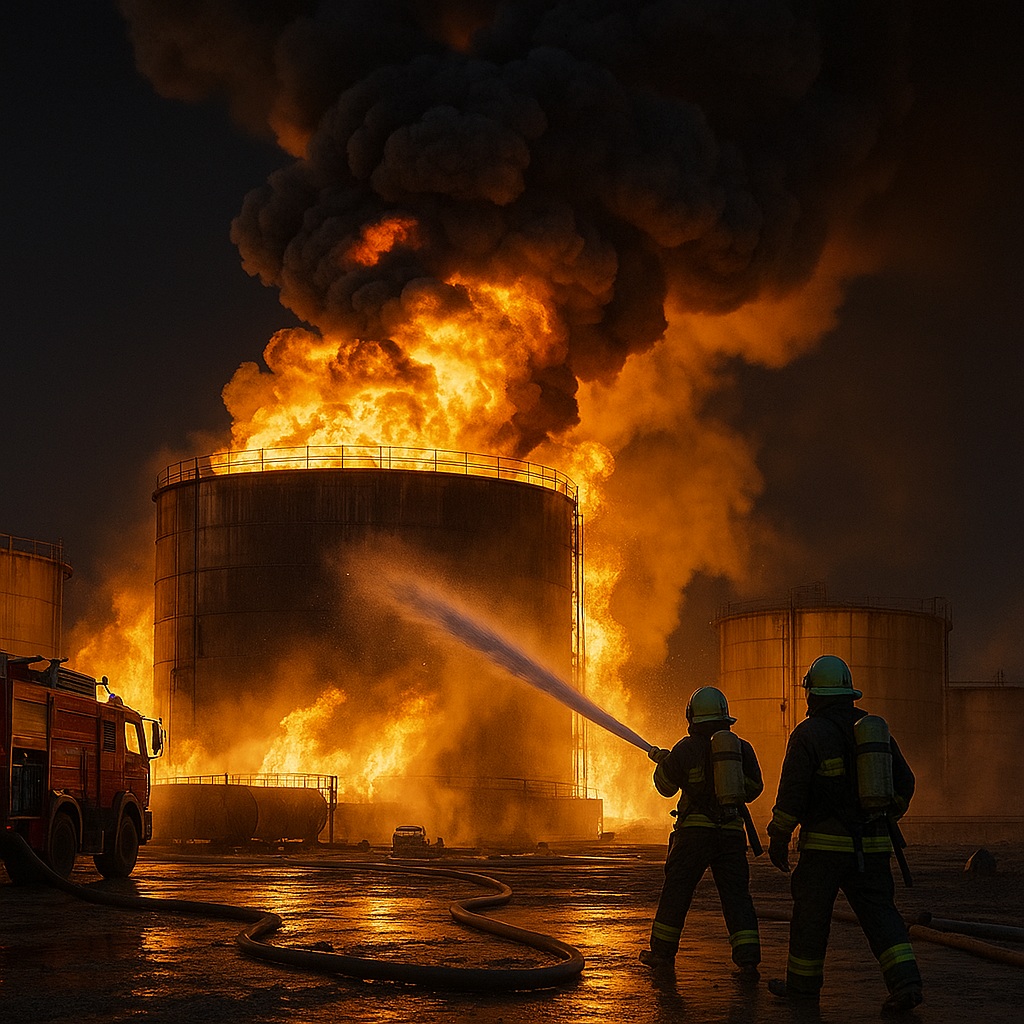
A dramatic overnight blast at a fuel hub underscores Ukraine’s deep-reach campaign while fierce urban combat ripples across the Pokrovsk–Myrnohrad axis.
In the deep hours before dawn, a Russian oil installation erupted into a wall of orange and smoke after what Ukrainian officials described as a deliberate long-range strike. The blaze, captured in grainy clips and satellite-style frames shared by officials and local channels, sent a pillar of soot into the night sky and forced emergency crews into a sprawling, high-risk response. Kyiv framed the hit as part of a sustained effort to degrade Moscow’s military logistics—specifically the fuel lifeline that keeps armor moving and missiles trucking toward the front.
The fire, in Russia’s southern energy belt, follows a string of Ukrainian drone sorties and sabotage operations striking refineries, depots, and terminals beyond the border. Analysts describe a war of logistics gathering pace as temperatures drop, with Ukraine escalating pressure on the nodes that feed Russia’s wartime economy and battlefield tempo. Moscow, in turn, has pounded Ukraine’s power grid and industrial base, pressing for outages that sap output and morale in the cold months ahead.
Officials in Kyiv said the operation involved long-range drones and was coordinated with other attacks aimed at fuel storage and industrial targets in occupied territory. Russian regional authorities acknowledged a large fire but avoided attributing the cause, a familiar gap between footage of burning tanks and official statements that leave room for deniability. Independent monitors assessed a significant disruption, at least in the short term, with the potential for cascading effects on rail and road fuel distribution networks if follow-on strikes materialize.
A campaign of attrition by other means
As the frontlines grind, Ukraine’s strategy has increasingly leaned on deep strikes to bend the shape of the battlefield without massed armor. The thinking is blunt: deny fuel, slow the guns. Past attacks on major refineries and oil terminals have triggered shutdowns and repair cycles, clawing resources away from front-line units and forcing Russia to reroute supplies over longer, more vulnerable corridors. This approach also aims to nudge global perceptions—demonstrating reach, precision, and a willingness to escalate pressure on targets that underpin Russia’s war effort.
The pattern has become familiar. Each Ukrainian hit on energy infrastructure is followed by retaliatory barrages on Ukrainian cities and critical substations. The rhythm is punishing, and civilians on both sides feel the whiplash—sirens in border regions, rolling blackouts across Ukrainian urban belts, and an unrelenting night sky that flickers between anti-air arcs and the dull glow of distant fires.
Donetsk: a fight measured in blocks
While the depot burned, the fiercest ground fighting remained concentrated far to the west of the front line’s bow, where the struggle for the Donetsk region has narrowed into neighborhood-by-neighborhood combat. Ukrainian officials report that assault groups continue to probe into the northern approaches of Pokrovsk, seeking to widen cracks and unsettle supply routes that keep the pocket holding. The terrain is ugly for both—rail spurs, industrial yards, low-rise housing, and the maze of shelters and basements that define close-quarters war.
Commanders describe a tempo that shifts with the weather: fog offers concealment for infiltrations; clear skies invite surveillance drones and loitering munitions. In the broader sector—around Myrnohrad and satellite settlements—Ukrainian units say they are trading artillery suppression and small-unit raids, using quadcopters for last-second corrections and to chase infantry fighting vehicles off exposed avenues. Casualty counts fluctuate by the day, but the pattern is steady: modest advances, violent resets, more rubble.
The view from Moscow and Kyiv
For Moscow, advances around the Pokrovsk axis are cast as proof that methodical pressure yields ground. Russian military channels boast of footholds along the approaches and claim to have forced Ukrainian redeployments away from other hot spots. Kyiv counters that the defense is holding under intense pressure and that any local breaches are being sealed with mobile reserves and precision fires. The information contest is almost as fierce as the fighting: geolocated snippets, blurry helmet-cam clips, and satellite flashes that analysts pore over to assemble a picture that rarely stays still for long.
Both sides understand what’s at stake. Pokrovsk is not just a dot on the map—it’s a logistical hinge for the region. If Russia can pry it loose, it would open vectors deeper into government-held Donetsk and strain Ukrainian lines that have weathered repeated campaigns since the fall of Avdiivka. If Ukraine holds, it buys time for repairs, rotations, and the continuation of deep strikes that aim to raise Russia’s costs far from the trench line.
Human costs, strategic signals
Behind the maps are families sheltering without steady power and crews in reflective jackets sprinting between transformers and shattered substations. Utility workers speak of a repair-and-repeat cycle; medics in Donetsk hospitals describe surges of wounded after each failed infiltration; fire brigades on both sides of the border fight industrial blazes that start with a drone’s small flash and end as infernos. The cumulative effect is corrosive. Even when guns go quiet for a spell, the drone of generators and the scrape of shovels in smashed stairwells keep the war present.
Diplomatically, the strikes reverberate. Kyiv argues that pressure on energy infrastructure inside Russia is lawful and proportionate, designed to curb the machinery of aggression. Western partners weigh those claims against fears of escalation and spillover in global energy markets. For its part, Moscow insists the attacks amount to terrorism and vows responses that often arrive before the statements are finished. The result is a grim equilibrium in which each side signals resolve by inflicting pain the other must feel and fix.
What comes next
With winter tightening, the contest for advantage is likely to hinge on logistics, air defenses, and the stamina of units lashed to the front. Ukraine will look to keep Russia off balance with strikes that force choices—guard the refineries and depots or guard the bridges and rails pushing supplies toward Donetsk. Russia will attempt to press its advantage in manpower and artillery density where the lines are thin, hoping for a breakthrough that turns local gains into a wider unraveling.
For now, the image that lingers is the glow of a depot fire licking at the low clouds and the crackle of small arms somewhere in the streets of a battered Donetsk satellite. The war remains what it has been for months on end: a struggle of reach against mass, of precision against pressure, and of two societies adapting, again and again, to the shock and grind of modern, industrial conflict.




 The Tower Post