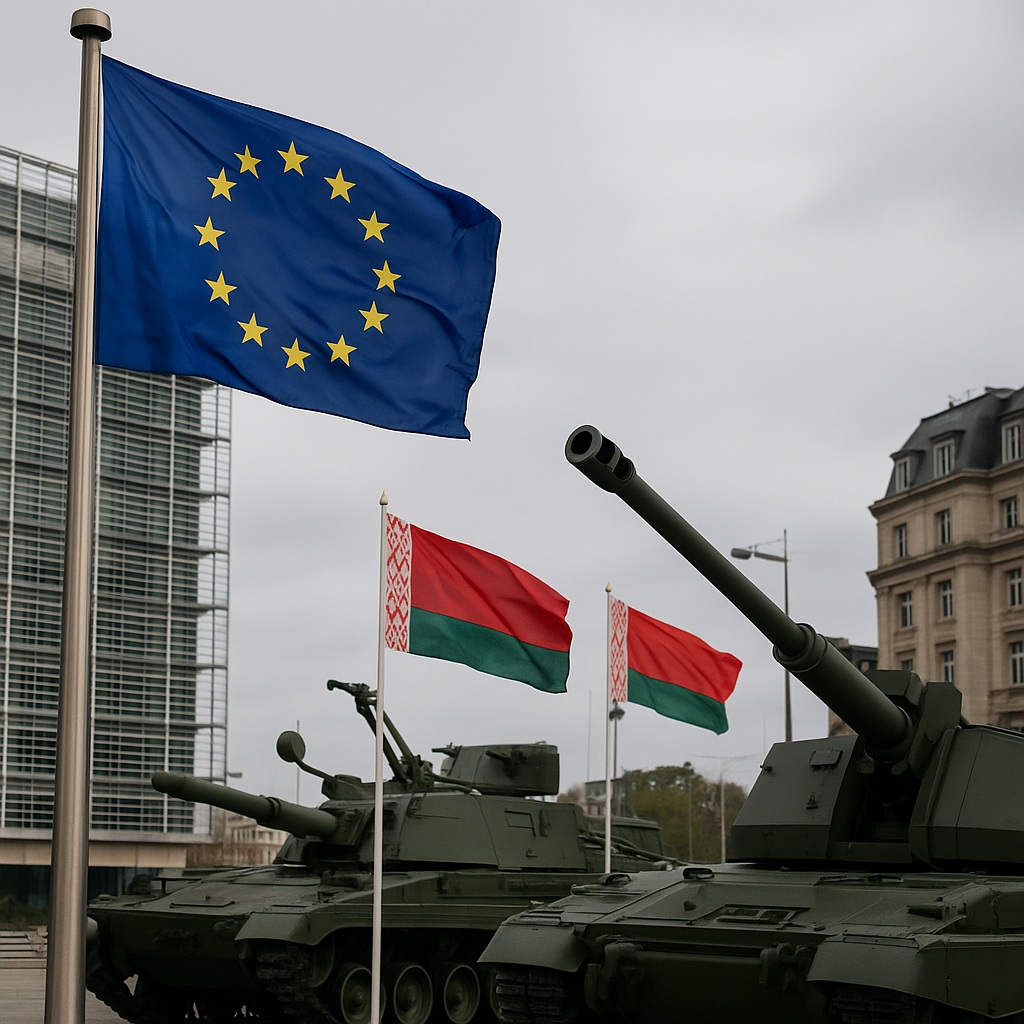
The European Union unveils a new restrictive package targeting Belarus’s role in the war in Ukraine, tightening export‑controls and defence‑sector links as part of its broader strategy to isolate Moscow’s regional enablers.
In a decisive move that underscores the European Union’s resolve to punish and deter the involvement of its neighbour Belarus in the conflict in Ukraine, Member States yesterday approved a sharpened set of measures designed to choke off Minsk’s capacity to support the Russian war effort. These restrictions mark a significant escalation in Brussels’ policy approach, signalling that Belarus is no longer treated merely as a regional partner to pressure but as a direct enabler of aggression.
A tightening spiral
The package, formally adopted by EU foreign ministers, extends beyond traditional travel bans and asset freezes to include heavy‑duty export controls on dual‑use goods, defence‑industry inputs and sensitive technologies. According to the EU’s official sanctions overview, Belarus faces bans on goods and technology “in the aviation, maritime navigation, space and defence industry” as well as export restrictions on dual‑use and other items which could contribute to industrial or military capabilities.
In practical terms, this means EU firms and their subsidiaries can no longer export materials, components or technical assistance to Belarus in a variety of strategic sectors — from aerospace and navigation tech to defence manufacturing and advanced electronics. Further, the new measures aim to plug persistent sanction‑circumvention channels via Belarus, a state that has long served as a logistical and industrial back‑door to Russia.
Belarus’s role under the spotlight
Europe’s action draws on a growing body of evidence that Belarus has facilitated the Russian war machine in multiple ways. The EU states that Belarus has permitted the use of its territory for missile launches, provided transit corridors for heavy weaponry through its airspace, and allowed refuelling of Russian aircraft on its soil.
By intensifying its export and trade restrictions, the EU is attempting two things simultaneously: degrade Belarus’s industrial and logistical support to Russia, and dissuade private sector actors from participating in shadow supply chains. Analyst briefings note that this latest package is among the most rigorous yet, echoing the structure of sanctions levied against Russia itself.
What’s new — and what it means
The key hallmarks of the new regime include:
- A ban on key exports to Belarus of military‑relevant goods, dual‑use technologies and items for aviation, maritime navigation, space and defence sectors.
- A prohibition on imports from Belarus of certain mineral and industrial goods, and restrictions on transit and services that facilitate Belarusian industrial capacity.
- Tightened rules on EU‑based companies’ subsidiaries and third‑country affiliates to ensure they do not become back‑doors for Belarus or Russia.
- Reinforced anti‑circumvention safeguards: ensuring that Belarus cannot be used as a conduit for components, goods or finance to Russia’s defence industry.
From a strategic standpoint, the EU appears to be shifting from a primarily punitive posture (targeting individuals and entities) to a structural one (altering trade flows, industrial linkages, and regulatory frameworks). The implication is clear: Belarus’s economy and industrial base will now feel the pressure more directly.
Reaction from Brussels and Minsk
Brussels emphasises that these new measures are not just a one‑off move but part of a broader ongoing framework: “The EU stands ready to adopt further sanctions if the Belarusian authorities continue their actions.” Foreign ministers in the EU gathered ahead of today’s session stressed that Belarus must make a clear break with its enabling role in Russia’s war if it is to see any normalization of relations.
For Belarus, the reaction is predictably defiant. Minsk, which has consistently framed its cooperation with Russia as a matter of sovereign decision‑making and strategic alignment, views the new restrictions as politically motivated and part of Western attempts to isolate it. Observers expect Minsk may attempt to intensify its pivot towards non‑Western partners, including in Asia and the Middle East, to sidestep the EU’s choke‑points.
Business and sanctions compliance ripple effects
The tightened regime raises immediate compliance challenges for EU exporters, third‑country vendors linked to EU business hubs and multinational corporations. Legal advisories highlight that companies must conduct thorough due‑diligence into their supply chains, especially if they touch Belarusian entities or transit points.
Moreover, importers and service firms within the EU who engage Belarusian counterparts are under sharper scrutiny. The risk now extends not only to direct dealings with Belarusian defence sectors, but also to unwitting contributions to capacity‑building (industrial, logistical or dual‑use) that supports Belarus’s involvement in the war. Lawyers note that the scope of the restrictions means that even seemingly innocuous goods or services — especially in aviation, software, maritime operations, electronics — could fall foul of the new rules.
Wider geopolitical consequences
The move sends several signals. First, it reinforces that the EU regards Belarus as part of the war‑machinery ecosystem linked to Russia, and not merely as a satellite state. Second, by bolstering its export‑controls and industrial link targeting, Brussels aims to raise the cost of Minsk’s complicity. Third, the step tightens one of the major “loopholes” through which sanctions on Russia had previously been evaded by routing goods via Belarus.
As one diplomat put it: “With this package, we just closed the biggest loophole of our sanctions regime.” While these words referred at the time to earlier measures, the tone and strategy clearly feed into the new measures adopted now.
The path ahead
Over the coming months, the EU will monitor Belarus’s behaviour not only in its direct assistance to Russia’s war effort but also in its broader economic and industrial links. If Belarus fails to show signs of reducing its role, further packages appear likely, possibly targeting larger swathes of the economy such as energy, refined goods, logistics hubs and transit networks.
For EU businesses, the message is clear: engagement with Belarus’s defence‑industrial sphere or transit pipelines for Russian links carries heightened risk. Firms will need to revisit risk assessments, supply‑chain exposures and potential legal liabilities under export‑control and sanctions regimes.
For Belarus, the damage could be multifaceted: restricted access to Western‑origin components and technology, reduced foreign investment, higher costs in its logging/transit network, and a harder time servicing its industrial ambitions — all while it remains economically enmeshed with a nation under intense pressure: Russia.
Conclusion
As of this mid‑November moment, the European Union has sharpened its response to Belarus’s enabling role in the conflict in Ukraine. The new restrictive measures – export controls, defence‑link bans, anti‑circumvention safeguards – reflect a matured sanctions strategy that goes beyond symbolic gestures. The result: Belarus faces a starker choice — either decouple from the logistics and industrial pipeline supporting Moscow, or endure an increasingly squeezed economic and technological future. Brussels, meanwhile, is signalling that the era of “soft” sanctions thresholds is giving way to structural disruption of the enabling networks around Russia’s war machine.
The coming weeks will reveal how Belarus reacts: whether through further alignment with non‑Western partners, adjustments in its military transit role, or internal economic shifts to withstand the pressure. For the EU, the intent is clear: Belarus must be turned from a back‑door into a front‑page case of accountability.


 The Tower Post