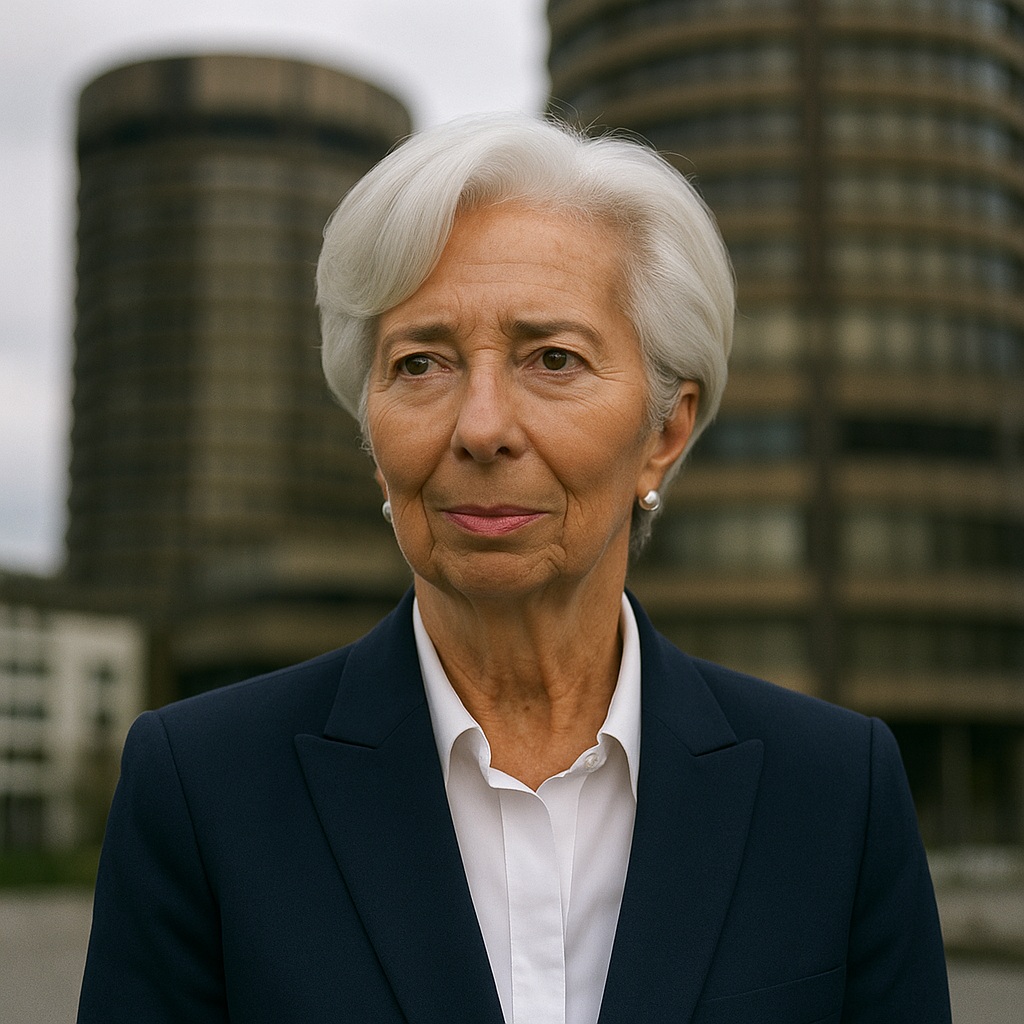
With Christine Lagarde set to take over two senior roles at the Bank for International Settlements, global central-bank governance tilts toward Europe.
In a move signalling a subtle but meaningful shift in the architecture of global central-bank coordination, European Central Bank President Christine Lagarde will assume the chairs of two prominent committees at the Bank for International Settlements (BIS), replacing U.S. Federal Reserve Chair Jerome Powell. The decision reflects not only the evolution of institutional leadership within the BIS, but also underscores the changing dynamics of influence among major central banks.
Powell has chaired the BIS’s Global Economy Meeting (GEM) and its Economic Consultative Committee (ECC) since taking over those posts in late 2019. The committees bring together some of the world’s most prominent central-bank governors to examine cross-border policy issues, financial-stability challenges and macro-economic developments. His term is set to conclude in mid‑2026, paving the way for Lagarde’s appointment.
Lagarde, who has led the ECB since November 2019, will begin at the helm of the BIS committees following Powell’s hand‑off. Her appointment is emblematic of the growing weight of European institutions in the global central-banking ecosystem. For observers of international-monetary governance, the transition is a clear signal: the centre of gravity is shifting — not dramatically overnight, but incrementally — toward Europe’s voices in global monetary and financial policy discussions.
Institutional Significance and Power Shifts
The BIS, often dubbed the “central bank of central banks”, serves as a hub for cooperation among its 63 member-central banks. Its GEM and ECC committees are highly regarded as platforms for senior central-bank governance outside of formal multilateral institutions. By assuming their chairs, Lagarde will not only preside over high-level dialogues but also help set the agenda for global central-bank coordination, from macro-prudential risks to the architecture of swap lines and cross-border liquidity.
For Powell, the leadership of these committees provided a strong U.S. voice in multilateral central-bank governance, complementing the bilateral dominance of the Fed in global monetary policy. Lagarde’s succession indicates a recalibration of that balance — albeit in a cooperative rather than competitive spirit.
Moreover, this transition comes at a moment when the ECB’s international role is under the spotlight. Lagarde herself has emphasised the euro’s potential international role, reinforcing Europe’s aspiration to punch above its weight in the shifting global monetary system.
Implications for Policy and Geoeconomics
With Lagarde at the helm of these committees, several policy implications are likely:
- Greater European framing of global financial-stability debates. The ECB’s approach to inflation, structural reform, and currency diversification may increasingly inform the BIS committees’ agenda.
- Potential shifts in swap-line and liquidity frameworks. Central-bank cooperation on U.S. dollar funding stress, euro liquidity provision and contingency-planning may see more overt European × global coordination, with the BIS as the convening venue.
- Re-emphasis on multilateral rule-setting. Lagarde’s legal-background and focus on governance suggest that the BIS’s consultative committees may deepen attention to structural issues — digital payments, cross-border payments, climate-risk integration — rather than just cyclical policy coordination.
- A symbolic message of influence. The succession is a visible signal of Europe’s role-expanding beyond the continental remit: a continent once regarded as periphery in global monetary power now stepping into a more central position.
Challenges and Limitations
Despite the symbolic weight, practical constraints remain. The BIS committees are not, by themselves, policy-setting bodies; their outputs are advisory and collaborative. The effectiveness of the chair depends not just on agenda-setting but on the willingness of member central banks to act and cooperate.
Furthermore, the United States remains the largest currency-area economy and the issuer of the global reserve currency; the Fed’s influence stretches beyond formal roles. Lagarde’s succession is therefore more evolution than revolution. And while the ECB has ambitions for global reach, the structural dominance of the dollar and the deeply rooted role of the Fed mean that shifts will be gradual and incremental.
Reading the Broader Picture
This leadership change at the BIS must be seen in context. Recently, other key posts at the BIS have gone to European-affiliated figures: for example, Spain’s former central-bank governor was appointed BIS General Manager earlier this year. Taken together, these appointments reflect a strategic recalibration of global monetary governance. The euro-area institutions are asserting a stronger voice in the global dialogue on financial-stability and monetary coordination.
In a world of heightened geoeconomic complexity — with currency rivalries, digitisation of payments, climate-related financial risk, and fragmentation of global supply-chains — having a foot firmly positioned in the global-central-bank coordination arena matters. Lagarde’s impending leadership role offers the ECB and European institutions a clearer pathway into that arena.
What to Watch
- The agenda of the BIS GEM and ECC under Lagarde’s chair-ship: will topics such as digital currencies, climate-risk in central-banking, and non-U.S. dollar funding take stronger prominence?
- Whether European-centric issues gain fresh traction: e.g., the internationalisation of the euro, European participation in global swap-lines, and coordination of non-dollar currency regimes.
- The tone of the transition: whether this is seen as a collaborative hand‑over or a subtle reordering of influence — and how the Fed responds in terms of its international posture.
- Whether tangible outputs follow: while chairs can set the meeting agenda, the real test is whether central banks act in concert on the issues raised.
As of mid‑November, the transition is set, and the announcement has been made public. The actual hand‑over will coincide with the end of Powell’s term early next year. What remains to be seen is how Christine Lagarde leverages her new chairmanship to influence global central‑bank policy and how the BIS committees evolve under her leadership.
In the years ahead, central bankers will watch closely: not just who is in the chair, but how the chair sets the tone, assembles the conversation and drives collective action. For Europe, the moment is both symbolic and strategic — a chance to shape the global monetary‑policy conversation in ways that reflect a changing world.




 The Tower Post