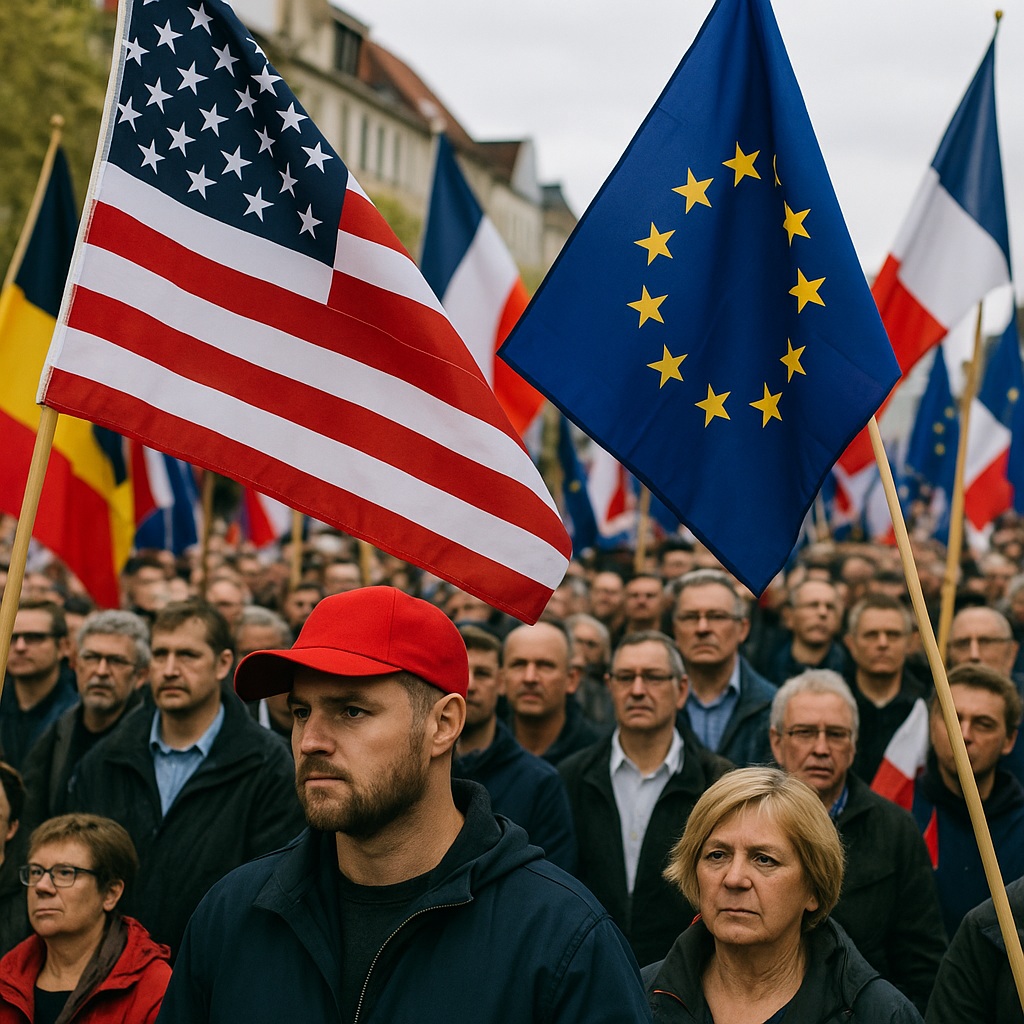
As U.S. political rhetoric gains traction abroad, Europe confronts a recalibration of its parties, alliances, and democratic self-definition
The influence of U.S. “Make America Great Again” politics, once considered a distinctly American phenomenon, has now taken firm root across Europe. What began as a turbulent reshaping of the U.S. political landscape has evolved into a transatlantic ideological export, subtly but unmistakably altering the strategies and identities of right-wing and centre-right parties throughout the continent. Although Europe’s political traditions differ significantly from those of the United States, the spread of MAGA-style messaging illustrates how modern populism transcends borders, adapting itself to new institutional environments and national debates.
From Rome to Berlin and from Madrid to Warsaw, political actors have adopted hallmarks of the MAGA approach: sharp cultural narratives, nation-first rhetoric, scepticism toward liberal institutions, and an assertive direct-to-voter communication style. These signals, once described as isolated echoes of American politics, have now formed into a recognisable pattern that is reshaping the tone and scale of right-wing discourse in Europe. Parties on Europe’s populist right have embraced these methods most enthusiastically, yet elements of MAGA-influenced positioning are increasingly visible within established conservative parties as well. Faced with shifting voter expectations and intensified competition from nationalist movements, the political centre-right is adjusting in ways that would have been deemed improbable only a few years ago.
Shared political pressures across the Atlantic have accelerated the diffusion of U.S. populist methods. Economic anxiety, cultural polarisation, migration pressures, and mistrust toward traditional political institutions are prevalent in many European societies. MAGA provides a ready-made narrative framework capable of activating these sentiments. European voters, much like their American counterparts, increasingly prioritise cultural identity, border control, national sovereignty, and protection from perceived external influence. The MAGA formula presents these issues with clarity and confrontational energy, making it highly attractive to political actors who seek sharp differentiation from the established centre.
The transformation of political communication has further increased the appeal of this model. Across Europe, parties rely on algorithm-driven engagement, rapid-response messaging, and emotionally charged narratives to reach supporters and opponents alike. Social-media ecosystems that reward outrage, identity signalling, and polarising content are ideally suited to MAGA-style rhetoric. Campaign strategists now treat digital spaces as primary arenas of contestation rather than supplementary channels, mirroring the communication logic pioneered in the United States.
Competitive pressure on traditional conservatives is another powerful driver. Mainstream centre-right parties have watched sections of their electorate drift toward nationalist movements that position themselves as more authentic representatives of conservative values. In response, some party leaders have experimented with sharper language on migration, law and order, national pride, and relations with European institutions. The borrowing of MAGA-style themes, even when not explicitly acknowledged, becomes a means of fortifying their base and preventing further erosion toward the populist right.
This adaptation, however, has triggered intense debate within conservative ranks. Many established figures warn that strategies rooted in permanent confrontation and suspicion of institutions threaten the foundations of European democratic norms. For these critics, the centre-right’s legitimacy has long derived from moderation, consensus-building, and a commitment to the European project. They argue that importing the emotional register and polarising tactics of MAGA politics risks undermining judicial independence, media pluralism, and the delicate balance between national and European levels of governance.
Others contend that the political environment has changed so dramatically that older approaches are no longer sustainable. In their view, adapting to MAGA-style communication is not ideological surrender but strategic realism. They point to voters who feel unrepresented by technocratic language and incremental compromises, insisting that a more assertive and identity-focused politics is necessary to keep democratic participation alive. This camp maintains that a new generation of conservative leaders must be able to speak the language of cultural anxiety and sovereignty without abandoning basic democratic commitments.
The rise of MAGA-influenced politics carries consequences that extend far beyond campaign aesthetics. It is altering parliamentary coalitions, policy priorities, and the tone of political life. Where centre-right parties once relied on alliances with liberal or social-democratic groups, some now explore tactical cooperation with nationalist or hard-right parties on matters such as border policy, security, and economic deregulation. This new geometry, based more on cultural alignment than on traditional left-right economics, shifts debates rightward and erodes older patterns of consensus-driven governance.
Key policy areas are being reframed under this pressure. In migration and asylum policy, calls for stronger borders, quicker procedures, and more restrictive frameworks have grown louder. Climate legislation is increasingly scrutinised through the lens of competitiveness and scepticism toward ambitious regulation. Arguments for national sovereignty re-emerge in discussions about the future of European integration, while debates around rule-of-law mechanisms become more contentious as parties under scrutiny seek political allies in Brussels and in national capitals.
Beyond institutional decision-making, the symbolic and cultural effects are significant. The vocabulary of politics becomes more combative, framing opponents not merely as rivals with different priorities but as threats to the nation’s identity or security. Media ecosystems polarise further as outlets and online communities orient themselves around competing narratives of grievance and restoration. Voters grow accustomed to a political style defined less by negotiation and more by identity affirmation, in which compromise is often framed as betrayal.
The diffusion of MAGA into Europe thus marks a turning point in the global story of populism. It reveals that ideational frameworks once assumed to be confined to national boundaries can now be transmitted rapidly across continents through shared media platforms, activist networks, and political consultancy. It also underscores a deeper transformation within Western democracies: electorates are increasingly mobilised by narratives centred on belonging, loss, and protection, rather than by traditional economic cleavages alone.
Europe now enters a period of adaptation and uncertainty. Parties recalibrate their positions in response to shifting electorates. Institutions reassess their role as guardians of pluralism and the rule of law. Citizens navigate a public sphere that feels more fragmented, more emotional, and more polarised than in previous decades. Whether the influence of MAGA proves to be a passing phase or a foundational shift will depend on how Europe’s mainstream political actors choose to respond, and whether they seek to resist, adopt, or fundamentally redefine the populist wave that has crossed the Atlantic.
For the moment, the trajectory is clear. The language, methods, and strategic logic of American-style populism have arrived in Europe, reshaped to fit its political landscape and historical experience. They are already influencing party strategies, coalition options, and the atmospherics of democratic contestation. In the years ahead, the question will not be whether Europe has been touched by MAGA, but how deeply that imprint will reshape the continent’s political future.

 The Tower Post