Diplomatic Tensions Rise as Baku Demands Answers Following Missile Impact on Embassy Perimeter in Ukrainian Capital

Azerbaijan has issued a firm diplomatic protest to Russia after a missile launched during Moscow’s latest large-scale attack on Kyiv struck the outer perimeter of the Azerbaijani Embassy, damaging part of the wall and nearby structures but causing no injuries, an incident that has quickly transformed from a wartime hazard into a pointed diplomatic confrontation between two countries that typically maintain a carefully balanced relationship.
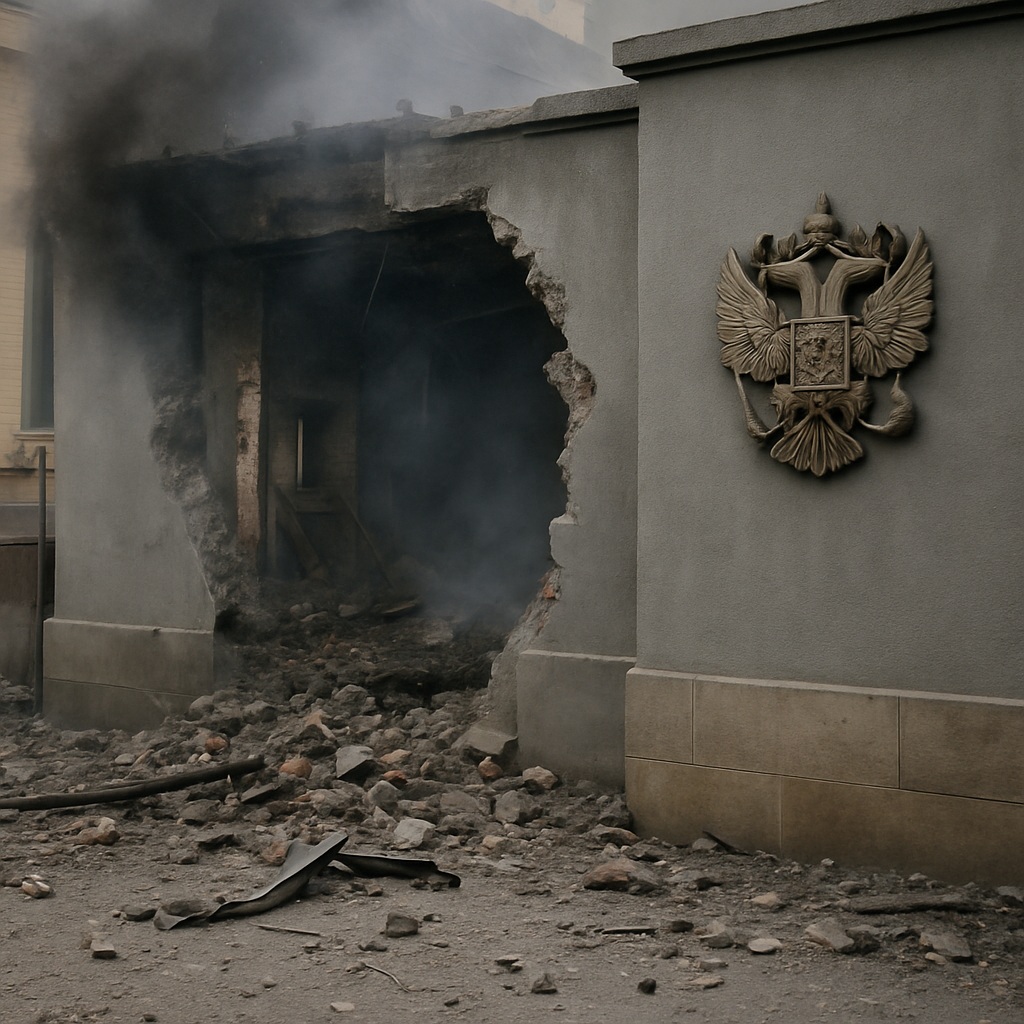
According to the Azerbaijani Foreign Ministry, the strike occurred during a night of intense bombardment on the Ukrainian capital, when multiple ballistic and cruise missiles targeted infrastructure, residential areas, and government zones, with fragments or blast pressure reaching the embassy compound, leaving a deep fracture along the diplomatic mission’s reinforced exterior wall and scattering debris across the consular courtyard.
Officials in Baku summoned Russia’s ambassador swiftly and demanded an official explanation, stressing that the coordinates of the Azerbaijani Embassy had been formally submitted to Russian authorities long ago to prevent precisely this type of incident, a detail Azerbaijan emphasized as evidence that Moscow had both the means and responsibility to avoid military actions near diplomatic zones.
The protest delivered by Baku was described as stern and unambiguous, with Azerbaijan insisting that damage to a foreign mission constitutes a violation of international diplomatic norms and cannot be dismissed as incidental collateral, especially given that previous Russian strikes in earlier stages of the conflict had already impacted Azerbaijani diplomatic or consular properties elsewhere in Ukraine, raising growing concerns that these repeated incidents form a troubling pattern.
The missile impact has also become a symbolic reminder of how the war in Ukraine increasingly spills beyond expected military boundaries, as diplomatic compounds, once assumed to be shielded by widely recognized conventions, find themselves vulnerable to the expanding radius of modern ballistic and drone warfare, with embassies across Kyiv reinforcing their shelters, blast walls, and emergency protocols in response to repeated nighttime bombardments.
For Azerbaijan, the incident forces a delicate recalibration of its approach to Moscow, as Baku has long maintained a strategic but cautious relationship with Russia, cooperating on regional security and energy matters while simultaneously pursuing independent policies in the South Caucasus; however, a missile damaging its embassy complicates this positioning by placing Azerbaijan in a situation where neutrality becomes harder to sustain without appearing to disregard direct threats to its own diplomatic infrastructure.
Analysts note that Azerbaijan’s demand for a full investigation is more than a procedural requirement; it is also a diplomatic signal to Russia that Baku expects accountability, transparency, and respect for the sanctity of its missions abroad, particularly during a conflict that Azerbaijan is not party to yet repeatedly feels the secondary effects of through physical damage and political pressure.
This incident may influence Azerbaijan’s wider foreign policy posture, as calls grow within diplomatic circles for stronger international guarantees, potential compensation mechanisms, and improved intelligence-sharing on risk zones in Kyiv, with some experts suggesting that Baku may quietly coordinate more closely with European partners or regional organizations to ensure the safety of its personnel and facilities in Ukraine moving forward.
While Russia has not yet publicly offered a detailed explanation, the absence of a clear response risks further straining relations, as Azerbaijan continues to insist that diplomatic missions must be insulated from military hostilities and that ignoring such breaches could encourage further erosion of internationally accepted norms that protect embassies even during wartime.
The damaged perimeter wall in Kyiv, still partially collapsed and marked by a circular blast scar, now stands as a visible symbol of the widening scope of the war and the vulnerabilities faced by countries with diplomatic presences in Ukraine, a physical reminder that the conflict’s reach extends not only across frontlines but deep into the spaces traditionally regarded as inviolate under international law.
Baku has reiterated that it will not allow the incident to go unanswered, emphasizing that the protection of its diplomatic personnel and facilities remains an essential pillar of its sovereignty and foreign policy, and that any assault or negligence affecting those missions—intentional or otherwise—demands clarification, accountability, and tangible steps to prevent recurrence.
As Kyiv braces for further waves of Russian attacks and foreign missions reassess their protective measures, Azerbaijan’s forceful protest underscores a broader truth emerging from the ongoing war: that diplomacy itself is increasingly conducted in the shadows of missile sirens, shattered concrete, and the uncomfortable realization that no diplomatic perimeter, no matter how carefully marked or formally recognized, is entirely beyond the reach of modern conflict.