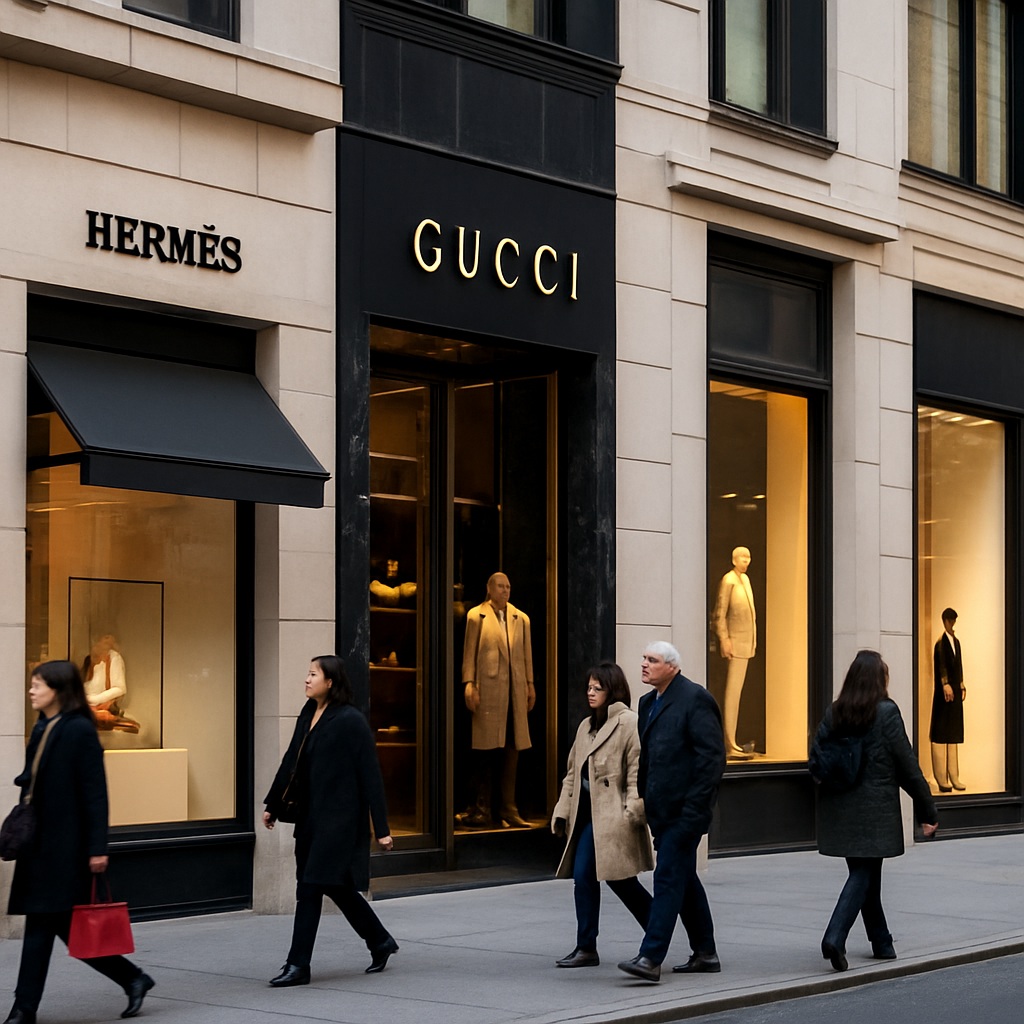
Two European giants spent a quarter-century buying their way to dominance. Now their playbook is reshaping U.S. luxury — and testing regulators’ patience.
As luxury executives gather for back-to-back investor meetings in mid-November, one question hangs over the industry: who will own the next generation of big-name brands?
For the past twenty-five years, the answer has usually been the same. Paris-based LVMH and Kering, built through relentless mergers and acquisitions, turned a fragmented world of family maisons into a high-stakes consolidation game. Their rise created the blueprint that American groups like Tapestry and Capri sought to follow — and the template that regulators are now more willing to challenge.
Today, with deal-making in U.S. luxury at an inflection point, the long arc of LVMH and Kering’s expansion explains both why consolidation feels inevitable and why it has suddenly become so politically sensitive.
From family maisons to financial assets
When Bernard Arnault fused champagne, cognac and leather goods into what became LVMH, luxury was still largely defined by stand-alone houses. Over the following decades, LVMH stitched together a portfolio that spans fashion, leather goods, jewelry, watches, beauty and duty-free retail, turning labels like Fendi, Bulgari and Tiffany into pieces of a single financial engine rather than isolated creative kingdoms.
The logic was simple but radical: use scale to secure the best retail locations, the most desirable media placements and the deepest talent bench, while smoothing out cyclical swings between categories. LVMH’s ability to absorb once-fragile houses and turbocharge them — backed by industrialized marketing and quietly formidable supply chain muscle — helped redefine what “luxury group” could mean.
Kering, the smaller but no less ambitious rival, came to the same game from a different starting point. Originally a French retail and distribution conglomerate, the group pivoted toward luxury through a series of bold, sometimes hostile moves, anchored around Gucci. That bet was followed by a string of acquisitions and stakes in Yves Saint Laurent, Bottega Veneta, Balenciaga, Boucheron and Alexander McQueen, among others, eventually rebranding as Kering and shedding most non-luxury assets.
Where LVMH framed itself as a federation of maisons, Kering presented a tighter, fashion-driven portfolio built around a handful of megabrands and a public narrative of agility and creativity.
Two different M&A philosophies
Side by side, the two European giants pursued distinct acquisition styles.
LVMH leaned into breadth. It bought into wines and spirits, soft and hard luxury, and even airport retail, building a house of brands whose exposure spans everything from crowd-pleasing accessible luxury to ultra-high-end jewelry. In the United States, it quietly became one of the most important foreign employers in fashion and beauty, absorbing brands such as Marc Jacobs, DKNY and Tiffany, and investing in up-and-coming New York labels to keep a foothold in new consumer tribes.
Kering, by contrast, rarely chased the same level of category diversification. Its acquisitions were concentrated in fashion and leather goods, occasionally extending into jewelry, eyewear and beauty, but always with a view to keeping each house sharply positioned. In recent years, as Gucci’s sales momentum slowed and debt crept higher, the group began pruning: exiting non-core watchmaking, slimming its portfolio and, this autumn, agreeing to sell its beauty division — including fragrance house Creed and long-term licenses for star labels such as Gucci and Bottega Veneta — to L’Oréal in a multibillion-euro deal.
The divestment underscores how deal-making at Kering has entered a new phase. After two decades of mostly buying, the group is now also selling to refocus on fashion and shore up its balance sheet, even as it maintains options for future acquisitions like a potential full takeover of Valentino.
LVMH’s “always on” deal machine
LVMH has been no less active in reshaping its portfolio in recent seasons, albeit from a position of strength. Following the blockbuster takeover of Tiffany, the group has continued to add smaller but strategic pieces: stakes in buzzy labels via its venture arm, moves into specialized Swiss watchmaking and, most recently, a minority investment in movement maker La Joux-Perret through its watch division, giving it deeper technical capabilities in high horology.
While none of these transactions rivals the scale of its biggest acquisitions, they signal that LVMH still believes in owning as much of the value chain as possible — from mechanisms and gemstones to retail square footage. The group is also doubling down on its earlier U.S. bets, pouring capital into revamped Tiffany flagships and new stores in Europe and Asia that mirror the New York “temple of luxury” format.
Taken together, these moves display a philosophy that sees M&A not as episodic, but as a constant process of fine-tuning: adding new growth engines, reinforcing industrial know-how and pruning underperforming assets when needed.
The American imitation game — and a regulatory wall
In the United States, the success of LVMH and Kering turned consolidation into a strategic imperative rather than a European curiosity. Department stores weakened, and homegrown luxury players began looking across the Atlantic for inspiration. What emerged were smaller-scale conglomerates like Tapestry, parent of Coach and Kate Spade, and Capri Holdings, owner of Michael Kors, Versace and Jimmy Choo.
Their attempted merger, announced as a transformative deal that would create a U.S.-based rival to the French giants, seemed almost like a delayed echo of LVMH’s earlier playbook. The combined group would have assembled a multi-brand portfolio with enough heft to negotiate better rents, invest aggressively in technology and compete for top creative talent.
But what had sailed through in Europe two decades ago hit a wall in Washington. The Federal Trade Commission sued to block the Tapestry–Capri deal on antitrust grounds, arguing that bringing Coach, Kate Spade and Michael Kors under one roof would weaken competition in the affordable-luxury handbag market. The companies ultimately walked away, and are now facing investor lawsuits over how the failed transaction was presented.
The message to corporate boardrooms in New York and Los Angeles was clear: the age of unchecked roll-ups in U.S. fashion is over, even as European titans continue to operate with more latitude at home.
Break-ups, not just build-ups
Ironically, the collapse of the Tapestry–Capri merger has ushered in a different wave of deal-making — driven more by break-ups than by mega tie-ups.
Capri, under pressure from shareholders, has begun carving itself up. The most headline-grabbing move so far is the agreement to sell Italian label Versace to Prada Group for roughly a billion-and-change in cash, a transaction that will shift one of fashion’s most storied names into the orbit of another Italian powerhouse. Other pieces of Capri’s portfolio, including Jimmy Choo and Michael Kors, are widely seen as potential future targets for either strategic buyers or private equity firms.
Tapestry, shut out of its dream deal, has turned inward and defensive: offloading the Stuart Weitzman brand to Caleres so it can refocus on Coach and the slow rehabilitation of Kate Spade. Instead of building an American answer to LVMH in one bold stroke, it now faces the more delicate task of proving it can grow organically — even as management keeps one eye on the M&A market in case a politically acceptable target emerges.
A new phase of consolidation — with tighter guardrails
All of this is happening against a backdrop of slower luxury growth, particularly in China, and higher borrowing costs. For LVMH and Kering, which already control many of the sector’s blue-chip houses, that environment favors incremental, surgical deals over the blockbusters of the past. Stakes in niche fragrance makers, high-end manufacturers or digital-native brands can move the needle without inviting regulatory backlash.
For American groups and private equity investors, however, the playbook is more complicated. Any move that concentrates too much share in a clearly defined category — like “affordable luxury handbags” — risks attracting scrutiny. That pushes the market toward adjacent plays: buying brands in new price tiers, categories or geographies rather than doubling down within one narrow segment.
At the same time, the French conglomerates’ long head start means that scarcity is becoming a strategic issue. Most heritage European brands of meaningful scale already live inside a large group or have well-defined owners. The few remaining independents, from Roman couture houses to specialist jewelers, know they can command premium valuations if they ever decide to sell — especially if they can foment a bidding war between LVMH, Kering, Richemont, Prada Group and assorted sovereign or family investors.
Why the next big move may still come from Europe
Despite the recent flurry of U.S. activity, industry insiders quietly expect the next truly transformative deal in luxury to originate in Europe, not America. The reasons are structural: LVMH and Kering have the balance sheets, the long-term family shareholders and the industrial infrastructure to absorb major assets, as well as a track record of weathering regulatory reviews on both sides of the Atlantic.
Kering’s decision to cash out of beauty and reduce debt has renewed speculation that it is reloading for future acquisitions once its flagship brand Gucci stabilizes. LVMH, meanwhile, has signaled interest in deepening ties with certain Italian icons and securing key suppliers in watches and jewelry, suggesting that even in a tougher macro environment, it sees consolidation as a tool for maintaining leadership rather than simply chasing growth.
The lesson for U.S. players is paradoxical. The very success of LVMH and Kering — their ability to turn creative maisons into globally scaled, professionally managed assets — has raised the bar for what a luxury conglomerate must be. Yet their dominance has also provoked a tougher regulatory response when others attempt to follow in their footsteps, especially in a political climate suspicious of corporate concentration and price power.
Looking ahead from mid-November
As the industry heads into the crucial holiday selling season, dealmakers describe a market defined less by exuberant shopping sprees and more by careful matchmaking. Private equity funds are circling distressed or subscale labels; Asian groups are scouting for Western names that could travel well across borders; and both LVMH and Kering remain ever-present, quietly running the slide rules on any house that could add strategic heft.
Over the last quarter-century, the two French groups did more than just buy brands. They rewrote the rules of what it means to be a luxury company, turning fashion into a global, capital-intensive business with industrial logic and Wall Street expectations. Whether in Paris, Milan or New York, every proposed deal in luxury today is judged — by bankers, investors and regulators alike — against the empires they built.
That is the enduring legacy of LVMH and Kering’s M&A era: even when they are not at the table, their shadow looms over every negotiation, shaping what is thinkable, what is possible and, increasingly, what is politically permissible in the world of high-end fashion.




 The Tower Post