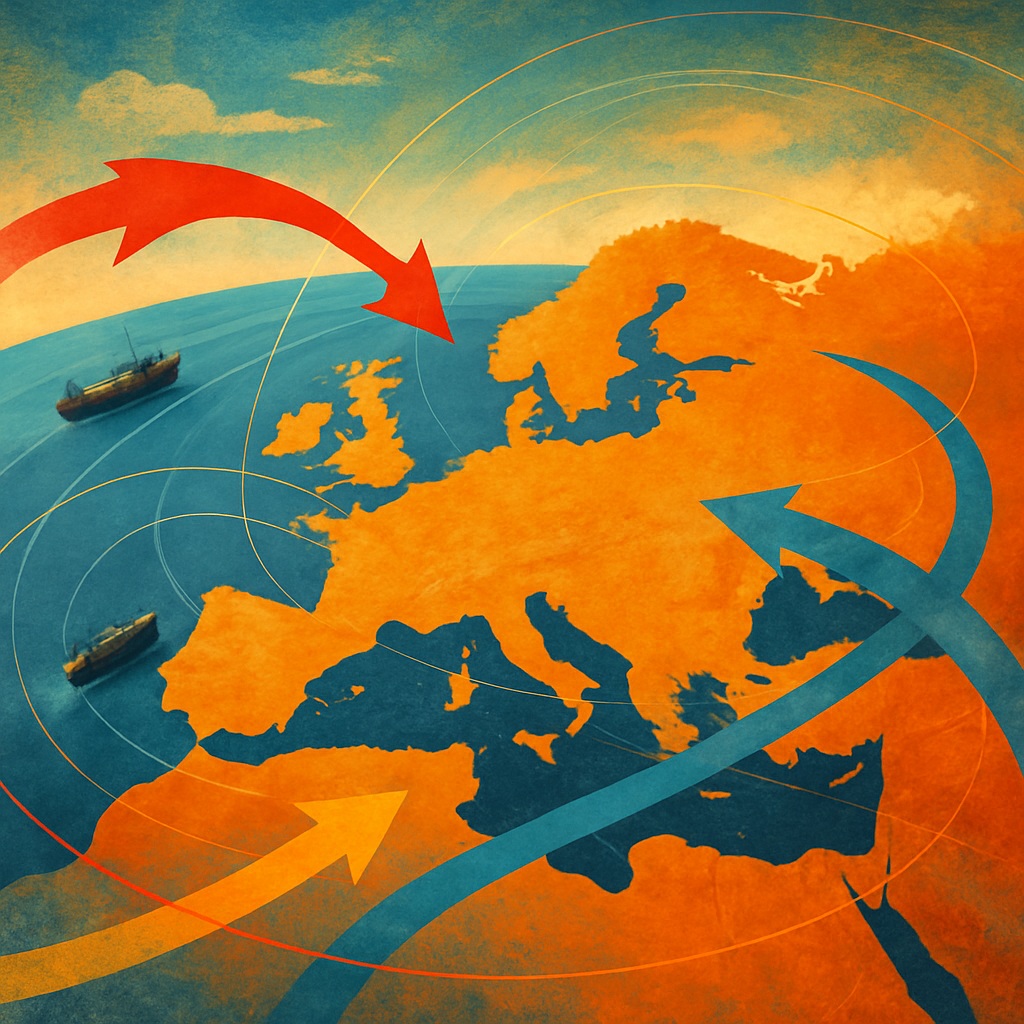
As global trade fragmentation deepens and geopolitical shifts accelerate, Brussels’ ambitions are outpaced and Europe finds itself on the back foot in the economic realignment of 2025.
Europe — once celebrated as a powerful trading bloc and global standard‑setter — is increasingly boxed in by geopolitical rivalries and trade wars that it neither initiated nor controls. The continent now stands at a crossroads, where its economic aspirations collide with a global environment defined by competition, disruption, and accelerated power shifts. As policymakers gather in Brussels this November, the gap between ambition and geopolitical reality has never been more evident.
For years, the European Union promoted “open strategic autonomy,” envisioning itself as a confident, outward‑looking power capable of influencing global standards and shaping trade flows. But today, the global trade order is fragmenting faster than the EU can adapt. Major economies are reinforcing protectionism, global supply chains are splintering into rival blocs, and strategic sectors — from semiconductors to green technologies — are becoming battlegrounds rather than cooperative ventures.
A growing number of analysts note that Europe’s position is weakening not because of a lack of vision, but because the world around it is changing more rapidly than its institutions can respond. Trade patterns that once evolved over decades now shift within months. Alliances once seen as stable are reconsidered. Policies designed for yesterday’s economic environment are proving insufficient for today’s strategic turbulence.
Trade Fragmentation Accelerates
The intensifying fragmentation of the global trade system is reshaping economic advantages worldwide. Key regions outside Europe have been quick to recalibrate, forging new supply chains and trade alliances that align with their geopolitical strategies. Europe, meanwhile, often finds itself responding to developments rather than directing them.
While Europe remains a major exporter of industrial goods, its traditional markets are becoming less predictable. The crisis‑driven rerouting of supply chains, the rise of bilateral trade deals outside EU influence, and escalating tariff rivalries have combined to erode the continent’s traditional strengths. The once‑reliable assumption that the single market’s size alone guarantees influence is increasingly challenged by agile economic blocs capable of moving faster and negotiating with fewer constraints.
Between Washington and Beijing
Europe’s relationship with the United States, long defined by cooperation, has entered a more uncertain phase. Tariffs, industrial subsidies, and sectors deemed security‑sensitive have created tensions that Europe struggles to navigate. While transatlantic ties remain structurally strong, Washington’s turn toward industrial competition has forced Brussels to consider more defensive tools — something the EU historically resisted.
China, meanwhile, continues to grow its influence across global supply chains. Its critical role in essential minerals, battery technologies, and intermediate goods creates both dependency and geopolitical vulnerability for Europe. European leaders face the complex task of derisking without decoupling, preserving economic engagement while ensuring security and resilience. This balancing act is increasingly difficult in a world that rewards decisiveness.
Ambition Bottlenecked by Institutional Complexity
The EU’s internal structure, while a strength in terms of democratic legitimacy, poses challenges in moments requiring swift strategic adjustment. Plans for technological leadership, industrial transformation, and green transition remain ambitious, but implementation is frequently slowed by regulatory debates, divergent national priorities, and funding constraints.
The “Brussels effect” — once shorthand for Europe’s ability to set global regulatory standards — remains influential but is no longer sufficient on its own to shape the emerging trade environment. Power today lies not just in rules, but in supply‑chain control, strategic partnerships, and economic agility. Europe risks discovering that influence built on regulation is limited unless matched by competitive industrial capacity.
Economic Consequences Becoming Clear
The symptoms of Europe’s shrinking influence are increasingly visible. Export growth is flattening. High‑tech sectors face competitiveness gaps. Energy‑intensive industries weigh relocation. Emerging markets, once stable destinations for European goods, are pivoting toward alternative suppliers offering lower costs or geopolitical alignment. Meanwhile, global investment flows are shifting toward regions perceived as more dynamic or predictable.
These developments do not suggest collapse, but they do signal that Europe is entering a phase of relative decline within a world that rewards speed and scale. The EU’s challenge is not simply to defend what it has, but to reinvent how it positions itself in global trade.
What Europe Must Do Next
Experts broadly agree that Europe’s future economic influence hinges on several urgent priorities:
- Greater trade diversification beyond its historical partners, with deeper ties to emerging markets in Africa, South Asia, and Latin America.
- Acceleration of internal reforms to strengthen the single market, reduce bureaucratic lag, and boost investment in strategic industries.
- A more assertive trade policy, capable of defending European interests without sacrificing multilateral principles.
- A realistic industrial strategy that builds capacities in key technologies while ensuring long‑term competitiveness.
- A renewed diplomatic push to ensure Europe remains a central player in shaping global trade norms.
The Bottom Line
As Europe confronts a world reshaped by rivalry, fragmentation, and uncertainty, its long‑standing assumptions about economic influence no longer hold. The continent does not lack resources or vision, but rather the agility required in a geopolitical era defined by rapid shifts. This November, as leaders reflect on Europe’s place in the global economy, one truth stands out: unless the EU adapts quickly, its ambitions may remain outpaced by the speed of global change.
Europe is not fading — but unless it moves decisively, it risks being overtaken by others who are.
 The Tower Post