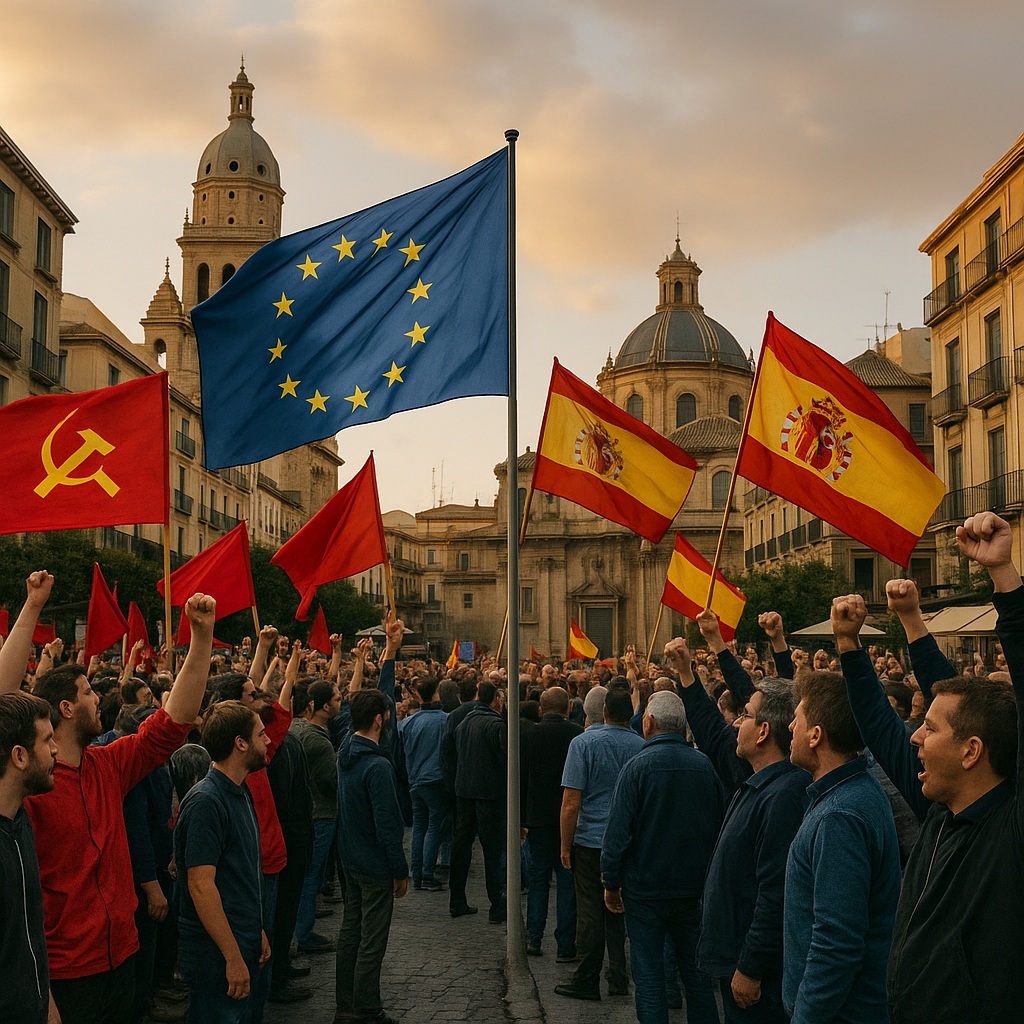
A trend story from Spain’s Murcia region signals a broader weakening of centrist politics across Europe
In the sun-scorched towns of Spain’s Murcia region, a political tremor has begun to reverberate across Europe. What once stood as a bastion of pragmatic centrism is now transforming into a battleground of increasingly radical alternatives. Conversations in markets, cafés, and agricultural cooperatives reveal a widening rift—one that mirrors similar fractures emerging from the Netherlands to Italy, from France to Germany. Europe’s middle ground, long the continent’s stabilising force, is starting to erode.
Analysts point to Murcia’s shifting political mood as a microcosm of a continental trend. Voters who once backed mainstream centre-left or centre-right parties have drifted toward the fringes, driven by frustrations over stagnant wages, migration pressures, climate-policy impacts on agriculture, and a sense of cultural dislocation. The region’s farmers, hit hard by droughts and rising production costs, have become a lightning rod for populist rhetoric promising protection, subsidies, and resistance to Brussels-driven environmental rules.
Across Europe, similar patterns are emerging. In cities and rural heartlands alike, the electorate is splintering into incompatible visions of the future. Far-right parties push for migration crackdowns and national sovereignty; far-left movements call for sweeping economic transformations and wealth redistribution. Between them lies a shrinking centre struggling to articulate a compelling narrative of stability and shared purpose.
Murcia’s political realignment has come with unmistakable symbolism. Once-steady support for traditional parties has thinned, replaced by surging backing for movements that challenge Spain’s consensus-driven norms. Local leaders report that long-time centrist voters express fatigue with compromise politics, arguing that incremental solutions no longer meet the urgency of their concerns. What was once an outlier region is now the blueprint for Europe’s accelerating polarisation.
Political scientists warn that the centre’s weakening risks long-term instability. Europe’s post-crisis decades—marked by economic downturns, migration waves, and geopolitical shocks—have left many citizens sceptical of establishment promises. Younger voters, particularly in areas with limited job prospects, are turning toward ideological certainty rather than moderation, while older generations feel alienated by rapid social change and global competition.
Yet the story is not uniformly bleak. In some pockets of Europe, including parts of Scandinavia and the Iberian Peninsula, centrist coalitions remain resilient. But even there, the gravitational pull of the extremes forces mainstream parties to adopt sharper rhetoric, stricter migration proposals, or more aggressive economic pledges. The political centre may still hold, but it is being reshaped under pressure.
In Murcia, the transformation is visible not only in voting booths but in social attitudes. Local associations that once served as bridges between communities now struggle to mediate increasingly bitter debates. Public forums have grown more confrontational, and online discourse reflects a broader mistrust of institutions. The region’s experience highlights a key challenge: when political identities harden, the shared space for negotiation narrows, making governance more difficult.
Europe now stands at a crossroads. As countries prepare for upcoming electoral cycles, the question is not simply which party will win, but whether the centre can reassert itself as a meaningful force. The uncertainty in places like Murcia resonates across the continent: voters are searching for alternatives that feel bold, decisive, and transformative. Unless centrists can reinvent their message, the landscape may continue to fracture.
For now, the quiet fields and coastal towns of Spain’s southeast offer a preview of a continental shift. The centre is not collapsing overnight—but it is undeniably cracking. And from those cracks, new political currents are flowing, reshaping Europe’s future in ways that are only beginning to emerge.


 The Tower Post