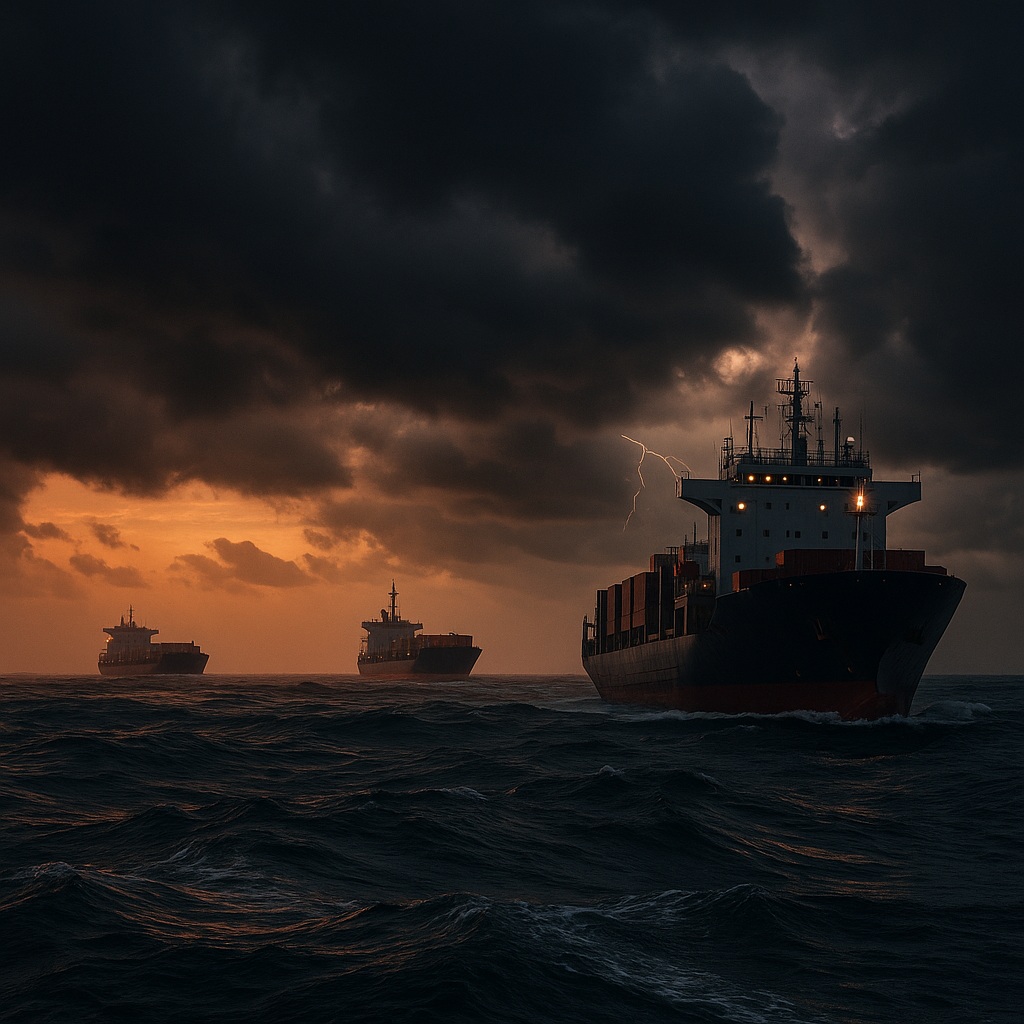
As global supply-storms, geostrategic realignment and shifting trade flows converge, Europe braces for turbulence.
As Europe moves through the closing weeks of the year, the economic skies over the continent are anything but calm; the region finds itself caught in gale-force trade winds driven by geopolitics, supply-chain reshuffles and rapid shifts in global commerce that are challenging everything from industrial output to export dependency, reshaping Europe’s growth horizon and leaving policymakers and businesses searching for a new compass.
A vortex of geopolitical turbulence has replaced the once-predictable breezes of globalisation, as the long era when goods, capital and labour moved smoothly across borders gives way to abrupt disruptions, with Europe’s economy increasingly exposed to strategic tensions ranging from rivalry between major powers to regional trade spats and the return of supply-chain risk as a primary concern for boardrooms and ministries alike.
The continent’s export-oriented manufacturing model is under strain as firms that once relied on stable flows of components and tariff-free access to global markets now face a rapidly changing landscape in which trade routes that were reliable are being recalibrated, forcing Europe to manoeuvre through pressured corridors where logistics, insurance and political risk must be weighed as carefully as price and quality.
In industrial heartlands from southern Germany to northern Italy, automotive, machine-tool and chemical producers report longer lead-times for key inputs, shifting sourcing strategies and growing uncertainty over demand from outside Europe, with some companies beginning to localise supply chains in ways that may offer resilience over time but that, in the near term, add cost, complexity and strategic hesitation.
Moreover, European exporters face intensifying competition as economies in Asia, the Middle East and Africa reorganise their supply chains and deepen regional ties, leaving Europe squeezed both as supplier and as market, while new trade corridors emerge, old habits fade and revenue pressure, margin erosion and a softer near-term outlook become recurring themes in corporate guidance.
New trade alignments and strategic hedging are reshaping the geography of commerce, with Europe no longer simply the end-market for global supply chains but also a transit point and a pivot between rival blocs, as middle-eastern hubs, African gateways and eastern transport corridors gain relevance and compel the continent to adapt to being one node in a broader network rather than the undisputed centre.
At the same time, trade policy is evolving into a more explicit instrument of grand strategy, as tariff threats, export controls, subsidies, carbon border measures and counter-moves resurface across major power blocs, creating an economic environment that is less transparent and forcing European business leaders to factor geopolitical risk and regulatory uncertainty into decisions that were once governed mainly by cost, efficiency and market potential.
For European economies, the twin demands of resilience and competitiveness are rising in tandem, as firms and governments seek to shield themselves from shocks by diversifying suppliers, near-shoring production and building buffer capacity, even as they struggle to maintain cost-competitiveness in global markets where rivals often benefit from cheaper energy, lighter regulation or more targeted state support.
Resilience, however, comes at a price, since reconfiguring global value chains, investing in new infrastructure, accelerating the energy transition and retraining workforces are long-term projects that require capital and political stamina at a moment when cost structures in many European countries remain elevated, raising the risk that the drag from weaker exports or disrupted inputs becomes more visible in corporate earnings and employment figures.
The political dimension is becoming increasingly pronounced as economic turbulence filters into domestic debates, with citizens questioning the promise of global integration when jobs feel insecure, prices are volatile and trade flows seem opaque, and with governments facing pressure to prove that their mix of trade agreements, industrial policies and green subsidies can deliver not just abstract competitiveness but tangible security and opportunity.
This creates a delicate balancing act in which locking down trade too tightly risks stifling innovation and growth, while leaving the system to operate on yesterday’s assumptions threatens to expose economies to the next wave of disruption, and across the continent there is a palpable mood of unease as voters, workers and executives sense that the winds are picking up but remain uncertain who will steer and who will merely be buffeted.
Navigating the road ahead will require a different playbook, and executives increasingly talk about the need for sharper supply-chain visibility, more diversified trade relationships, nimble policy adaptation, disciplined cost-structure reviews and clearer communication about risk so that investors, employees and customers understand both the opportunities and the vulnerabilities that define this new trading environment.
In practice, that means investing in technologies that track shipments and suppliers in real time, exploring alternative markets where European brands still command trust, urging policymakers to cut red tape while accelerating infrastructure upgrades, and building internal cultures that are comfortable with scenario planning and contingency strategies rather than relying on a single forecast or a single set of assumptions.
As Europe sails deeper into these one-hundred-mile-per-hour trade winds, it is increasingly clear that the old era of steady tailwinds may be over and that the continent has entered a phase of strategic adjustment not just to economic cycles but to tectonic shifts in how trade itself is organised, financed and governed, with implications that stretch from factory floors to foreign ministries.
For companies and governments that recognise the scale of this shift early, adapt quickly and invest in genuine resilience, the present turbulence could still become a period of opportunity marked by stronger global positioning, deeper partnerships and more sustainable industrial footprints, but those that cling to outdated assumptions or delay hard choices may find that the storm quietly redraws the map around them.
On this mid-November horizon, Europe’s economy is sailing in demanding seas, with winds that are fast, currents that are volatile and a forecast in which smooth sailing is no longer guaranteed, and the outcome will hinge on how nimbly the continent can adjust its course while the storm is already under way rather than waiting for the skies to clear.

 The Tower Post