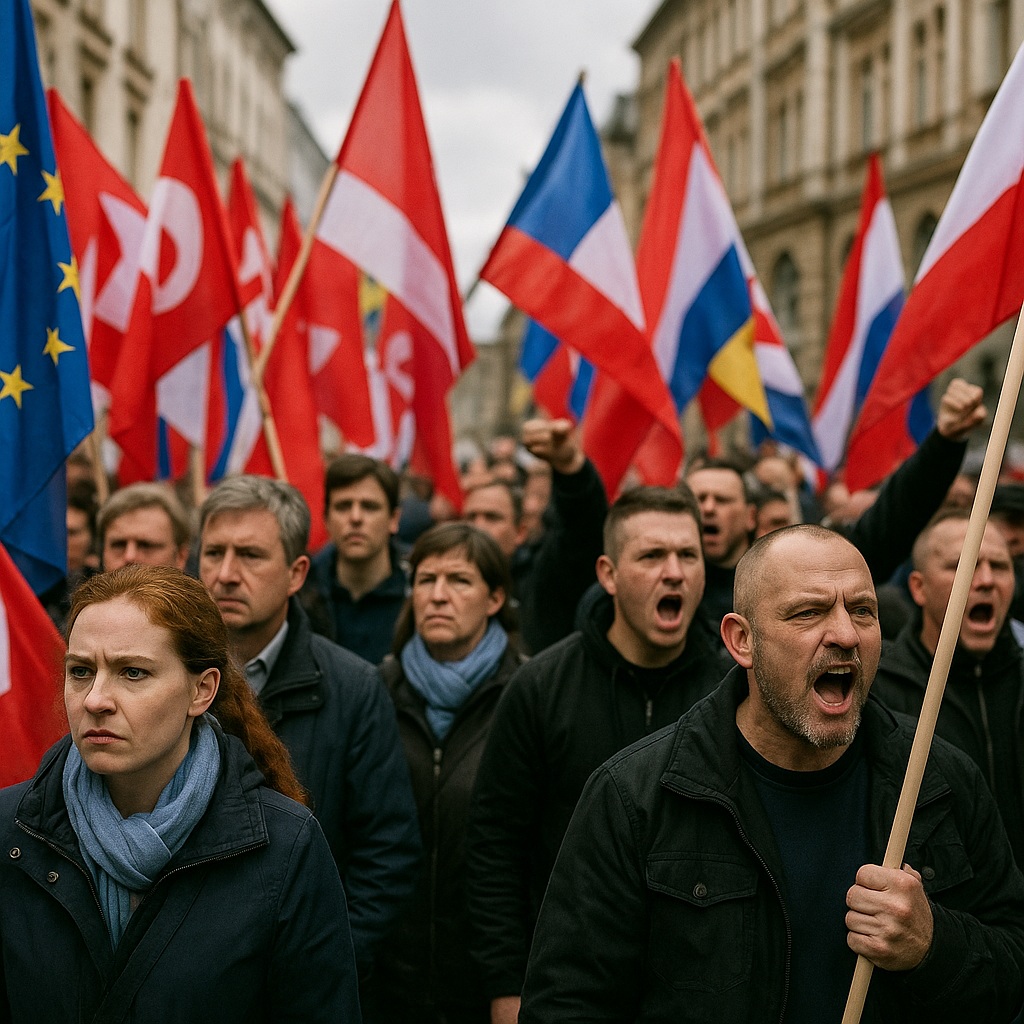
As polarisation deepens across the continent, traditional centrist parties struggle to hold their ground against resurgent far-right movements.
Across Europe, the political landscape is undergoing a profound shift. Once anchored by sturdy centre-left and centre-right parties, the continent’s politics are now drifting toward the ideological extremes. The once-reliable centre is showing deep fractures, exposing a political vacuum that far-right movements are increasingly eager—and able—to fill.
From parliaments to street-level activism, the rise of the far right is no longer a fringe phenomenon. It is reshaping national debates, redefining coalitions, and forcing mainstream parties to recalibrate their strategies. Political scientists argue that this transformation has been years in the making, driven by cultural anxieties, economic uncertainty, and an erosion of trust in established institutions. But only recently has the shift become unmistakable.
Observers across European capitals describe a public mood marked by unease. Voters who once aligned comfortably with centrist parties now express disillusionment with what they see as stagnation, lack of vision, and an inability to address concerns around migration, identity, and security. As the centre struggles to articulate a unifying narrative, the far right has stepped into the spotlight with simplified messaging, direct language, and promises of national renewal.
In several countries, traditional coalition formulas have begun to falter. Centrist parties that once commanded majorities now face fractured parliaments and unpredictable alliances. Analysts warn that this instability could make governance more difficult, increasing the risk of political gridlock at moments when Europe faces pressing challenges—from climate adaptation to technological competition and geopolitical tension.
Some within the political centre argue that their struggle stems less from ideological weakness and more from a changing media ecosystem. Rapid-fire news cycles and polarising digital platforms have amplified more extreme voices, placing centrist messages at a disadvantage. Others contend that the centre must adapt by offering bolder solutions, rather than incremental reforms that feel outdated in a rapidly evolving world.
Across the continent, far-right movements have seized on this turbulence. Their leaders present themselves as defenders of cultural identity and national sovereignty, promising to challenge what they portray as remote bureaucracies and detached elites. Their rise has been accompanied by sophisticated communication strategies that resonate strongly with voters who feel overlooked or alienated by traditional parties.
Yet the shift is not uniform. In some regions, centrist leaders have mounted successful pushbacks, rallying broad coalitions and reframing public debates. Political historians note that Europe’s political evolution has often followed cyclical patterns, with periods of polarisation eventually giving way to renewed stability. However, they caution that the current moment differs in scale and intensity, with socio-economic pressures and external geopolitical forces adding new layers of complexity.
As Europe moves through this period of political realignment, questions loom about the future of its democratic institutions. Will centrist parties reinvent themselves to regain public trust? Can the far right translate electoral momentum into sustainable governance? And how will increasingly polarised electorates shape the decisions of leaders navigating an unpredictable political climate?
For now, one reality is clear: the centre is no longer holding as firmly as it once did. In its place, a more fragmented—and volatile—political landscape is emerging, one that reflects the deep social and cultural crosscurrents sweeping the continent. On this November day, Europe finds itself at a crossroads, with choices ahead that may define its political trajectory for years to come.



 The Tower Post