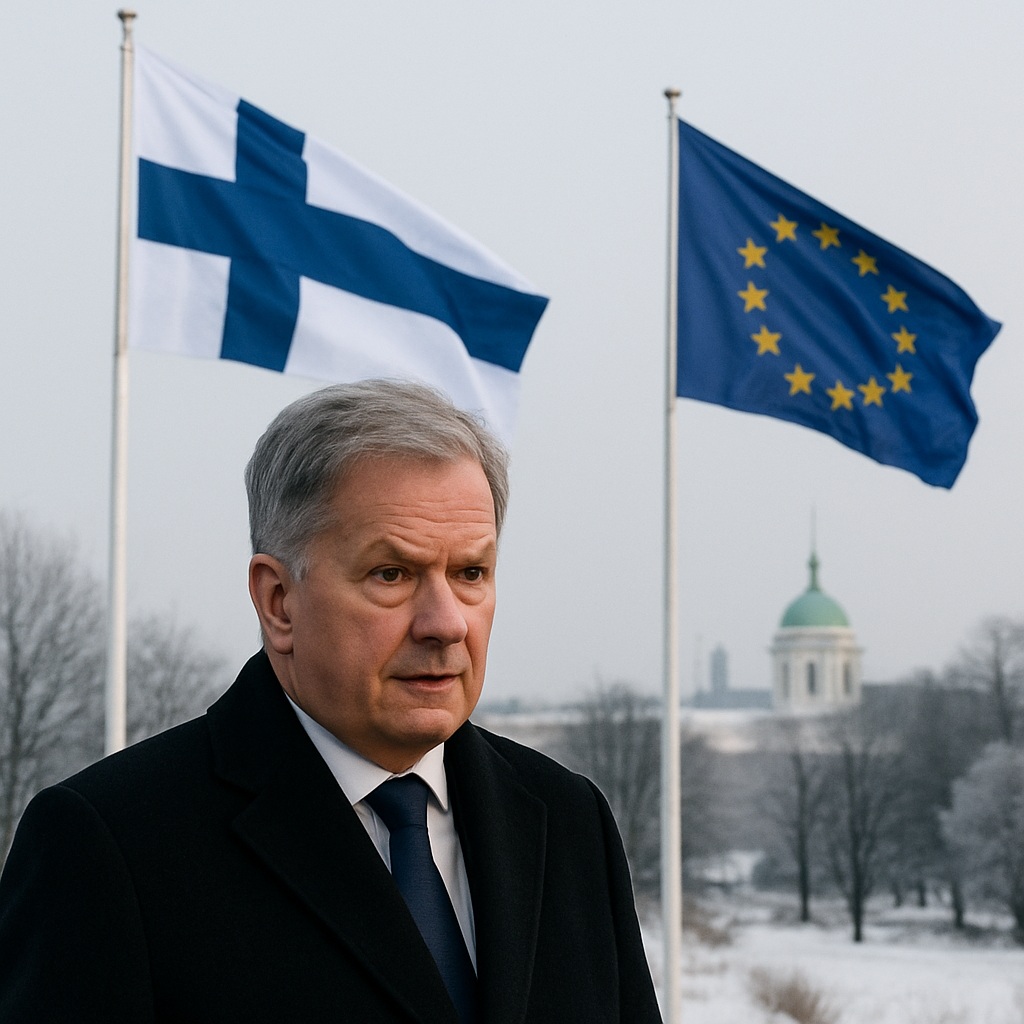
President Sauli Niinistö warns that a negotiated end to the conflict in Ukraine is not imminent and calls on European allies to maintain support despite pressure at home.
With winter setting in across northern Europe, Finland’s President Sauli Niinistö delivered a pointed message to the continent’s political elite: the war in Ukraine is far from over, and now is not the time for wavering resolve. In a speech and subsequent interviews this week, Niinistö asserted that a cease‑fire is unlikely before spring and that European states must hold firm in their backing of Ukraine—even in the face of domestic distractions and scandal.
War, Winter and Resolve
Speaking from Helsinki, Niinistö drew upon Finland’s historical experience of standing firm in the face of its eastern neighbour to emphasise Europe’s need for endurance. While he stopped short of predicting an exact date, his assessment was clear: the fighting will persist through the colder months, and diplomatic relief is unlikely until conditions improve on the battlefield.
In his remarks, Niinistö said that much of the onus now falls on European governments to maintain cohesion, sustain military and financial support for Kyiv, and resist the fatigue that so easily sets in when wars drag on. He warned that Russia—far from wanting a quick deal—is likely content to let the war grind, aiming to wear down Western cohesion rather than seek compromise.
A Call to Europe’s Backbone
Niinistö’s appeal to “holding the nerve” comes at a sensitive time. Across Europe, leaders are under pressure at home: economic strains, domestic political scandals, energy concerns and war‑weariness. In Finland itself, discussions over national defence and budget priorities have grown sharper, while in many EU capitals the question of how long to sustain Ukraine’s support is increasingly being asked.
The Finnish president made clear that wavering now could have far‑reaching consequences. If Europe were to scale back its support prematurely, he argued, Russia would interpret the signal as a victory of attrition—not a negotiated settlement. That, he warned, could reshape the security architecture of the continent for years to come.
Why Spring, Not Sooner?
Behind the caution is a sober reading of the conflict on the ground: Ukraine’s counter‑offensive capabilities remain constrained, Russian forces continue to hold key positions, and winter conditions will hamper both military operations and humanitarian outreach. Moreover, the delicate issues of post‑war reconstruction, territorial claims and security guarantees remain unresolved and highly complex.
Niinistö cautioned that genuine peace talks require Ukraine to be in a position of strength. That means more than arms and ammunition—it means rebuilding infrastructure, ensuring political stability, and maintaining credible deterrence. Until such a balance is achieved, he suggested, any formal cease‑fire would carry too many risks for Kyiv and its backers.
Domestic Scandals and External Consequences
Niinistö did not shy away from acknowledging that Ukraine’s internal governance scandals—particularly those involving allegations of corruption—are a liability for European partners. He urged Western capitals not to allow these issues to be weaponised by Russia or to become an excuse for withdrawal. “The internal challenges are real,” he said, “but abandoning Ukraine now would hand the initiative to Moscow.”
In Finland, his message hits home: as a country with a long border with Russia and a recently reaffirmed place in the trans‑Atlantic alliance, Finland’s foreign policy stance carries weight far beyond its size. Niinistö’s warning is as much about Finland’s own security perspective as it is about European unity.
The Bigger Picture: What’s at Stake
For Europe, this is more than a moral commitment. It is a strategic pivot: either the continent underwrites a rules‑based order in which aggression is deterred, or it concedes that major power wars can be fought on its doorstep with limited opposition. Niinistö argued that the latter outcome would embolden not just Moscow but other revisionist actors observing how the West responds.
In addition, Europe faces an intertwined set of challenges—energy security, defence investment, supply‑chain resilience, and hybrid threats such as disinformation campaigns. The war in Ukraine has become a catalyst for these weaknesses, and Niinistö emphasized that retreating now would risk losing the momentum built on collective defence reforms.
What Comes Next
In the coming months, European capitals will know that they face a protracted scenario. Niinistö’s message suggests that:
- Support for Ukraine must continue unbroken through the winter, even in the absence of visible breakthroughs.
- Mechanisms for rebuilding and stabilising Ukraine must be developed in parallel with frontline support.
- European defence cooperation and investment must remain priorities.
- Political leadership and strong public communication will be vital.
Final Word
On the eve of a cold European winter, President Niinistö’s warning carries weight: wars do not pause with the falling leaves, and cease‑fires do not always coincide with expectations. His call to Europe is direct: “Do not look for relief yet. Consolidate your support. Hold your nerve.”


 The Tower Post