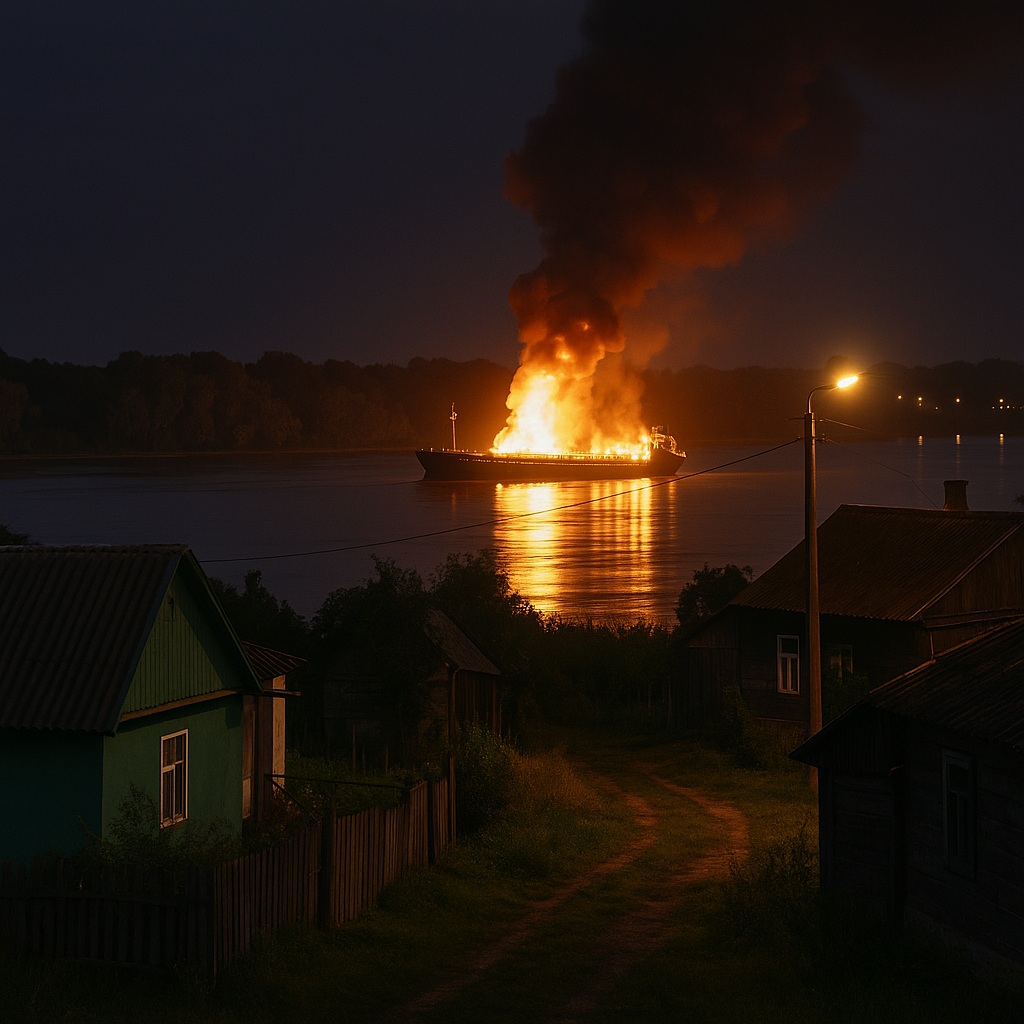
Spill-over of Russian assault prompts precautionary evacuations in NATO’s eastern flank
Romania has found itself once again at the uneasy edge of a conflict occurring just across the water. In the latest escalation of tension along NATO’s eastern frontier, Romanian authorities evacuated several Danube-border villages after a drone-launched strike ignited a liquefied petroleum gas (LPG) tanker moored on the Ukrainian side of the river. The attack—attributed to forces aligned with Vladimir Putin—has revived regional anxieties over the slow but steady creep of the war’s hazards into neighboring territories.
Officials described the strike as a “provocatory action,” carried out against a Turkish-flagged tanker that was off-loading fuel at a Ukrainian port across from Romanian soil. The attack produced a towering column of fire that lit up the river delta and raised immediate fears of a secondary explosion large enough to affect Romanian homes just across the waterway. In response, authorities initiated rapid evacuations of nearby rural communities as a protective measure, moving residents and even farm animals to temporary shelter sites farther inland.
A Borderline Emergency
Residents who fled described a sudden, disorienting scramble. Some were already accustomed to hearing distant thuds from the Ukrainian side of the frontier, but few expected to see flames reflecting off their own windows or to receive alarms instructing them to abandon their homes at short notice. Emergency vehicles drove through the villages, urging families to leave before the situation potentially escalated.
Many recounted seeing the burning silhouette of the tanker from their gardens or from the banks of the Danube. “The heat felt unnatural, even from here,” one evacuee said, recalling the glow that cast long shadows through the unpaved lanes. “We didn’t know if there would be an explosion or debris flying in our direction.”
NATO’s Quiet Calculations
Though Romanian territory was not struck directly, analysts say the incident underscores the precarious balance NATO must maintain while monitoring Russia’s increasingly erratic targeting patterns. A strike so close to a NATO border is, in the words of one European diplomat, “an invitation to misinterpretation.” Any misfire or unintended incursion onto Romanian soil could trigger a collective security debate with potentially far-reaching consequences.
Romania has frequently coordinated with alliance partners on airspace surveillance, drone-tracking, and maritime risk assessments since the conflict intensified. While officials refrained from calling this attack a deliberate test of NATO’s boundaries, they acknowledged that the strike’s location made it impossible to ignore implications for the alliance’s eastern posture.
The Human Dimension
In the chaos following the strike, humanitarian organizations and local councils mobilized to assist evacuees. Many residents spent the night in makeshift shelters, gyms, or with relatives farther inland. Although some evacuees have since returned, others remain in limbo while safety inspections continue.
Farmers expressed concern over disrupted livestock care and potential long-term environmental impacts. Though no contamination has been detected on the Romanian side, agricultural advisors are monitoring water and soil conditions to ensure safety for crops and animals.
A New Era of Regional Preparedness
The incident has prompted Romanian authorities to reevaluate the readiness of local emergency systems. Plans are underway to expand early-warning networks in rural settlements, bolster cross-border communication with Ukrainian responders, and refine protocols for rapid evacuations.
Looking Forward
For the residents along Romania’s river frontier, life is slowly returning to an uneasy normal. Children are back in school; boats move along the Danube once again; and fishermen, though cautious, have resumed their routines. Yet the sense of security once associated with this quiet rural stretch is undeniably altered.
The fire that consumed the tanker may now be extinguished, but its reflection in the river has left a lasting mark on the people who saw it. As the war in Ukraine shifts and evolves, border communities like these will continue living in a space where international politics and daily life overlap—sometimes violently, always unpredictably.



 The Tower Post