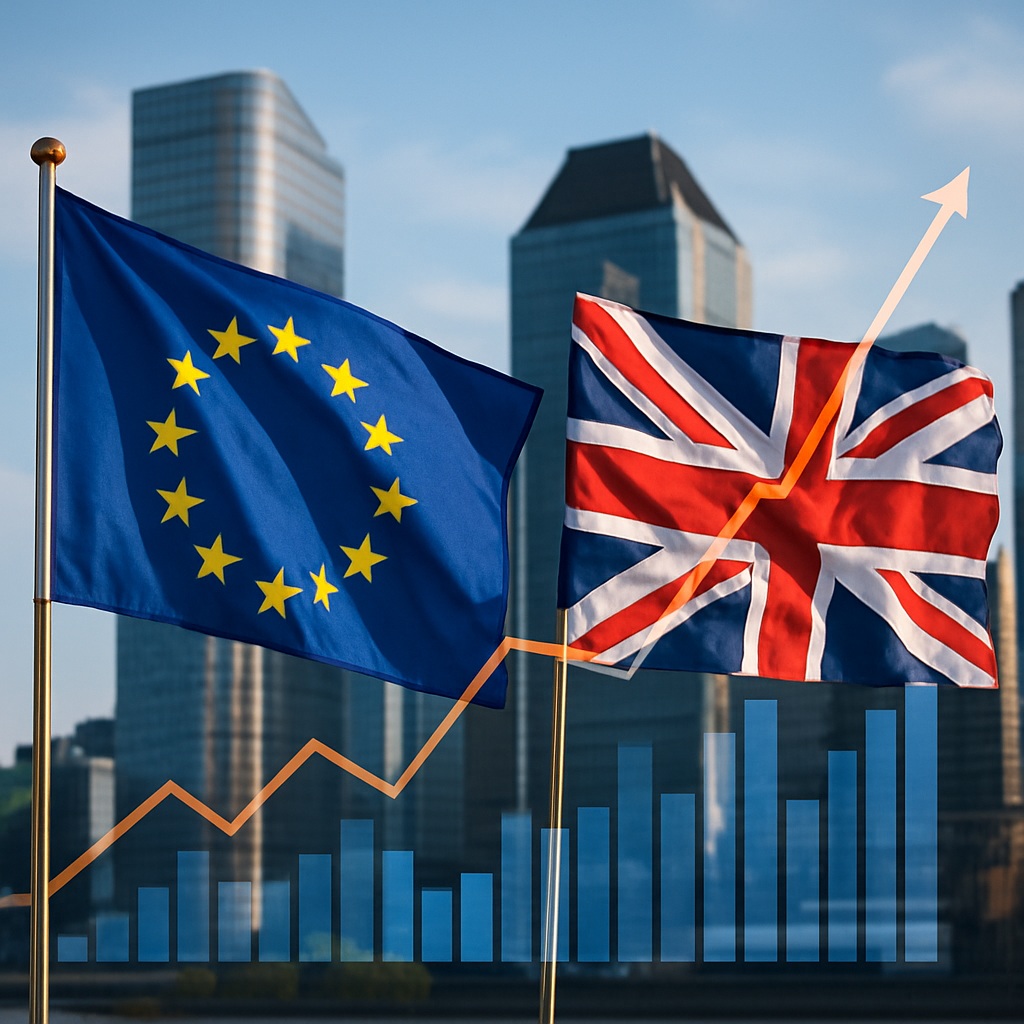
Analysts See Europe Gaining Momentum as Post‑Brexit Divergence Deepens
As November 2025 draws to a close, economic analysts across Europe are increasingly convinced that the European Union is set to grow at a faster pace than the United Kingdom in the coming year. The shift—subtle in past forecasts but now becoming unmistakable—highlights how the two economies have continued to diverge nearly a decade after the Brexit referendum.
In Brussels, policymakers describe a cautiously optimistic climate. While growth remains uneven across member states, the bloc’s coordinated investment initiatives, strengthened industrial policies, and improvements in cross-border energy infrastructure are beginning to bear fruit. Economists say these developments are creating a more resilient foundation for continental recovery, particularly as global supply chains stabilise after years of disruption.
In contrast, the UK economy is facing headwinds that analysts warn could persist well into 2026. Businesses continue to grapple with labour shortages, elevated import costs, and weaker investor confidence. Although government officials in London point to recent policy adjustments aimed at revitalising key sectors, industry leaders argue that the lingering effects of trade friction are constraining growth at a crucial moment.
For European officials, the projected acceleration in growth is being celebrated as evidence that the EU’s long-term strategy is working. Investments in digital transformation, green technology, and unified fiscal support mechanisms have collectively strengthened the bloc’s competitiveness. These factors, combined with robust consumer spending in several major economies, have led analysts to predict a broader and more sustained expansion across the continent.
In the UK, however, the outlook is more uncertain. Economists note that despite recent efforts to encourage innovation and streamline regulatory processes, the pace of recovery remains uneven. The services sector—traditionally a cornerstone of British economic strength—has shown signs of strain, and manufacturers continue to report difficulties adjusting to evolving trade requirements.
What makes the current divergence particularly significant, analysts say, is the growing contrast in investor sentiment. While European markets have experienced renewed confidence, the UK has seen a more cautious approach from global investors who appear to be waiting for stronger signals of long-term stability.
Still, experts emphasise that the economic story of 2026 is far from predetermined. Both regions face global pressures, from fluctuating energy prices to political uncertainty in key trading partners. Yet, as things stand, the momentum appears to be shifting firmly toward the European Union.
For many, the emerging gap between the two economies underscores a broader narrative: the long-term consequences of political choices made years earlier. As analysts prepare their final outlooks for the coming year, the expectation is clear—the EU’s economy is on track to outpace that of the UK, marking a pivotal moment in Europe’s post-Brexit trajectory.



 The Tower Post