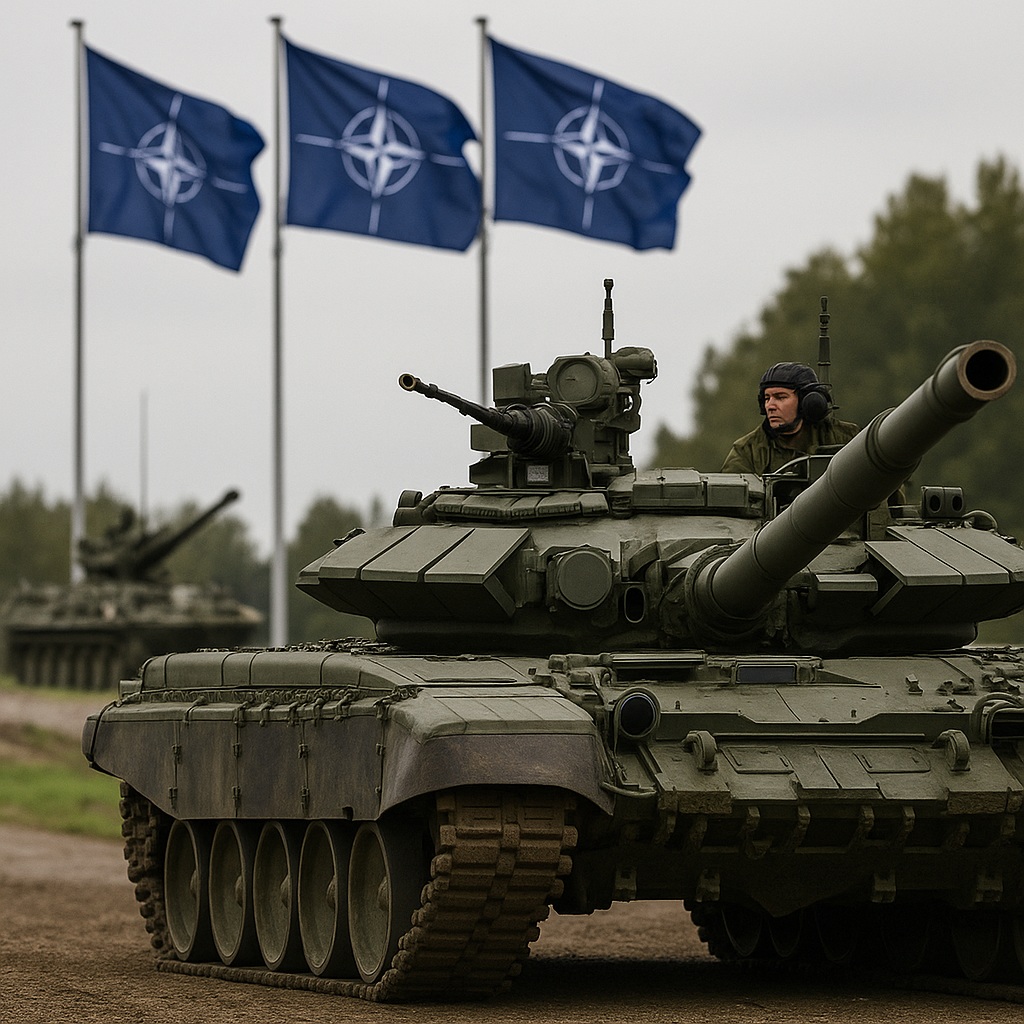
Why Russia’s War With NATO Would Move Far Faster Than the Conflict in Ukraine
As European capitals quietly reassess their defence postures, a growing chorus of analysts now warns that a direct confrontation between Russia and NATO would unfold at a strikingly faster pace than Moscow’s grinding campaign in Ukraine. The reason, they argue, lies not only in the nature of the adversaries involved, but in the structure of Russia’s war-fighting machine, which has evolved under the pressures of protracted conflict and international isolation.
Unlike Ukraine—whose early resistance relied heavily on local territorial defence units, ad‑hoc logistics, and urgent foreign supply—NATO represents a fully integrated military bloc with long‑standing command architecture, established deployment corridors, and an extensive, unified intelligence backbone. The presence of these systems on day one of any escalation would drastically alter Russian strategic calculations. Moscow would have neither the time nor the permissive space it initially exploited in Ukraine. Instead, analysts note, Russia would likely begin with rapid, high‑intensity strikes aimed at overwhelming NATO early and fragmenting the Alliance’s response cycle.
What gives this scenario particular urgency is Russia’s demonstrated capacity for fast operational adaptation. Over the course of its campaign in Ukraine, Russia transitioned from an overextended assault to a more methodical, artillery‑driven approach supported by layered air defences, electronic warfare, and a dramatically expanded domestic arms industry. In a conflict involving NATO, Russia would not need months to restructure its military posture; much of the machinery for fast escalation already exists. Missile production has accelerated, drone assembly lines have proliferated, and the security apparatus has consolidated political authority in anticipation of potential wider confrontation.
European defence officials also stress that geography would accelerate Russian tempo. While Ukraine offered depth—allowing for defensive fallback lines and tactical regrouping—much of Eastern Europe presents shorter distances between borders, cities, and strategic assets. This compression raises the risks of rapid breakthroughs or early disruption to critical infrastructure. NATO would be capable of far stronger retaliation, but the window to absorb the first blows and coordinate a response would be narrower than expected.
Another factor is Russia’s doctrine itself, which increasingly emphasises creating operational shock to keep adversaries off‑balance. In Ukraine, Russia faced the challenge of mobilising a vast campaign against a country determined to defend every metre of territory. But against NATO, whose reaction would be coordinated across multiple fronts, Moscow might aim to strike hard and fast to present the Alliance with simultaneous crises. This could include cyber operations, targeted disruptions of logistics hubs, and early missile salvos intended to neutralise NATO’s forward‑deployed assets before they can be reinforced.
However, the speed of such a confrontation does not imply Russian strategic advantage. While Russia could initiate rapid escalation, NATO retains overwhelming cumulative strength once mobilised. The challenge, then, is timing. Defence planners warn that Europe must be prepared not for a slow‑building conflict resembling the first months of fighting in Ukraine, but for a scenario where hours and days matter more than weeks. Air‑defence integration, stockpiled precision munitions, and pre‑positioned forces are increasingly seen not as long‑term luxury items, but as urgent necessities.
There is also the political dimension. In Ukraine, Russia has leveraged periods of stalemate to regroup, negotiate temporary relief, or adapt industrial output. But in a direct conflict with NATO, the Kremlin would face immediate international isolation and confrontation with an alliance whose political coordination—when perceiving existential threat—tends to accelerate dramatically. NATO’s capacity for rapid alignment, often underestimated, could compress decision‑making cycles and deny Moscow the slower rhythms it once exploited.
By November 2025, these debates have intensified across Europe. Military analysts repeatedly caution policymakers that strategic speed—not just military mass—will define the early phase of any Russia‑NATO clash. The lesson from Ukraine is not that Russia is slow, they argue, but that Russia was constrained by a specific adversary and misjudged the political and operational landscape. In a conflict against NATO, those misjudgements would not be repeated.
The core message emerging from defence institutes, war‑gaming centres, and intelligence briefings is clear: Europe must prepare for a conflict that would move with unprecedented rapidity. Russia has spent years recalibrating its war‑fighting posture. NATO, they warn, cannot afford to assume that the tempo of Ukraine is the tempo of tomorrow. The stakes—and the speed—would be far greater.

 The Tower Post