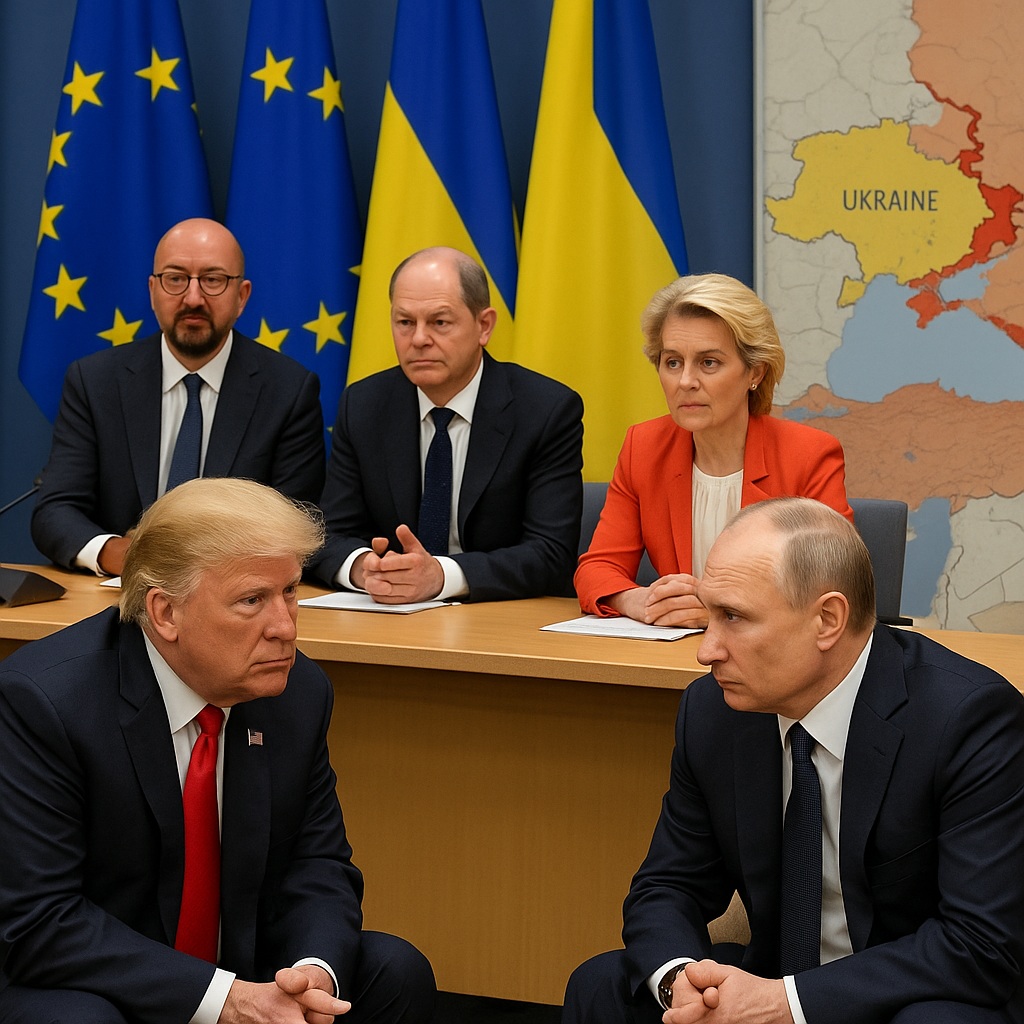
Key European capitals push back as a Trump-brokered roadmap could let Moscow set terms without full EU involvement
In a wave of diplomatic unease sweeping through Europe, top officials from across the European Union are voicing sharp concerns over a proposed peace framework for Ukraine that the Donald Trump administration has developed in concert with Russia — a plan many fear sidelines Europe’s voice at a crucial moment in the conflict.
The draft concept, described by multiple diplomats familiar with the discussions, would place significant conditions on Ukraine’s sovereignty, including territorial concessions in the east and strict limitations on its military posture. Even more troubling for Brussels is that the framework appears to have been shaped primarily through U.S.–Russia channels, bypassing the EU despite its central role in supporting Ukraine politically, militarily and economically since the full-scale invasion began.
EU officials have long insisted on a principle that nothing concerning Ukraine’s future should be negotiated without Ukraine — and without Europe. That principle is now under strain. Several senior European diplomats said the exclusion of major EU capitals from preliminary talks represents not only a procedural failure but a strategic one, potentially embedding Russian preferences in the very architecture of any settlement.
From Berlin and Paris to Warsaw and Tallinn, leaders are openly questioning why Europe, which has borne much of the war’s humanitarian and economic fallout, has been cast as an observer rather than a co-architect of peace. A senior French official described the dynamic bluntly: “A deal reached above our heads is a deal that cannot hold.”
German officials voiced similar concerns, warning that any agreement that appears imposed — or one that forces Ukraine into concessions it rejects — risks unraveling the moment it is signed. Those critics point to Europe’s decades-long experience managing security crises on the continent and maintaining sanctions regimes, arguing that without EU participation, enforcement mechanisms will be weak or nonexistent.
The unease intensified as fragments of the plan became public. According to diplomats, the proposal could press Kyiv to agree to a demilitarized corridor along existing front lines and to defer, indefinitely, its aspirations for NATO membership. Supporters of the framework in Washington reportedly view these concessions as necessary to “break the stalemate” and to provide President Trump with a high-profile diplomatic achievement.
European capitals, however, fear the plan tilts too far toward Moscow’s long-stated objectives: limiting Ukraine’s military independence, codifying Russian control over occupied territories, and keeping Kyiv outside Western security structures. For EU states bordering Russia, particularly those in the Baltic region, the implications would be profound. These governments argue that if Russia is rewarded for its aggression, the credibility of Europe’s security guarantees may erode.
Ukraine, for its part, has expressed alarm over the contours of the emerging framework. Officials in Kyiv insist any settlement that undermines territorial integrity or weakens national defense capabilities would jeopardize the country’s long-term survival. European officials broadly agree — and many have privately criticized Washington for pushing Kyiv too aggressively toward compromise.
At stake is not only the shape of peace in Ukraine but also Europe’s role in the global diplomatic order. The EU has spent the past several years asserting the need for “strategic autonomy,” yet its sidelining in these talks has exposed persistent vulnerabilities. Some diplomats argue the situation illustrates how quickly Europe can be outmaneuvered when major powers operate bilaterally.
Still, Brussels is moving to reassert itself. The European Commission and the European External Action Service have begun drafting proposals for alternative negotiation formats that would embed the EU more deeply into any future talks. Officials are also coordinating with Kyiv to ensure that Ukraine’s red lines are clearly communicated to Washington.
France and Germany, traditionally central to European crisis diplomacy, are expected to lead a push for greater involvement in the next phase of negotiations. Both governments have signaled that they will not accept a peace arrangement that constrains Ukraine without the EU’s consent — or one that offers Russia a path to sanctions relief without meaningful security guarantees.
Even within Washington, some voices have warned that excluding Europe risks undermining the very stability any peace deal seeks to create. But the Trump administration appears determined to maintain tight control over the process. Analysts note that Trump has long favored bilateral negotiations, believing they provide greater leverage than multilateral frameworks.
The next stretch of diplomatic engagement is expected to be pivotal. European leaders are preparing coordinated messages urging the U.S. to integrate EU positions into the next round of discussions. Meanwhile, Kyiv is intensifying its outreach to European partners, emphasizing that any settlement must protect both Ukrainian sovereignty and Europe’s long-term security architecture.
As tensions rise, European officials say the lesson is clear: in an era of shifting alliances and transactional diplomacy, the EU cannot rely solely on established partnerships to safeguard its interests. Instead, it must proactively assert its role — at the table, not in the margins — to help shape the terms of peace on its own continent.
Whether Washington adjusts its approach remains uncertain. But for Europe, the stakes could not be higher. The contours of the eventual settlement will shape Ukraine’s recovery, Russia’s strategic posture, and the balance of power in Europe for years to come. And EU leaders insist that none of these outcomes should be determined without Europe’s full participation.

 The Tower Post