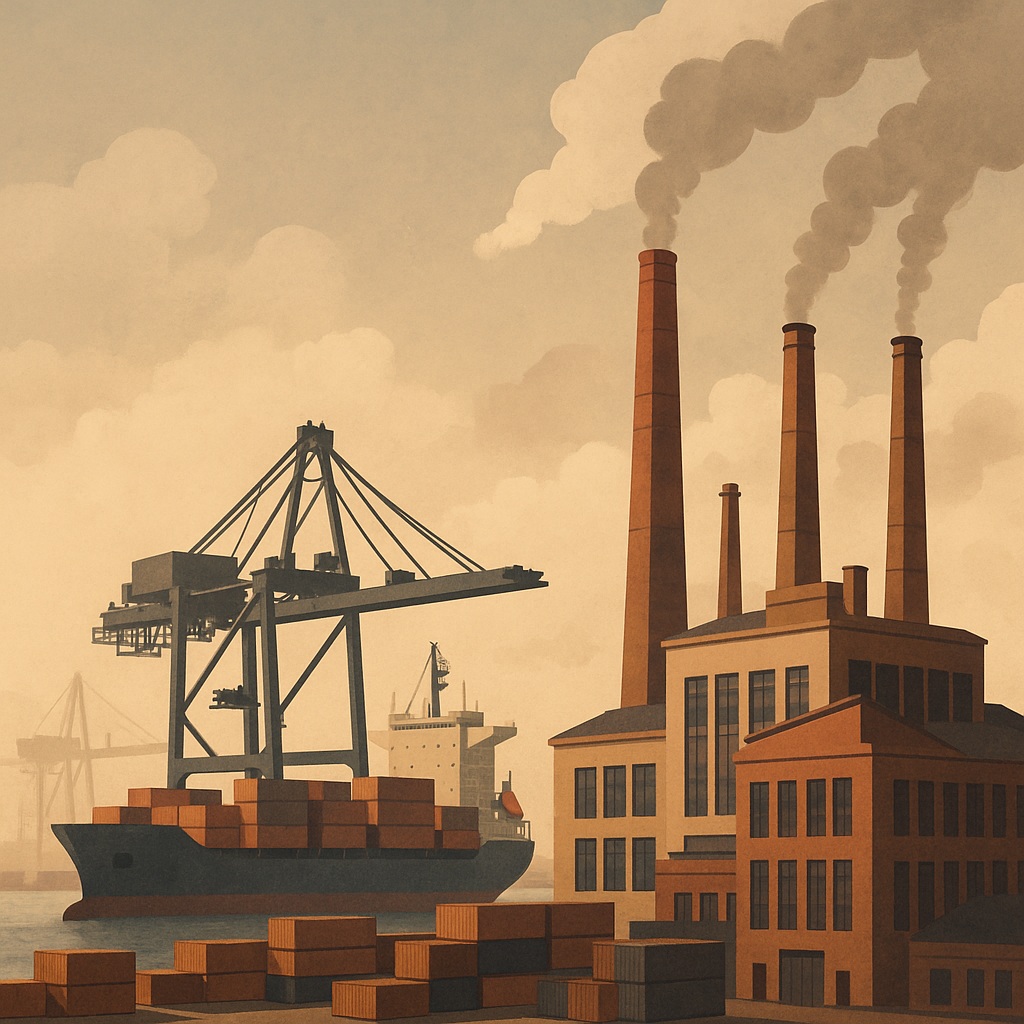
Lagarde warns the EU’s export‑driven model is becoming obsolete as global trade patterns shift

Europe’s economic direction is facing a defining moment. In recent remarks, European Central Bank President Christine Lagarde warned that the European Union remains anchored to an economic model built for “a world that is gradually disappearing.” Her comments underscore a growing concern among policymakers: the continent’s long‑standing reliance on global trade, foreign supply chains, and external demand no longer provides the security or growth it once did.
The EU’s export‑led framework emerged in an era of expanding globalisation, when open markets, predictable trade routes, and ever‑deeper economic integration seemed irreversible. For decades, European manufacturers rode this wave, powering growth through strong demand abroad. But the global landscape has changed. Rising geopolitical tensions, the weaponisation of supply chains, and an international shift toward strategic autonomy have reshaped economic realities.
Lagarde emphasised that Europe’s vulnerability stems from its dependence on imported strategic materials and technologies. This model assumes stability in international cooperation—an assumption that now appears fragile. External shocks, once considered rare, have become frequent. Firms reliant on complex global supply networks continue to face volatility, delays, and cost spikes. Europe’s industrial backbone, particularly manufacturing‑heavy economies, has felt the strain. Output has slowed, competitiveness has tightened, and the assumptions that once supported the bloc’s growth are losing ground.
Yet Lagarde’s warning was not merely a diagnosis. It was a call to action. She argued that the EU must pivot toward strengthening its internal market, improving cross‑border integration, and modernising its economic architecture. Harmonising regulations, expanding capital‑market depth, and reducing fragmentation within the bloc could unleash new domestic momentum. Instead of depending predominantly on overseas demand, Europe would build a growth engine powered from within.
Digitalisation and industrial innovation form another pillar of this proposed shift. Lagarde stressed that Europe must accelerate its adoption of emerging technologies—and ensure that value creation in critical industries remains within the continent. From artificial intelligence to energy technologies, Europe faces competition from global players that have invested heavily in future‑oriented industries.
Still, she acknowledged that Europe retains significant resilience: stable labour markets, strong consumption supported by employment, and a base of innovative firms ready to adapt. But resilience is not the same as long‑term sustainability. Without deep structural reform, Europe risks sliding into stagnation.
For businesses, Lagarde’s message signals a period of recalibration. Supply chains may need diversification, domestic markets may take on greater importance, and strategies built solely around global export strength may need rethinking. For citizens, the shift could lead to a more internally focused Europe—one centred on regional innovation, intra‑EU economic activity, and a stronger collective industrial identity.
The larger question is whether Europe can muster the political and institutional coordination needed to adapt. Inaction, Lagarde warned, carries real economic costs. The world is changing quickly, and the EU must decide whether to change with it or be shaped by forces beyond its control.


 The Tower Post