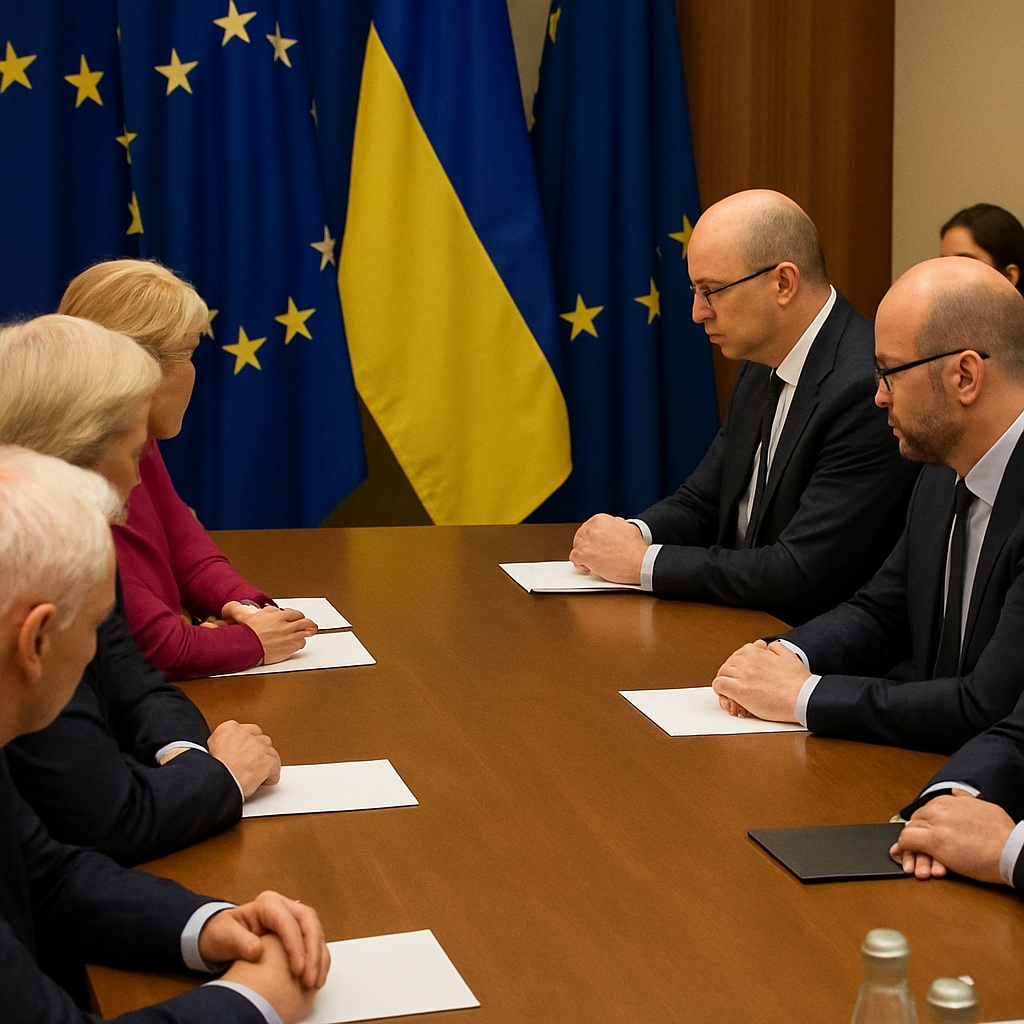
As Washington and Moscow press ahead with a draft cease‑fire blueprint, European capitals insist the continent must shape — not simply observe — any future settlement.
Europe’s political landscape is once again convulsing around the question of war and peace on its eastern frontier. As diplomatic signals intensify between Washington and Moscow over a proposed framework to halt fighting in Ukraine, European governments are pushing back with an unusually unified message: no peace plan can be legitimate or lasting if Europe is not at the table.
For months, U.S. and Russian officials have quietly exchanged draft provisions for what insiders describe as a “comprehensive cessation framework.” The document — circulating in diplomatic circles — outlines measures that include troop withdrawals, restrictions on Ukraine’s future military capabilities, and phased sanctions relief for Russia. While neither side has publicly confirmed the text, leaks suggest the plan’s architecture reflects a compromise driven primarily by American and Russian strategic calculus.
To European capitals, this is precisely the problem.
Europe’s leaders argue that any settlement drawn up primarily by Washington and Moscow risks baking in structural weaknesses that will haunt the continent for decades. The European Union’s foreign affairs chief put it bluntly in a recent briefing: “Europe is not merely a stakeholder. The security of our continent is directly bound to the outcome of this war. We cannot be spectators to a plan that determines our future.”
Europe’s Case: Security, Sovereignty, and Strategy
At the core of Europe’s demand is a convergence of strategic concerns:
- The war is reshaping Europe’s security map.**
From the Baltics to the Balkans, governments face heightened defence spending, shifting military postures, and renewed pressure to reinforce NATO’s eastern flank. A settlement that leaves Ukraine diplomatically weakened or territorially compromised could embolden further Russian assertiveness, critics warn. - Europe will shoulder the reconstruction burden.**
Regardless of how peace is achieved, the EU is expected to lead Ukraine’s long‑term reconstruction, governance support, and economic integration. European officials argue they cannot effectively plan or fund such an effort without shaping the political settlement itself. - The question of Ukrainian agency.**
Several European ministers have stressed that Ukraine must not be pressured into accepting terms that compromise its sovereignty. Any deal that appears imposed from outside — particularly one mediated predominantly by the U.S. and Russia — risks lacking both legitimacy and durability. - The transatlantic balance of power.**
European diplomats privately express concern that Washington’s desire for rapid de‑escalation might come at the cost of long‑term European stability. If the peace deal is seen as an American‑Russian initiative, Europe fears being relegated to the role of executor rather than architect of its own security order.
Alarm Over Reported Draft Elements
Although the proposed U.S.–Russia plan remains fluid, several elements have raised alarm in European capitals:
-A proposed ceiling on the size and capabilities of Ukraine’s armed forces.** To Eastern European governments, this would leave Ukraine permanently vulnerable.
-Ambiguous arrangements on territorial control in the Donbas.** Diplomats fear these could entrench de facto Russian authority without clear pathways for reintegration.
-Phased sanctions relief linked to Russian compliance.** Some EU states worry Moscow could exploit such provisions while retaining leverage on the ground.
-The perception of a bilateral superpower negotiation.** Europe’s exclusion has become a symbol of deeper structural concerns about its global role.
One senior European diplomat described the emerging dynamic as “the return of great‑power politics — with Europe expected to clean up the aftermath.”
A Growing European Counter‑Initiative
In response, several European governments are formulating a joint counter‑proposal. Early discussions suggest a framework emphasizing:
-Security guarantees for Ukraine** backed by a coalition of European states.
-A long‑term European monitoring mission** to oversee cease‑fire lines and report violations.
-A reconstruction package** tethered to democratic reforms and international oversight.
-A multi‑party negotiation architecture** in which Ukraine and the EU hold equal footing with the U.S. and Russia.
European officials stress that unity is critical. “If we speak with one voice,” said a Baltic foreign minister, “we will shape the negotiation. If we speak separately, others will shape it for us.”
Kyiv’s Position: Cautious but Wary
Ukraine, while continuing to engage diplomatically with Washington, has shown growing discomfort with concessions implied in the draft plan. Ukrainian officials have insisted that no agreement will be signed without full consultation with European partners, who remain Kyiv’s primary economic and political supporters.
Behind closed doors, Ukrainian negotiators have also expressed concerns that certain provisions could compromise the country’s long‑term security and weaken its defence capabilities at a critical moment in its state‑building trajectory.
What This Means for the Coming Weeks
As the situation evolves, the central question becomes whether Europe can assert enough diplomatic weight to shape the emerging peace architecture. Several capitals are preparing for intensified negotiations, emergency ministerial consultations, and coordinated messaging aimed at Washington.
Russia, for its part, appears content to let divisions simmer among Western allies. By engaging directly with the U.S., the Kremlin signals it still views global affairs through a great‑power lens, in which Europe plays a secondary role.
But Europe is determined to challenge that premise.
With the political climate intensifying and winter diplomacy accelerating, European governments are making clear that this negotiation — whenever it formally begins — will define not only Ukraine’s future, but Europe’s own strategic identity.
The message, repeated across interviews, press briefings, and diplomatic cables is unmistakable:
Europe insists on a seat not merely at the table, but at the head of it.

 The Tower Post