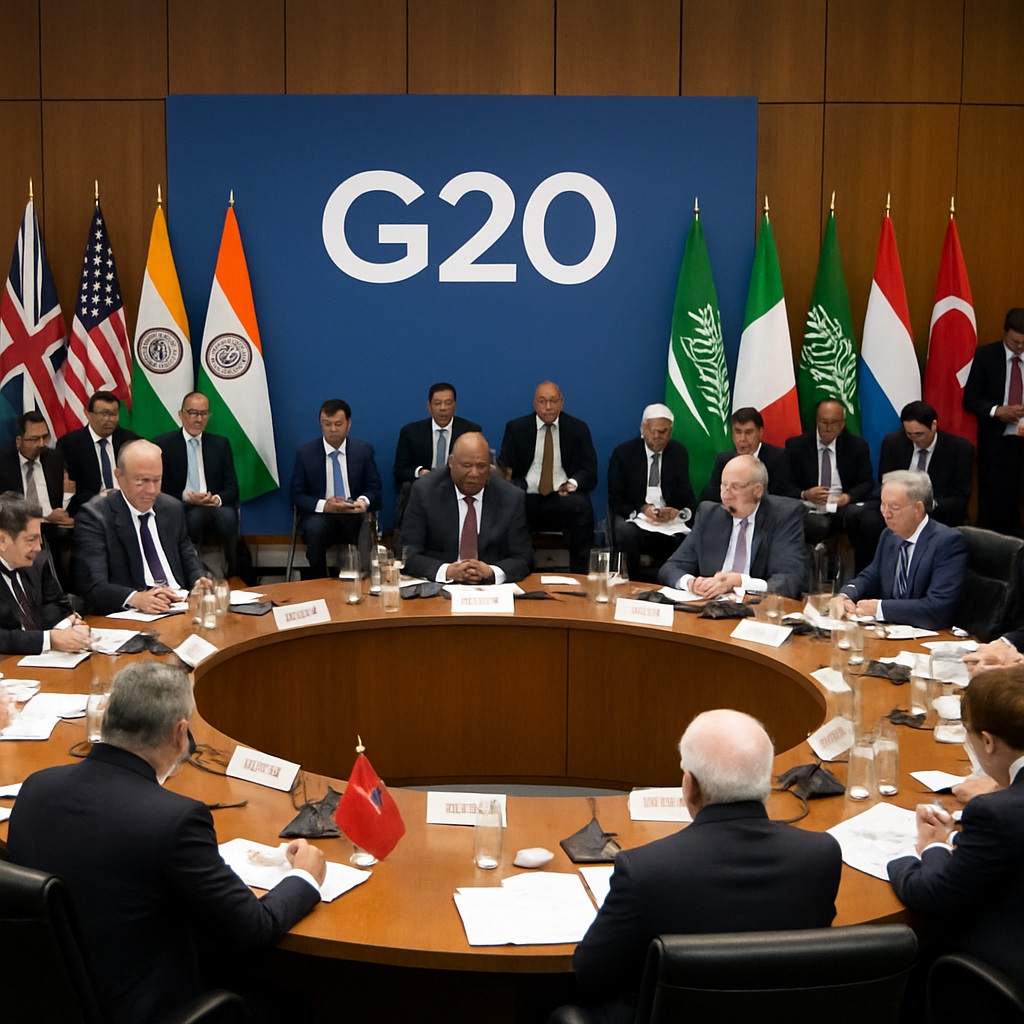
G20 Leaders Forge Historic Climate and Economic Pact in Johannesburg as the U.S. Stays Absent
The 2025 G20 Summit in Johannesburg concluded with a sweeping declaration on climate action and global economic resilience—remarkable not only for its scope but for the conspicuous absence of the United States, whose delegation ultimately did not attend. Leaders from the world’s major economies pressed forward, framing the agreement as a necessary evolution in multilateral cooperation rather than an act of defiance.
Across two days of high-stakes discussions, heads of government emphasized that the cost of inaction on climate and global inequality had become untenable. While the absence of the U.S.—traditionally a central architect of G20 outcomes—initially cast uncertainty over negotiations, the remaining members coalesced around shared priorities with unusual speed and cohesion.
The final declaration calls for enhanced climate-finance mechanisms aimed at accelerating renewable-energy transitions in developing economies, alongside the expansion of green-infrastructure guarantees supported by multinational lenders. Delegates described the pact as a bridge between advanced and emerging economies, acknowledging that uneven access to technology, private investment, and climate-resilience funding had widened global divides.
Several leaders argued privately that the U.S. absence created space for more assertive commitments from blocs such as the African Union, the European Union, and South American partners, who pressed for stronger language linking climate goals to economic justice. Their influence was evident in the declaration’s emphasis on restructuring supply chains in ways that reduce both emissions and dependency risks.
Economic policy, too, took center stage. With global inflationary pressures receding unevenly, G20 members endorsed coordinated measures to stabilize commodity markets and safeguard critical mineral access. Central bank governors, meeting parallel to the summit, stressed the need for data-driven monetary strategies that balanced growth with long-term financial stability.
Yet the geopolitical undertones were impossible to ignore. Analysts noted that several participating governments sought to demonstrate that the G20 could maintain legitimacy and operational capacity even without full attendance from any single power. For host nation South Africa, the successful adoption of the declaration was also a diplomatic victory, showcasing the country’s ability to convene consensus at a time of fracture in global governance.
While U.S. officials offered no formal reaction following the summit’s conclusion, diplomats from multiple delegations expressed hope that Washington would re-engage in subsequent G20 processes. “The strength of the forum has always been its capacity to adapt,” one European representative observed. “This declaration reflects that spirit—even in challenging circumstances.”
On the ground in Johannesburg, public sentiment ranged from cautious optimism to pride. Civil-society groups praised the climate-finance commitments but warned that implementation would be the true test. Business leaders noted that clearer investment frameworks, especially for sustainable infrastructure, could unlock significant private-sector participation if governments follow through.
As the summit wrapped up, the unspoken question lingered: how the absence of one of the world’s largest economies will shape the G20’s path forward. For now, leaders appear determined to show that the group remains capable of collective action—driven not by unanimity, but by urgency.
In Johannesburg, the message was unmistakable: when the global community decides it cannot wait, it moves ahead regardless of who is in the room.


 The Tower Post