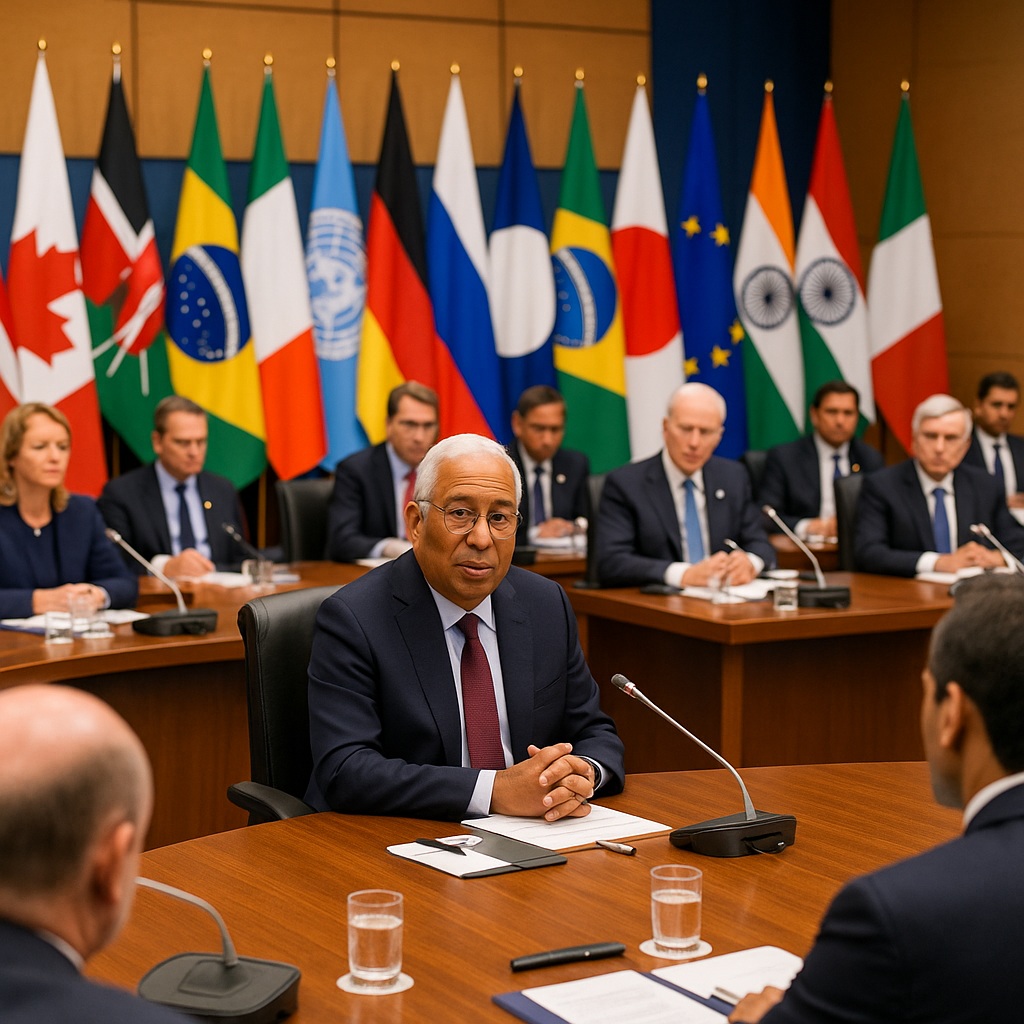
At the Johannesburg G20 Summit, Portugal’s President warns that clean‑energy ambitions hinge on secure, transparent mineral supply chains.
JOHANNESBURG — In a packed plenary hall at the G20 Summit, Portuguese President António Costa placed critical‑minerals supply chains at the center of the global economic debate, urging leaders to confront what he described as “the defining strategic tension of the clean‑energy age.” Speaking at a pivotal session, Costa framed the rapid acceleration of renewable‑energy deployment as both a geopolitical opportunity and a source of mounting vulnerability.
With demand for lithium, nickel, copper, cobalt and rare‑earth elements rising sharply each year, Costa argued that governments can no longer rely on fragmented market dynamics or loosely coordinated trade frameworks. “The energy transition is advancing at a pace unmatched in modern history,” he said, “but the mineral foundations of this transformation are showing signs of strain. Without coordinated action, the world risks a mismatch between ambition and supply.”
His remarks resonated in a summit dominated by debates over energy security, industrial policy and the uneven distribution of mineral reserves. Several delegations highlighted the growing concentration of processing capacity in a handful of countries, raising fears that new dependencies could replace the fossil‑fuel vulnerabilities the world is trying to escape.
Costa’s intervention built on Portugal’s growing role in Europe’s emerging critical‑minerals landscape. With sizable lithium resources and expanding research initiatives in battery technologies, the country has pitched itself as a bridge between European demand and global production networks. Yet Costa cautioned against framing the issue as a scramble for national advantage. “We cannot simply replicate old patterns of extractive geopolitics,” he said. “The transition must be fair, environmentally responsible and anchored in international cooperation.”
He called for three priority actions: diversification of supply chains, transparency across extraction and processing, and stronger partnerships with mineral‑producing nations that ensure equitable benefit‑sharing. According to the Portuguese delegation, these measures are essential to stabilizing markets and preventing speculative spikes that have repeatedly disrupted clean‑tech manufacturing.
The session’s backdrop underscored the urgency. Delegates cited expanding bottlenecks in refining capacity, rising community resistance to new mining projects, and the escalating cost of integrating raw‑material governance with environmental commitments. Costa argued that these challenges demand not only technical solutions but political accountability. “Minerals are becoming the new fault lines of global competition,” he warned. “Our responsibility is to ensure they do not become barriers to a sustainable and inclusive future.”
Observers noted that Costa’s message struck a balance between pragmatic risk awareness and optimism about innovation. He pointed to advances in recycling, substitution materials and digital tracing technologies as evidence that a more resilient minerals economy is within reach—provided multilateral institutions keep pace. He urged the G20 to take the lead in developing standards for responsible sourcing and in coordinating strategic stockpiles to buffer against supply disruptions.
Behind the diplomatic exchanges, business leaders attending the parallel G20 Investment Forum emphasized that the next wave of clean‑energy manufacturing will depend on predictable mineral flows. Several pointed to a surge in private‑sector interest in African, Latin American and European mineral projects, though concerns over permitting delays, infrastructure deficits and regulatory uncertainty continue to temper investor enthusiasm.
Costa’s address placed particular emphasis on the African continent, whose mineral wealth positions it at the heart of the global transition. He encouraged G20 members to support value‑added processing and technology transfer within African markets, arguing that resilience will ultimately come from broadening the geographic footprint of mineral supply chains rather than centralizing it. “Prosperity must be shared,” he said, “or the transition risks deepening inequalities that could undermine its legitimacy.”
As the summit moved into its final phase, diplomats suggested that critical‑minerals governance may feature prominently in the leaders’ communiqué. Whether the group will embrace Costa’s call for a new global compact remains unclear, but his intervention pushed the issue higher on the agenda of the world’s major economies. With competition for mineral resources intensifying, his message carried a hint of urgency: cooperation now may determine whether the clean‑energy revolution remains both feasible and fair.


 The Tower Post