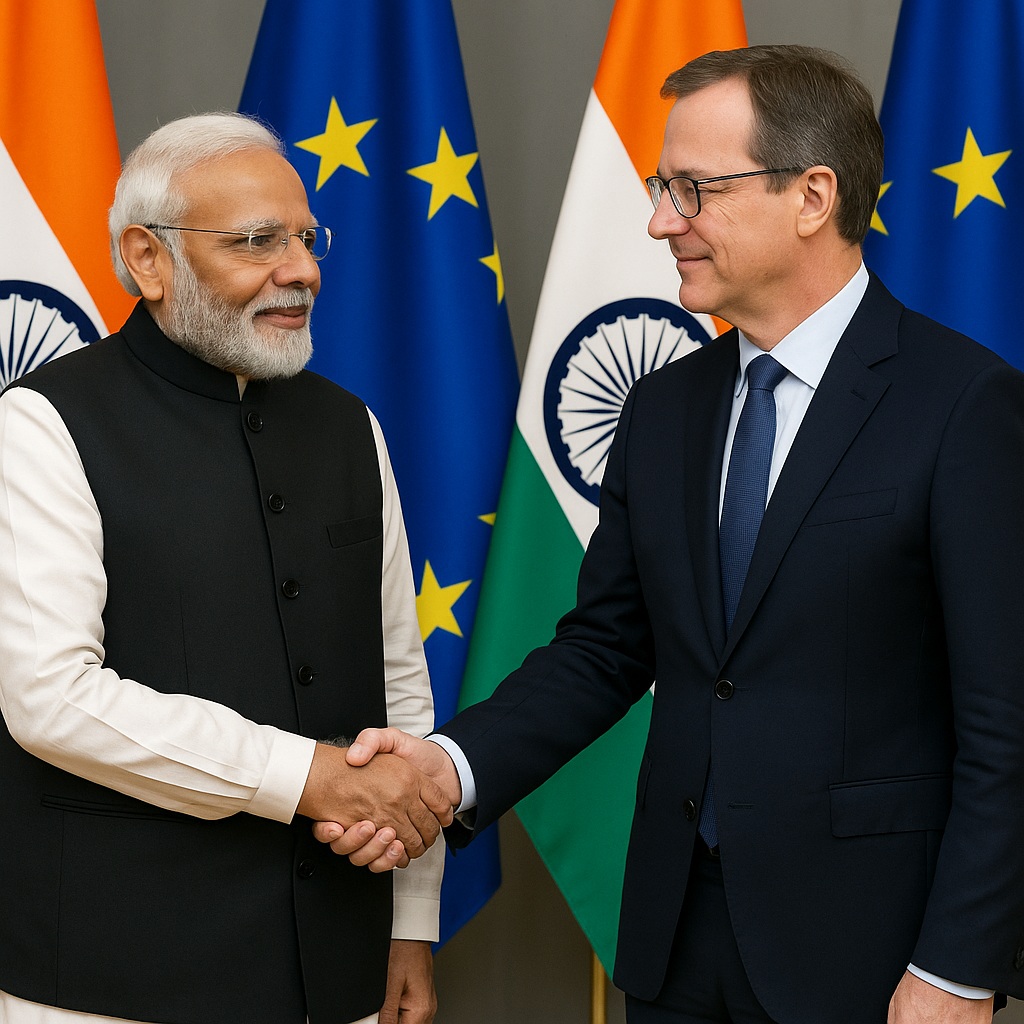
As geopolitical realignments accelerate, New Delhi and Brussels prepare to elevate their partnership at a high-level summit, aiming to finalize a long-negotiated trade pact and expand cooperation across technology, security, and climate.
India and the European Union are advancing toward one of the most consequential diplomatic milestones in the history of their relationship, with leaders preparing to finalize a long-discussed free trade agreement and a broadened strategic agenda at an upcoming summit early next year. The move reflects the growing urgency felt on both sides to strengthen partnerships amid an increasingly fluid global order defined by fractious geopolitics, supply-chain disruptions, and rapid technological transitions.
Officials and analysts across New Delhi and Brussels describe the moment as pivotal. India, now firmly positioned as one of the world’s fastest-growing large economies and a rising geopolitical influencer, has steadily expanded its global outreach. The European Union, navigating its own internal transitions and managing strained ties with other major powers, sees India as a critical partner for economic resilience, security balancing, and technology cooperation.
A Negotiation Years in the Making
The proposed free trade agreement—reopened after a long hiatus—has been marked by intricate discussions over tariffs, digital trade, sustainability standards, and intellectual property rules. Negotiations, once stalled by divergent regulatory approaches and market-access demands, have accelerated over the past year as global economic vulnerabilities pushed both partners toward greater convergence.
Diplomats familiar with the talks say the latest draft reflects significant compromises. India has moved toward easing certain import duties and enhancing regulatory transparency, while the EU has shown flexibility on data-governance expectations and sustainability benchmarks, recognizing India’s developmental realities. While technical chapters continue to be refined, negotiators on both sides describe the overall framework as “substantially complete.”
Business groups in both regions have expressed optimism. Indian exporters expect a major boost in textiles, pharmaceuticals, and agritech, while European manufacturers—particularly in automotive, green technologies, and precision machinery—anticipate expanded opportunities in India’s rapidly modernizing market. The FTA is also expected to include a digital-trade segment, reflecting the centrality of data flows and emerging technologies in both economies.
Recalibrating Strategy in a Shifting World
Beyond trade, the upcoming summit is expected to unveil a refreshed strategic agenda that deepens cooperation in defense, critical technologies, clean energy, and maritime security. The strategic environment—from the Indo-Pacific to Europe’s eastern neighborhood—has shifted significantly in recent years, intensifying the need for multidimensional partnerships.
India and the EU have already expanded joint naval exercises, cybersecurity dialogues, and resilience partnerships aimed at reducing dependencies in critical supply chains. The new agenda is likely to amplify these efforts, incorporating frameworks on space-situational awareness, semiconductor cooperation, migration management, and green hydrogen deployment.
European officials note that India’s role in global south diplomacy, supply-chain diversification, and digital-governance leadership makes it an indispensable partner. Indian policymakers, meanwhile, see the EU as a stable and technologically advanced counterpart capable of supporting India’s own ambitions in manufacturing, climate action, and infrastructure modernization.
Economic Synergies and Political Calculations
The push for convergence is not merely technical. It is deeply shaped by larger global currents—rival blocs competing for technological dominance, evolving security alliances, and economic turbulence affecting emerging and developed markets alike.
For India, securing diversified trade relationships is key to reducing external vulnerabilities and accelerating domestic transformation. For the EU, partnering with a fast-growing, democratic, and strategically independent power offers a pathway to reduce over-dependence on single-source suppliers and gain a more assertive foothold in the Indo-Pacific.
Analysts warn, however, that the success of the agreement will depend on sustained political will. Domestic industries in both regions remain cautious about rapid market opening, and regulatory differences may continue to create friction even after an agreement is signed. Yet the mood in both capitals suggests that strategic considerations now outweigh hesitations.
A Partnership Set to Define the Next Decade
If finalized, the FTA and strategic agenda could reshape the trajectory of India-EU relations, turning what has long been a largely under-leveraged partnership into one of the world’s most consequential diplomatic and economic alliances. Both partners appear determined to avoid past cycles of stalled ambition, emphasizing operational cooperation, long-term investment, and consistent political dialogue.
As the global order continues to evolve in unpredictable ways, India and the European Union are signaling that their interests increasingly align—and that the moment has arrived to translate shared values and complementary strengths into a durable, future-oriented framework. The upcoming summit is expected to mark the beginning of that new chapter.

 The Tower Post