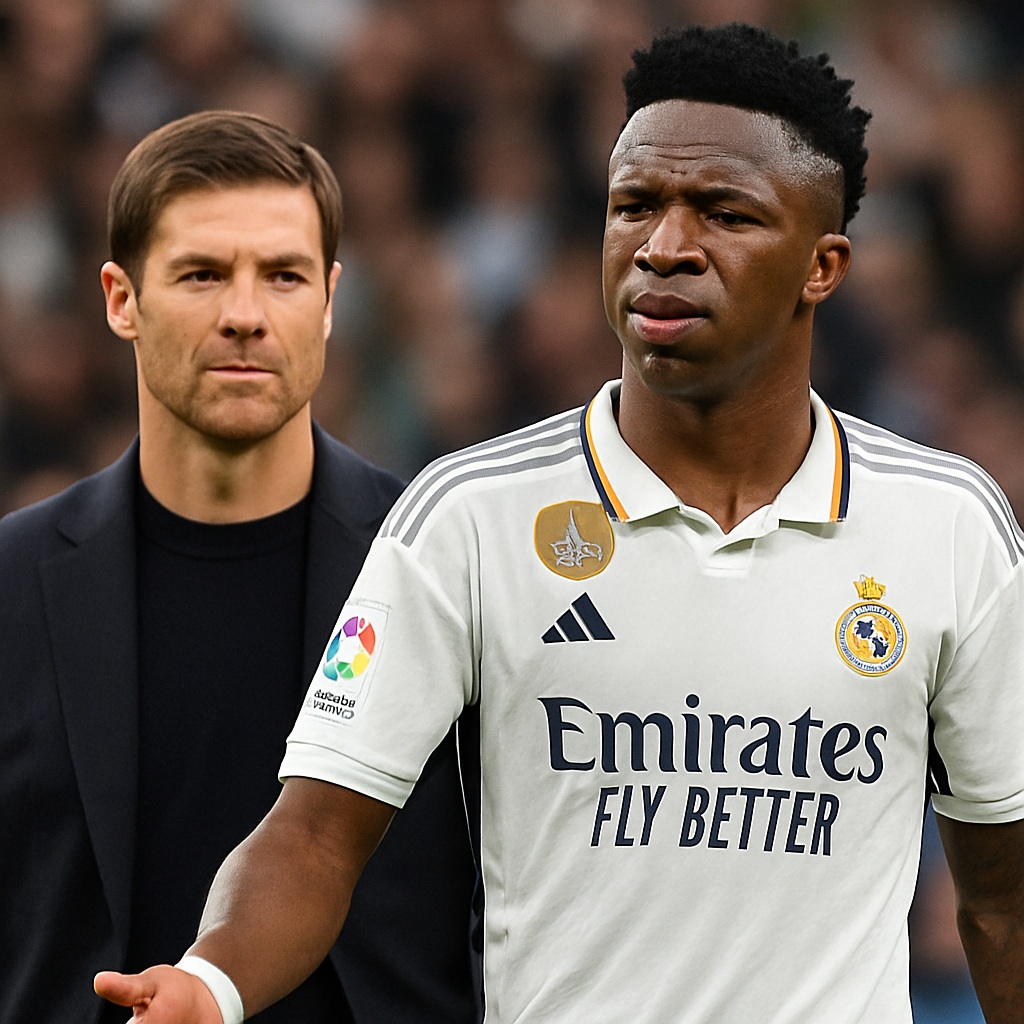
“If nothing changes, I won’t stay” — Vinícius Júnior tells Real Madrid he won’t renew amid tension with coach Xabi Alonso
Madrid — The tension swirling around Real Madrid this month has grown from whispers in the corridors of Valdebebas to a fully fledged storm consuming the club’s news cycle. What began as a routine contract‑extension discussion with Brazilian star Vinícius Júnior has transformed into one of the most delicate internal crises the club has faced in recent seasons. The forward has made it clear: under the current circumstances, he is unwilling to sign a new deal, placing pressure on management and inviting the attention of Europe’s biggest clubs.
The unease has been brewing since early autumn. Although Vinícius has long been regarded as one of the crown jewels of Madrid’s squad, the arrival of coach Xabi Alonso ushered in a tactical restructuring that appears to have unsettled the winger. Insiders describe a widening disconnect not only on the pitch but also personally, with communication between player and coach reportedly sharp, sporadic, and increasingly strained. Privately, Vinícius is said to feel that certain decisions — substitutions, positional switches, and tactical instructions — reflect a lack of confidence in his role, something he struggles to accept given his enormous contributions in recent seasons.
Multiple people close to the club describe moments in team meetings where Alonso’s expectations clashed with the Brazilian’s instincts. Alonso, known for discipline, structural rigor and pressing intensity, demands strict adherence to tactical roles. Vinícius thrives on improvisation, instinctive movement, and freedom in the attacking third. The philosophical collision was perhaps predictable; the extent of the fallout, less so.
Unrest behind the scenes
Sources familiar with the situation indicate that the rift began quietly but escalated quickly. Early in the season, Vinícius found himself benched for what Alonso described as “rotational reasons.” The decision, although defensible on paper given the crowded fixture list, was reportedly perceived by the forward as an early signal of mistrust. His frustrations grew with each subsequent match in which he felt under‑utilized or mispositioned, particularly when deployed on the right flank — a role that historically diminishes his direct threat and comfort.
An internal meeting between Vinícius and club president Florentino Pérez marked a turning point. The forward reportedly told the president that a contract renewal “makes no sense” without clarity and respect regarding his place in the project. Pérez, who has long championed the Brazilian as a future face of the club, was said to be taken aback by the bluntness of the message.
Moments of friction
The relationship between Alonso and the forward has been further complicated by visible on‑field tension. In one match earlier this season, Vinícius reacted with clear frustration when substituted, shaking his head and avoiding eye contact with the coach. Though such incidents are commonplace in football, this particular episode resonated with teammates and media, becoming symbolic of deeper unresolved issues.
Privately, players have noted the strained dynamic. Some describe Alonso’s approach with Vinícius as “distant,” while others insist the coach has attempted constructive dialogue but been met with resistance. The truth likely lies somewhere in the middle — a matter of mismatched personalities and expectations rather than hostility. Still, in an environment as pressurized as Real Madrid, such friction can quickly inflate into a narrative of crisis.
What’s at stake
Vinícius’s contract technically runs until 2027, giving the club time on paper. In reality, however, the timing could not be more sensitive. With the club in the midst of a competitive domestic campaign and navigating a crowded international calendar, uncertainty around one of their star attackers creates potential instability.
Moreover, Real Madrid have invested heavily — financially and symbolically — in building their brand around a new generation of talent. Vinícius, alongside other rising stars, has been central to marketing, global outreach, and long‑term squad planning. Losing him, or even seeing him openly unsettled, could signal disarray and weaken the club’s position when negotiating future renewals or transfers.
European giants are already monitoring the situation. Clubs from England, France, and even the emerging Saudi project are believed to have inquired discreetly about his status. Although Real Madrid are unlikely to entertain a sale in the near term, the very existence of such interest places pressure on the club to stabilize the situation quickly.
Wider implications for Real Madrid
Beyond the personal dispute, the saga shines a light on deeper structural questions within the club. Alonso’s appointment represented a shift toward a more modern, intense, system‑based style of play — a contrast with the more fluid, star‑driven approach of recent years. The transition has inevitably created winners and losers within the squad. While some players have thrived, adapting seamlessly to the coach’s philosophy, others — Vinícius chief among them — feel constrained.
This raises concerns internally about whether the club has effectively managed the human aspect of the transition. At a club as culturally complex as Real Madrid, harmony is not merely a bonus — it is essential. The balancing act between tactical evolution and preserving the core identity of the team is delicate, and the Vinícius situation suggests the equilibrium may not yet be fully established.
Furthermore, there are questions about communication channels. Is the technical staff engaging with key players in a sufficiently collaborative way? Do the squad leaders feel involved in shaping the team’s direction? The answers to these questions could determine not only Vinícius’s future but also the long‑term success of Alonso’s tenure.
Where things go from here
As of now, both sides appear committed to avoiding public escalation. There are no ultimatums, no open conflicts, and no immediate moves toward a transfer. Instead, the tension sits in an uneasy limbo — widely acknowledged yet unaddressed in any meaningful way.
Behind closed doors, the club hopes that performances and positive results will soothe tensions over time. They believe that if Vinícius feels decisive, valued, and integrated within the system, the atmosphere may thaw naturally. But those familiar with the player say his concerns run deeper, rooted not in temporary frustrations but in long‑term trust.
Vinícius, for his part, has expressed to those close to him that he wants clarity and respect more than promises. He does not seek special privileges, they say, but recognition of his importance and a tactical plan that maximizes his strengths. Without that, a renewal is not only unlikely but undesirable in his view.
As the season progresses, the situation will demand careful handling from the club’s leadership. A misstep could push the player further away; a well‑managed dialogue could restore stability. What is clear is that the coming months may prove pivotal for both Vinícius and Real Madrid — a critical moment in shaping the club’s identity in the years ahead.
In elite football, star power and managerial authority often collide. But rarely does the conflict feel so symbolic of a broader crossroads. For Real Madrid in late November, the saga surrounding Vinícius Júnior is more than a contract dispute — it is a test of vision, unity, and the future direction of the club.



 The Tower Post