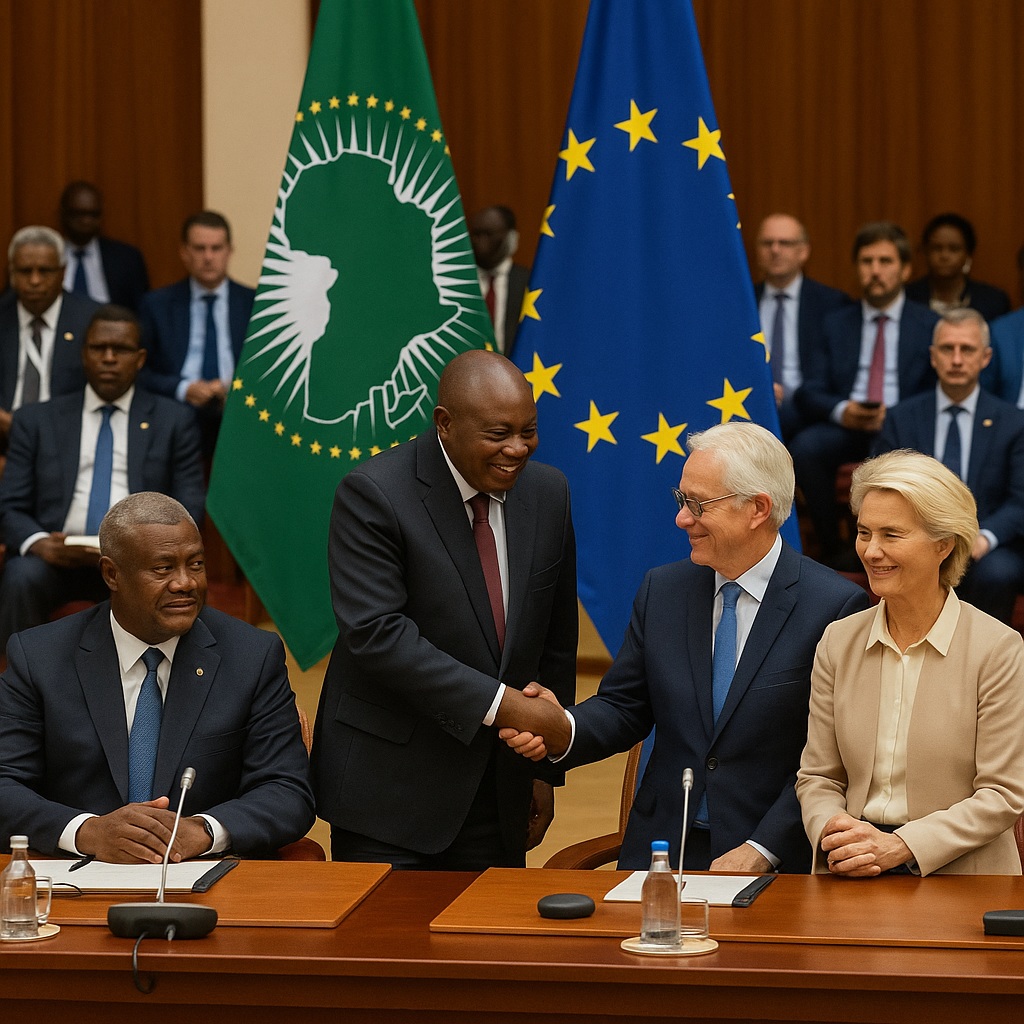
Angola gathering marks a quarter-century partnership focused on infrastructure, education, climate resilience, and a renewed push for global governance reform
The latest AU–EU summit, held in Angola, illustrated how profoundly the political and economic landscape between Africa and Europe has shifted. What began as a development-focused partnership twenty‑five years ago has evolved into a platform where both sides increasingly speak of mutual interests, shared political responsibility, and the need to rebalance global governance structures. The gathering – which drew heads of state, ministers, civil society leaders and private‑sector delegates – signaled a pragmatic but ambitious stage in the partnership, one that places the Global South at the center of its strategic thinking.
Across meeting halls and sideline discussions, the tone was noticeably different from earlier summits. African leaders asserted a firmer role in shaping the agenda, reflecting a wider continental push to move beyond aid‑centric dialogues. European representatives, facing geopolitical volatility, supply‑chain realignments and climate pressures, acknowledged that cooperation with Africa has become a strategic necessity, not a matter of benevolence. The Angolan summit made that dynamic clear: this is a relationship undergoing a structural redefinition.
A central theme was infrastructure—long identified as the cornerstone of Africa’s economic acceleration but historically underfunded. European officials highlighted new commitments aimed at unlocking cross‑continental transport corridors, digital infrastructure expansions and regional energy interconnections. African delegates emphasised that infrastructure must reflect local priorities: integrating rural communities, strengthening intra‑African trade routes, and boosting industrial capacity under the African Continental Free Trade Area. Angola, which itself is navigating a diversification agenda, used the summit to showcase the regional benefits of modernised ports and logistics networks that link the Atlantic to interior trade hubs.
Education and skills development emerged as equally critical areas of cooperation. While Europe faces acute labour shortages in several sectors, African economies are grappling with massive youth populations entering job markets with limited opportunities. The summit’s joint education initiative aims to reverse this mismatch. Rather than repeating previous models of scholarship‑only support, the new approach prioritises vocational training, university research partnerships, digital‑skills programmes and teacher‑training exchanges. Delegates argued that closing the skills gap is a prerequisite for long‑term stability, investment attraction and industrial growth across African regions.
Climate cooperation was another pillar of the agenda. African states, among the regions most vulnerable to climate impacts despite contributing minimally to global emissions, pressed for a more equitable distribution of climate finance and access to green technology. European leaders, keen to secure reliable partnerships for renewable energy supply chains and carbon‑market frameworks, signaled a greater willingness to support African‑led adaptation strategies. Discussions centred on drought early‑warning systems, resilient agriculture, coastal protection and locally owned renewable‑energy industries. While financing gaps remain, the summit’s communique suggested a shift toward long‑term, co‑developed climate programmes rather than isolated project funding.
Perhaps the most consequential element of the summit was the emphasis on global governance reform—a topic once sidelined, now thrust to the forefront by geopolitical fragmentation. African leaders reiterated that institutions such as the United Nations Security Council, the IMF and the World Bank must better represent emerging economies. Many highlighted that global decision‑making structures no longer reflect the demographic, economic, or political realities of the twenty‑first century. European officials acknowledged these concerns more openly than in past meetings, recognising that legitimacy and stability in multilateral institutions depend on a broader distribution of power.
This evolving consensus extends beyond moral arguments. The summit discussions showed that both continents understand the practical implications: without more inclusive governance, global systems risk losing effectiveness at a moment when they are most needed. From climate emergencies to public‑health threats and digital‑economy regulation, transcontinental cooperation is essential. The Angola summit positioned the AU–EU partnership not only as a bilateral arrangement but as a platform influencing wider Global South alliances, including Africa’s expanding engagement with Asia and Latin America.
Yet the summit also highlighted lingering tensions. African delegates pushed for clearer timelines on funding commitments and warned against conditionalities that could constrain domestic industries. European officials raised concerns about debt sustainability and governance capacity in certain states. Both sides acknowledged the challenge of coordinating across 27 EU members and 55 AU member states with diverse interests, political systems and development levels. Despite these hurdles, negotiators noted that trust has improved as the relationship matures.
Civil society organisations used the summit to advocate for stronger gender‑inclusive policies, transparent climate financing, and protections for indigenous communities affected by large‑scale infrastructure projects. Youth delegates pressed leaders to move beyond declarations and deliver measurable progress on education, technology access and job creation. Their presence served as a reminder that the success of the AU–EU partnership depends not only on diplomatic communiques but on tangible improvements felt by ordinary citizens across both continents.
The Angola meeting ultimately offered a snapshot of a partnership in transition. What once revolved around development assistance now leans toward co‑investment, joint innovation and shared global influence. The summit’s message was unmistakable: Africa and Europe are entering a phase in which collaboration is framed not by hierarchy, but by interdependence. This shift corresponds with a wider rebalancing of the global order, where emerging economies are asserting their voice and established powers recognise the limits of old frameworks.
As delegates departed Angola, the sense was that the partnership’s next chapter will be defined less by ceremonial anniversaries and more by concrete outcomes: functioning energy corridors, reformed financial institutions, thriving student exchanges and climate‑resilient communities. If the commitments made at the summit translate into sustained action, the AU–EU alliance could become one of the most significant engines of Global South cooperation. The real test, however, will be whether both continents can maintain the momentum and continue shaping a shared future in an era of rapidly shifting global realities.




 The Tower Post