How AI in retail and media is reshaping jobs, hiring, and creative work
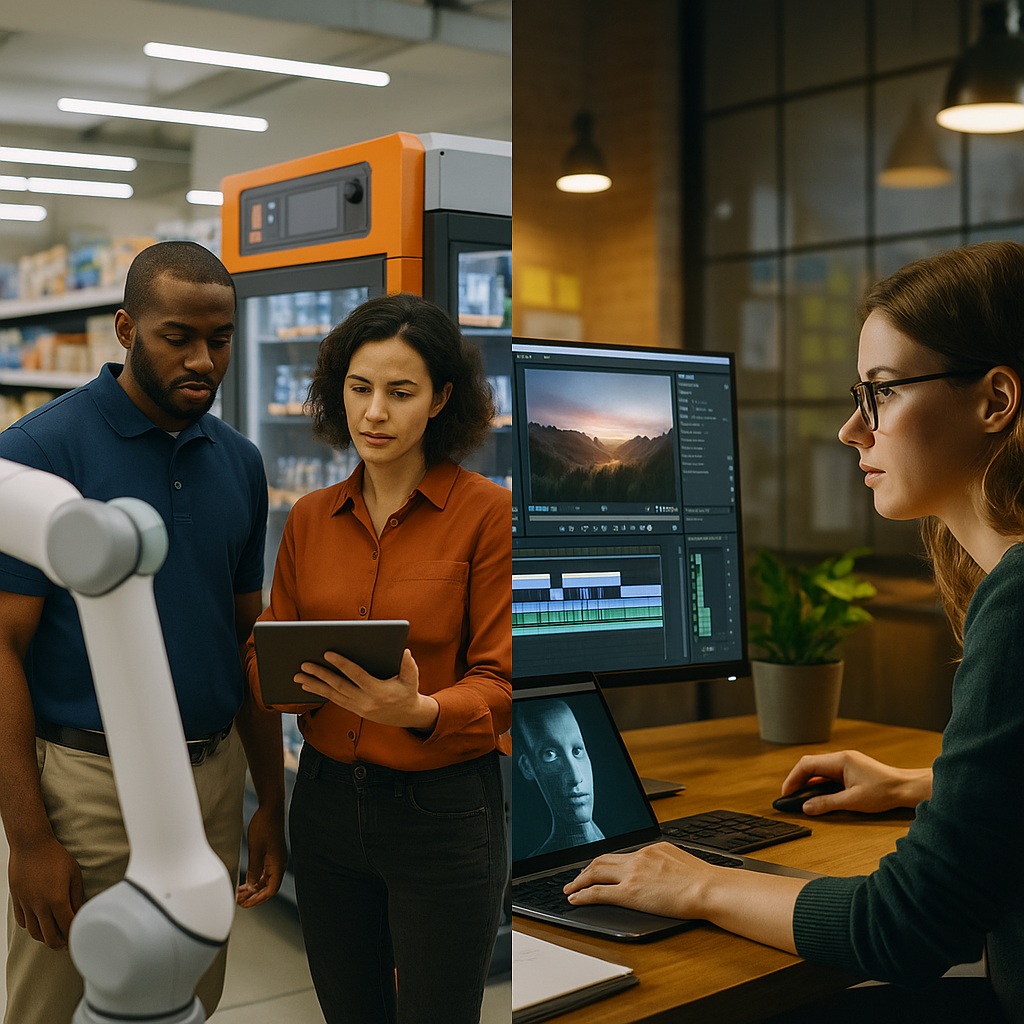
In a grocery superstore on the edge of town, a floor manager starts her shift by checking a dashboard instead of walking the aisles. An AI system has already forecast traffic, scheduled staff, and flagged which shelves will need attention by midday. Across the city, a video editor at a streaming studio opens her laptop to find rough cuts preassembled by generative software, complete with suggested B‑roll and subtitles. Different industries, same pattern: algorithms are quietly moving into the heart of daily work.
From retail chains to global media groups, large employers are doubling down on artificial intelligence and automation just as workers grow anxious about a fresh wave of job losses. Corporate leaders cast the technology as a lifeline in a tough economy, promising higher productivity and new kinds of roles. But a growing list of restructurings and hiring freezes suggests that the benefits and burdens are not being shared evenly.
Recent research from a regional branch of the U.S. central bank found that roughly one in five firms in its business surveys now use AI in some part of their operations, and a substantial share expect that number to rise quickly. Many of those companies say AI has not yet triggered mass layoffs, but it is already reshaping how they think about hiring and what kinds of roles they need. Instead of explicitly cutting jobs, some employers are slowing or redirecting recruitment as automated systems take over slices of routine work.
The trend is especially visible in retail. Consulting studies and vendor data suggest that AI‑driven scheduling tools can boost workforce utilization by double‑digit percentages and cut overtime costs, while producing staff rotas in a fraction of the time managers once spent hunched over spreadsheets. For chains that operate on razor‑thin margins, the math is compelling: fewer idle hours on the clock, and staffing that flexes up or down with forecast demand.
Retail giants are moving fast. Big‑box brands have rolled out predictive labor‑planning software that blends sales history, local events, and even weather forecasts to determine the right number of associates per shift. Others are layering in computer‑vision systems that watch shelves and stockrooms, automatically generating task lists for employees when displays are empty or inventory is misplaced. At one major U.S. retailer, executives say AI tools are already helping rewrite product descriptions, spot online fashion trends, and decide which items get prominent placement in stores or on the home page.
Supporters say that for frontline staff, this can reduce drudgery. If an algorithm can handle the puzzle of scheduling, the argument goes, managers can spend more time coaching, and associates can be redeployed from manual stock counts to customer‑facing roles. Walmart and other chains experimenting with AI‑enabled task management insist they are using technology to “take the robot out of the human,” not the human out of the store.
Yet the timing of recent job cuts has sharpened skepticism among workers. Retail job losses have climbed sharply this year, with tens of thousands of roles eliminated or consolidated across major brands. Amazon and Target alone have announced deep reductions in corporate and back‑office staff, citing the need to streamline operations in an era of e‑commerce and automation. At Target, an internal “Trend Brain” AI system that helps merchandisers spot style shifts and test campaigns on synthetic consumer profiles was unveiled just months after a major round of white‑collar layoffs.
The message on earnings calls is consistent: AI is central to the next chapter of retail. One industry blog recently highlighted platforms from big software providers and specialist start‑ups that promise to create “intelligent retail workforces,” blending customer data, employee performance metrics, and automated coaching. Another report on self‑service technology predicts that automated checkouts, kiosks, and cashier‑less formats could form a market worth well into the tens of billions of dollars within less than a decade, as stores lean harder into frictionless shopping.
On the ground, though, some workers say the transition feels less like empowerment and more like being managed by a black box. In interviews, retail employees describe schedules that shift week to week based on algorithmic forecasts, sometimes making childcare and second jobs harder to juggle. Others worry that every scan, upsell, and customer interaction is feeding performance dashboards that might eventually justify cutting hours—or cutting them.
Hiring is also changing before candidates even step inside a store. Retail was an early adopter of AI‑assisted recruiting, and vendors say large chains now rely on automated screening, chatbots, and video‑interview analysis to handle huge volumes of applicants. Advocates argue that such tools can reduce time to hire and help spot overlooked talent. Critics warn that biased training data and opaque scoring systems risk encoding discrimination and making it harder for workers to challenge a rejection.
If retail is where AI meets the mass labor market, media is where it collides head‑on with human creativity. Newsrooms, broadcasters, and streaming platforms are experimenting with generative tools at every stage of production. Surveys by industry research groups show that a vast majority of editors believe AI is already transforming their work, even if relatively few organizations have fully scaled the technology across their operations.
In practice, that transformation looks less like robot journalists and more like a swarm of invisible assistants. AI systems now suggest headlines, tag and archive content, translate stories into multiple languages, and surface background research in seconds. In some newsrooms, reporters use chatbots to outline drafts or generate alternative angles; in others, tools automatically assemble social‑media posts or newsletters once a story is filed. A report for European public broadcasters this year found that experimentation with generative AI has given way to more systematic deployment, with managers focused on governance, training, and risk‑management frameworks.
The entertainment side of media is moving just as quickly. Streaming giants have adopted AI‑powered dubbing to localize shows into dozens of languages at a fraction of the traditional cost, helping them reach new audiences. Start‑ups and creative agencies are popping up to offer AI‑assisted video production, from text‑to‑video storyboards to automated editing and special‑effects pipelines. Analysts expect the AI market in media and entertainment to grow at a blistering pace over the next few years, with generative tools increasingly woven into everything from movie trailers to sports highlights.
For editors and producers, the upside is obvious: more content, faster, and often cheaper. A marketing team that once struggled to cut a handful of videos per month can now experiment with dozens of variants in the same time. News outlets use automation to republish stories in multiple formats and languages, squeezing more value from each investigation or feature. Some publishers say AI is helping free up reporters for deep, original work by taking over the repetitive tasks that used to eat up their day.
But here, too, the human impact is complicated. Hollywood’s labor disputes over the past couple of years aired fears that studios would use AI to generate scripts, reuse actors’ likenesses, or automate visual‑effects work without adequate compensation or consent. Unions representing journalists have pressed publishers for guarantees that generative tools will not be used to replace staff, and for transparency when AI is involved in producing content. Media watchdogs warn that as automated systems churn out ever more convincing text, audio, and video, the risk of misinformation and erosion of trust grows.
Beneath the headlines about layoff waves and “AI taking jobs,” the reality is more nuanced. Economists tracking the rollout of AI across the economy have found that relatively few firms so far attribute direct job cuts to the technology. Instead, they talk about “redeploying” workers, not filling certain roles as people leave, or shifting hiring toward data science, engineering, and oversight roles while trimming administrative and routine tasks. Surveys of workers suggest that many people already use AI at work—drafting emails, summarizing meetings, or analyzing data—often without a formal mandate from their employer.
That gap between narrative and lived experience fuels much of the current anxiety. Tech evangelists talk about a future in which intelligent agents handle drudge work and humans focus on higher‑value tasks, echoing recent remarks by high‑profile executives who predict that AI and robotics could eventually make traditional jobs optional for many. For a retail cashier watching self‑checkout lanes multiply, or a junior producer watching AI cut the first version of a promo reel, that vision can feel distant.
Policy debates are starting to catch up. Regulators in multiple regions are drafting rules around automated decision‑making in hiring and workplace monitoring, while industry bodies issue guidelines on AI transparency in news and entertainment. Some companies are setting up joint committees with worker representatives to review new tools before deployment, or offering retraining programs aimed at transitioning staff into AI‑adjacent roles such as prompt engineering, data annotation, or system supervision.
Whether those safeguards are enough remains an open question. What is clear is that the current wave of AI and automation is not confined to white‑collar offices or far‑off factories. It is reshaping the way people are hired, scheduled, evaluated, and creative work is produced, from the shop floor to the editing suite. As retailers race to automate stores and media companies scramble to reinvent storytelling with algorithms, the conversation about what work looks like—and who benefits—has shifted from theory to everyday reality.
For the floor manager checking her AI dashboard and the editor reviewing machine‑cut footage, the technology is no longer a distant prospect. It is a colleague, a competitor, and a force that will shape their careers for years to come. What comes next depends less on the capabilities of the systems themselves and more on the choices executives, regulators, and workers make, together, about how to share the gains and cushion the shocks of this new automation wave.




 The Tower Post