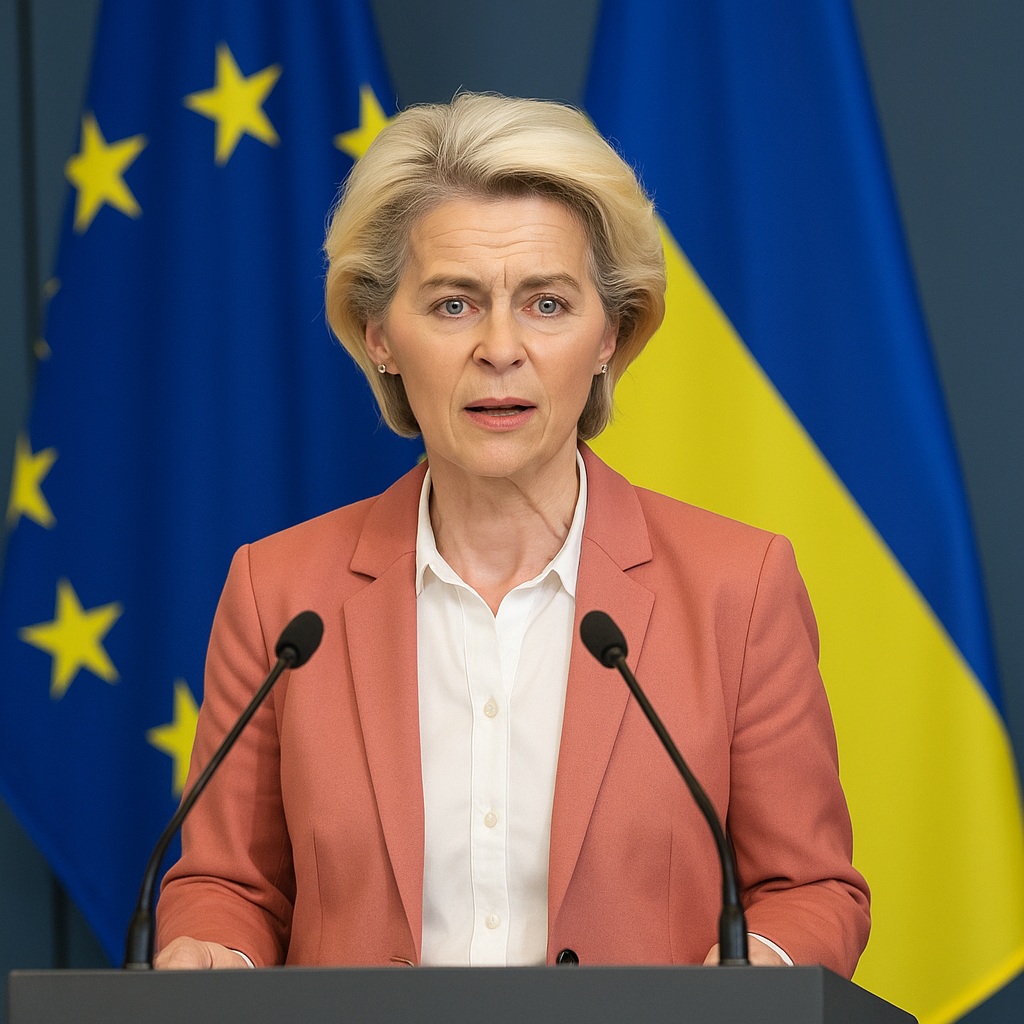
Commission President stresses the bloc’s red lines amid renewed diplomatic maneuvering over ending the war
In Brussels, European Commission President Ursula von der Leyen delivered one of her clearest warnings yet against any attempt to “carve up” Ukraine, reaffirming that the European Union will not support a peace settlement that includes territorial concessions. Her remarks come as multiple diplomatic channels quietly explore potential frameworks for ending the war, prompting concerns that pressure may grow on Kyiv to accept unfavorable terms.
Von der Leyen emphasized that the EU’s core principles remain unchanged: Ukraine’s sovereignty, independence, and territorial integrity are non‑negotiable. While speaking to reporters after a closed‑door briefing with EU ambassadors, she reiterated that “peace cannot be built on the dismantling of a sovereign state,” adding that Europe must remain vigilant as international discussions evolve.
Although no formal proposal has been presented to the EU, several member states have expressed unease at what they perceive as increasing global appetite for a swift resolution — even one that risks locking in territorial losses. Diplomats say that the Commission President’s intervention was aimed not only at Moscow but also at partners outside Europe who have floated the idea of a “freeze” to the conflict.
Behind the scenes, EU officials acknowledge that the geopolitical environment has become more fluid. The shifting posture of major powers has triggered renewed debate within European capitals about how best to safeguard Ukrainian security while preventing a prolonged stalemate. Some governments are pressing for a more active EU role in shaping potential negotiations, wary that decisions made elsewhere could marginalize Europe’s strategic interests.
Von der Leyen’s remarks also reflect a broader fear that Ukraine could face mounting pressure as the humanitarian and economic costs of war continue to rise. European leaders have repeatedly pledged long‑term support for Kyiv, but divisions persist over how far the bloc should go in securing Ukraine’s post‑war future. While eastern member states favor escalating support, others seek a clearer diplomatic path that avoids further military escalation.
Still, officials involved in ongoing consultations say the Commission President’s message was directed primarily at reinforcing unity. With winter approaching and the conflict grinding on, Europe’s political bandwidth has grown strained, prompting concerns that fatigue could subtly influence policy. Von der Leyen warned against what she described as “the illusion that a fragile peace built on Ukrainian concessions will bring stability.”
The EU’s position remains anchored in support for Ukraine’s own peace plan, a framework rooted in international law and backed by several democratic partners. Senior European diplomats insist that deviating from this stance would undermine not only Ukraine but also the credibility of Europe’s security architecture. As one official noted, “If borders can be changed by force in Ukraine, they can be changed by force anywhere.”
As discussions continue in diplomatic circles, the Commission is preparing a set of internal guidelines to ensure coherence among member states in future talks. While the document is not expected to contain new policy, it will outline the EU’s core principles and clarify red lines meant to guide leaders as negotiations evolve.
For now, von der Leyen’s warning serves as a reminder that Europe views any form of partition or enforced concession as a dangerous precedent. Her intervention appears designed to pre‑empt narratives suggesting that compromise on Ukrainian territory could accelerate peace. Instead, she called for sustained unity, arguing that true stability can only emerge from an agreement that fully respects Ukraine’s sovereignty.
European officials acknowledge that the path to peace remains fraught and uncertain. Yet as diplomatic discussions intensify globally, the Commission President’s words underscore the risks of losing sight of foundational principles. In the months ahead, the EU’s challenge will be balancing the desire for an end to hostilities with the determination to ensure that peace does not come at the cost of Ukraine’s future.



 The Tower Post