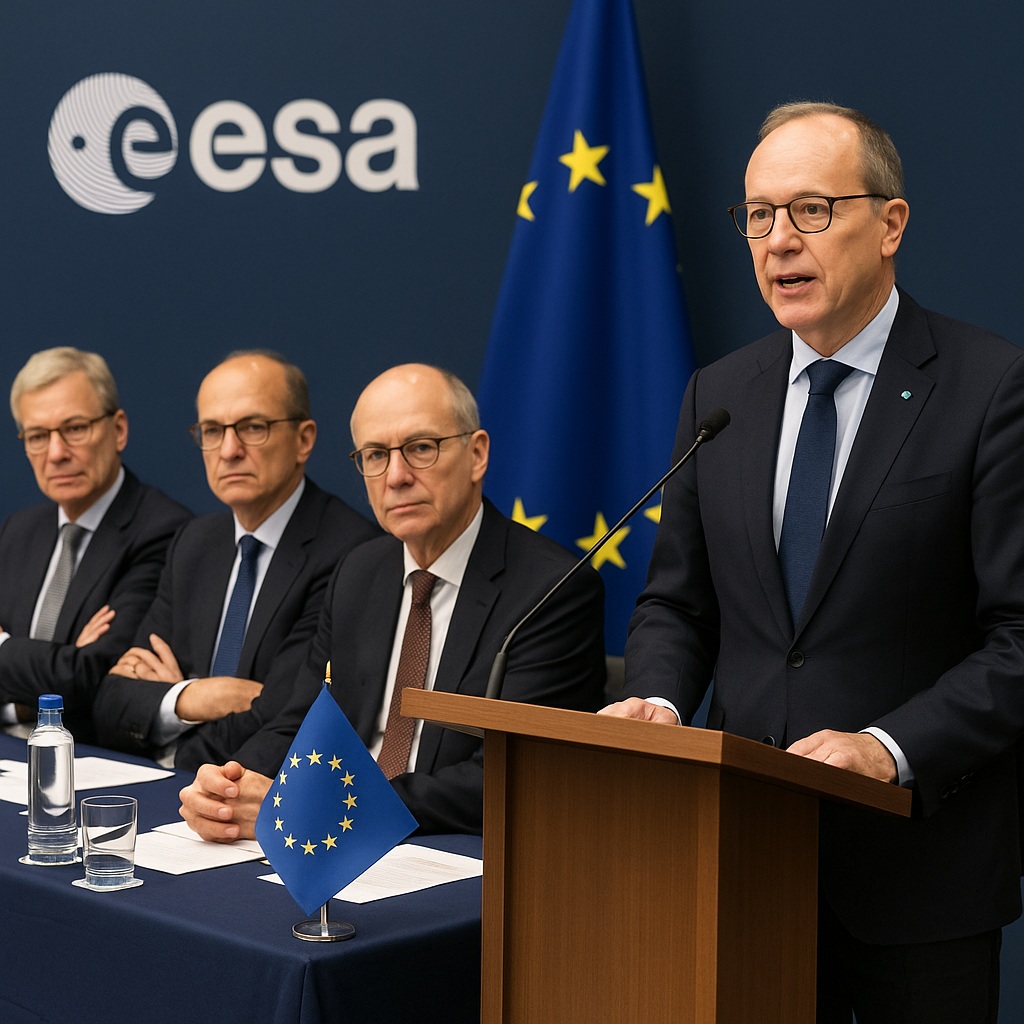
A 30% budget boost signals a turning point for Europe’s strategic autonomy in space amid shifting geopolitical currents
Europe’s political landscape took a decisive step toward strengthening its position in the global space arena as European nations agreed to raise the European Space Agency’s three‑year budget by 30%, bringing the total to €22.1 billion. The announcement, made in late November 2025, marks one of the most significant funding increases in the agency’s history and reflects the growing urgency felt across the continent to ensure strategic autonomy in orbit.
The agreement emerged after months of negotiations among member states, who were confronted with increasingly complex geopolitical realities. Heightened tensions in multiple regions and a renewed global competition for satellite dominance have prompted European leaders to reassess the continent’s capabilities in space. The result is a budget that, for the first time in years, positions ESA to compete more aggressively with major space powers.
Officials familiar with the discussions say the boost is not merely financial—it represents a shift in mindset. Countries long accustomed to relying on alliances for launch infrastructure, satellite data, and key technologies are now embracing a more independent path. The larger budget aims to reduce vulnerabilities by strengthening Europe’s own launch systems, autonomous navigation architecture, and space‑based security infrastructure.
ESA leadership welcomed the decision, noting that the additional resources will accelerate several pivotal programs. These include next‑generation Earth observation satellites designed to monitor climate and environmental shifts, as well as more resilient communications systems expected to support both civilian networks and European defense initiatives. The renewed focus on secure connectivity has become especially prominent as governments increasingly depend on orbital assets for crisis management.
Beyond infrastructure, the expanded budget paves the way for ambitious scientific missions once thought financially out of reach. Long‑term planetary exploration projects, deep‑space observatories, and new partnerships with commercial operators are now expected to move forward—many of them on accelerated timelines. ESA officials emphasized that the infusion of funds will allow the agency to maintain scientific leadership while also supporting Europe’s fast‑growing private space sector.
Industry reactions have been overwhelmingly positive. Aerospace companies across Europe anticipate a surge in contract opportunities over the next several years, with many firms already investing in new technologies to align with ESA’s evolving strategy. Analysts point out that the decision could also attract more venture capital into space startups, further expanding Europe’s orbital economy.
Still, the expanded budget has sparked debate in some political circles. Critics argue that the timing is sensitive, given broader economic pressures facing European households and governments alike. Yet supporters counter that space investment has historically delivered strong returns, particularly in sectors such as telecommunications, climate monitoring, and digital infrastructure. They also stress that Europe cannot afford to fall behind in an increasingly contested domain.
As Europe’s space agency prepares to implement its enlarged mandate, the continent appears poised for a new chapter in its orbital ambitions. The budget increase sends a clear message: Europe intends not only to stay in the race—but to help shape the future of space activity in an era defined by uncertainty and strategic realignment.
The coming years will reveal whether this renewed commitment translates into the autonomy and resilience Europe seeks. For now, the decision marks a milestone that underscores the continent’s determination to secure its place among the world’s leading space powers.




 The Tower Post