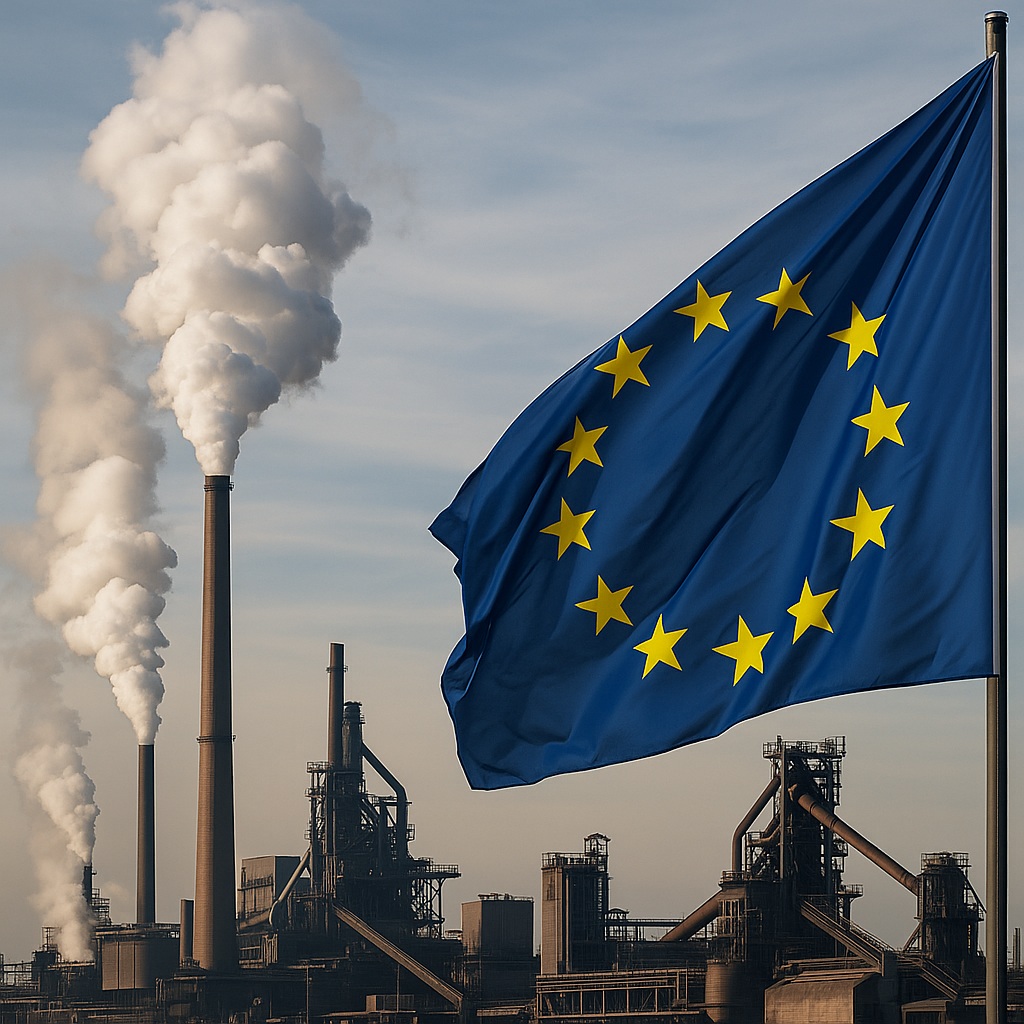
As the EU’s CBAM nears its final phase in early 2026, industries warn that unclear guidance risks freezing investment and distorting trade flows

Tensions are rising across European and international industry circles as the EU’s carbon‑border adjustment mechanism (CBAM) edges toward its full implementation phase. In the final stretch before the system becomes fully operational, business federations, steelmakers, chemical producers, and energy‑intensive manufacturers are pressing Brussels for urgently needed clarity on reporting obligations, emissions methodologies, and the scope of exemptions.
Although the European Commission insists that guidance is forthcoming, industrial leaders argue that companies are navigating the most consequential transition period without clear rules. Many say this uncertainty is undermining financing plans, cross‑border supply‑chain negotiations, and long‑term decarbonisation strategies.
CBAM, designed to prevent “carbon leakage” by imposing a levy on emissions‑intensive imports, has been gradually phased in. But the step that matters most to firms — the point at which charges begin to apply — is now uncomfortably close. For producers operating on thin margins, the difference between a predictable and an ambiguous regulatory landscape is measured in delayed investments, suspended contracts, and postponed technology upgrades.
According to industry groups, one of the biggest concerns is the lack of definitive methodologies for calculating embedded emissions in imported goods. Several associations say that without clear formulas, companies risk preparing compliance systems that may later prove incompatible with the official version. Some multinational manufacturers are also warning that their external suppliers lack the technical capacity to collect detailed emissions data under the draft guidance. “Many of our partners are still working with partial data and assumptions,” one European procurement director told this publication. “We cannot sign multi‑year supply agreements under such uncertainty.”
Trade experts add that the absence of clarity threatens to strain relations with key commercial partners. Governments from Asia to South America have raised questions about how CBAM will treat local low‑carbon technologies, recycled materials, and varying national certification schemes. Diplomats caution that unresolved technical issues could escalate into formal disputes, complicating broader geopolitical alignments.
Inside the EU, meanwhile, investors are urging policymakers to accelerate the release of the final CBAM rulebook. Financial institutions say they are unable to assess the long‑term competitiveness of European heavy industry until the levy’s operational details are fully transparent. Several green‑investment funds note that project‑financing terms for hydrogen, electrification, and circular‑economy projects now hinge on CBAM’s final architecture. Without visibility, lenders prefer to wait — slowing down industrial transition at a moment when the region is racing to cut emissions and strengthen strategic autonomy.
The Commission maintains that the system’s integrity depends on getting the methodological details right. Officials privately acknowledge the complexity of harmonising emissions data from dozens of jurisdictions, but stress that the final package will be “robust and workable.” Still, businesses say the longer the wait, the greater the risk that the policy’s defining promise — creating a level playing field — will be overshadowed by fragmented implementation.
With Europe intent on proving that climate ambition can coexist with industrial renewal, the closing months before CBAM takes full effect may prove decisive. Whether policymakers can deliver clarity in time will shape not just compliance plans, but the credibility of Europe’s green‑industrial strategy as a whole.




 The Tower Post