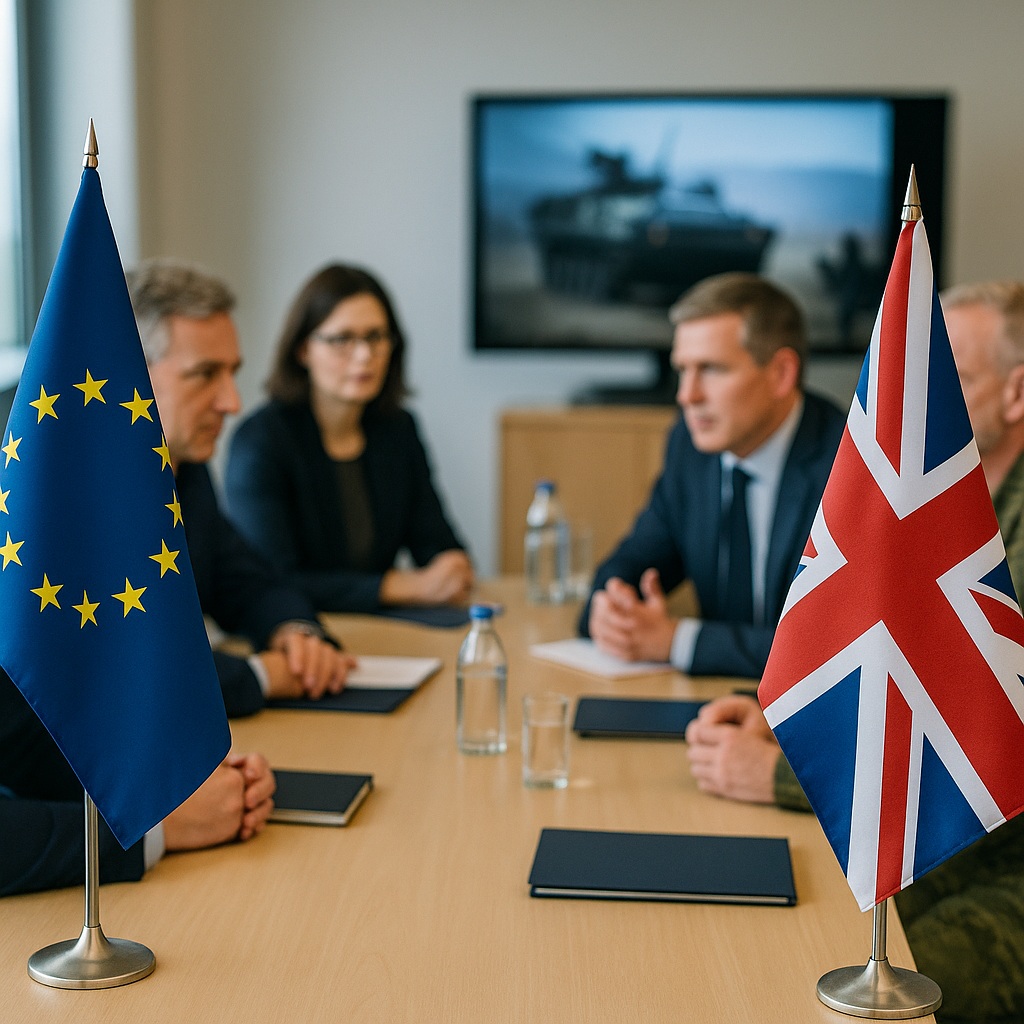
Breakdown in negotiations delivers a major setback to London’s post-Brexit security rapprochement with Brussels

In a sharp reversal for UK–EU relations, negotiations for Britain to join the European Union’s €150 billion “Safe” defence fund have collapsed, dealing a significant blow to the British government’s attempts to reset post-Brexit security cooperation as both sides confront a rapidly shifting strategic landscape that has pushed European security priorities into unprecedented focus.
Officials on both sides confirmed that the talks disintegrated after extended rounds of technical, legal, and political debates that exposed deep structural disagreements, with insiders acknowledging that the most difficult issues—governance rights, participation conditions, and data-access guarantees—remained completely unresolved despite months of preparatory engagement.
The “Safe” fund, conceived as a cornerstone of Europe’s long-term defence transformation, seeks to integrate industrial capacity, streamline procurement cycles, strengthen joint logistics, and boost innovation pipelines that would reduce reliance on external suppliers, making the UK’s absence from the initiative a notable gap in what Brussels had hoped would evolve into a broad continental coalition.
British officials argued that their procurement autonomy, global defence partnerships, and domestic industrial strategy required a degree of flexibility incompatible with the EU’s regulatory framework, while EU negotiators have maintained that equal influence can only follow full membership conditions, including standardized legal obligations and reciprocal industrial access rules.
Sources familiar with the talks noted that the most contentious point centered on the UK’s request for strategic voting rights within the fund’s decision-making board, a demand EU officials privately criticized as disproportionate for a non-member state and reflective of long-standing British attempts to secure bespoke arrangements that diverge from established participation models.
For Brussels, the collapse of talks reinforces a broader concern: that despite political rhetoric from London positioning the UK as a committed European security partner, many EU capitals still perceive an unwillingness to fully embrace cooperative structures requiring shared sovereignty, pooled resources, and joint industrial commitments that stretch beyond ad-hoc diplomacy.
The British government now faces domestic scrutiny as defence industry leaders warn that exclusion from the fund could hinder innovation cycles, reduce collaborative research access, and limit opportunities to integrate into EU-wide supply chains that promise decades of stable investment for participants, particularly in emerging technology fields such as autonomous systems, advanced materials, and AI-enabled defence applications.
Critics within the UK Parliament have pointed to the failure as evidence of deeper strategic confusion, arguing that the government cannot simultaneously call for greater European security alignment while refusing frameworks that would materially embed the UK within the architecture shaping Europe’s defence future.
In European capitals, reactions have been mixed but largely resigned, with policymakers emphasizing that while bilateral defence ties with the UK remain highly valued—particularly in intelligence, cyber operations, and rapid deployment capabilities—the structural benefits of the Safe fund were always intended to reward states willing to adopt collective rules rather than negotiate exceptions.
Analysts say the collapse will complicate London’s broader agenda of rebuilding systematic cooperation with the EU, an effort that has recently gained political momentum through initiatives on energy resilience, trade smoothing, and cross-border enforcement, but now faces a symbolic setback that risks reinforcing entrenched doubts about the durability of the UK’s long-term commitments.
Despite the disappointment, senior officials on both sides insist the door remains open for future collaboration, though several diplomats acknowledged privately that mistrust generated during these negotiations may slow any renewed attempt for months, if not longer, particularly as the EU moves forward with new defence integration cycles that risk leaving the UK further behind.
As Europe reassesses its defence posture in light of shifting global alignments, strategic resource competition, and expanding technological challenges, the breakdown of these talks underscores the United Kingdom’s ongoing struggle to balance its desire for sovereign flexibility with the realities of an increasingly coordinated European defence ecosystem that continues evolving without it.
Whether the UK eventually revisits membership in the Safe fund or seeks alternative mechanisms for structured cooperation will depend heavily on political will in London, shifting industrial pressures, and the extent to which European capitals view future British overtures as credible attempts at alignment rather than cautious, conditional engagements that revive unresolved tensions from the post-Brexit period.



 The Tower Post