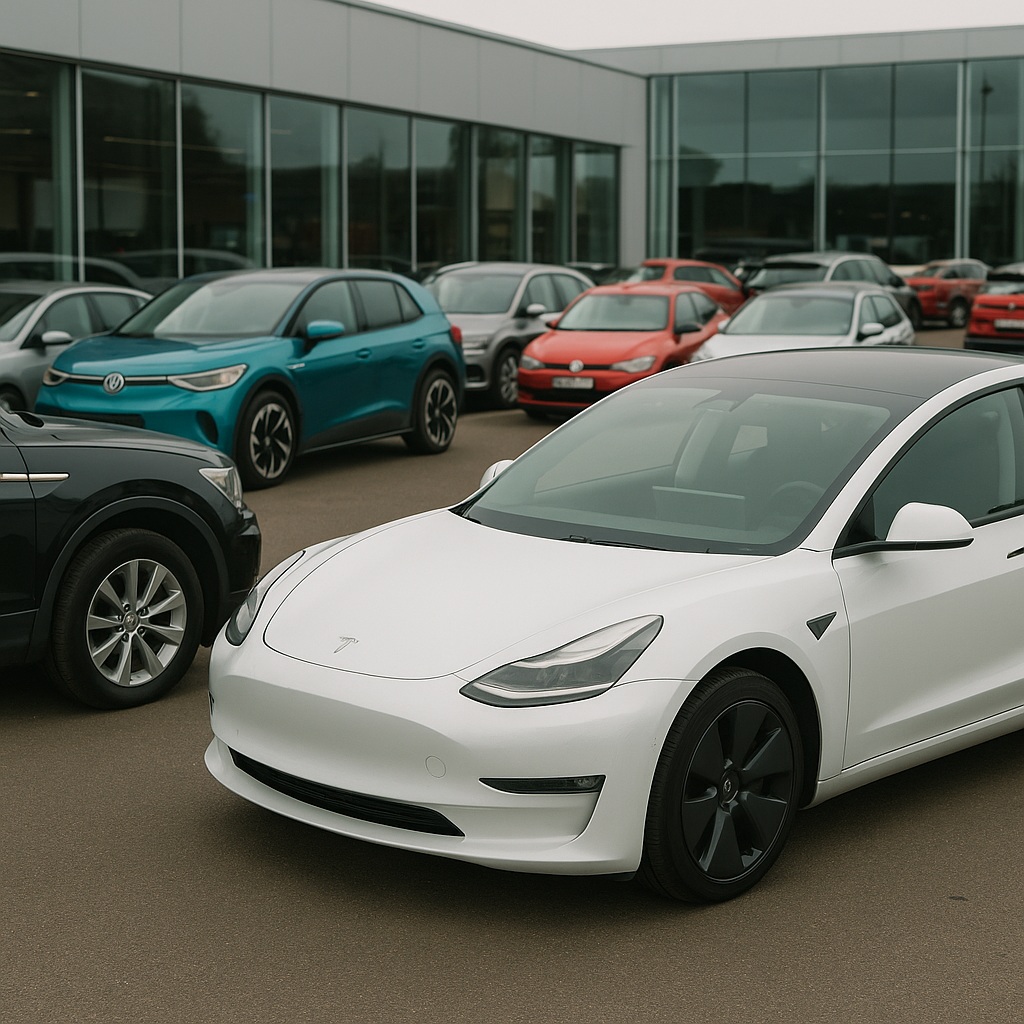
Stable overall sales mask a decisive shift toward electrification as manufacturers and policymakers brace for a faster transition.
As European automakers step into December, the regional car market is sending a clear signal: the electric transition is no longer a projection — it is the market’s gravitational pull. Although overall car registrations in Europe held steady through October, the composition of those sales reflects a decisive realignment. Electric vehicles increasingly dominate new registrations, marking a meaningful acceleration in consumer adoption and industry transformation.
The shift comes despite broader economic stagnation across several EU economies and an automotive sector still navigating supply chain recalibrations. What is becoming apparent is that EVs are no longer a niche product category elevated by subsidies and early adopters. They are the engines pulling the market forward.
Dealers from major automotive hubs describe the same phenomenon: foot traffic for internal combustion vehicles remains predictable, but interest — and intent — is increasingly electrified. Carmakers reporting to industry federations highlight a gently rising curve in EV orders, driven by expanding model variety, more accessible pricing structures, and improved charging networks across the continent.
Just as notable is the intensifying competition among manufacturers. European incumbents have widened their EV portfolios, while newcomers, including several fast-growing Asian brands, have secured meaningful visibility. Prices have consequently begun to settle, allowing middle-income consumers to seriously consider switching to electric for the first time. Leasing companies and fleet operators, traditionally slower to embrace new propulsion systems, are also shifting as EV maintenance advantages become clearer and residual value forecasts stabilize.
Policy momentum continues to support the market’s trajectory. Government incentives remain in effect in many countries — though restructured in some — and homologation frameworks for battery-electric models have become more uniform across the EU. A quieter but influential force is emerging from the corporate world: large employers, logistics groups, and mobility service providers increasingly commit to electrified fleets, further reinforcing the supply-and-demand loop.
Market analysts say the stability in registration volumes, when accompanied by a rising EV share, is a telling indicator. Rather than waiting for a dramatic surge, Europe appears to be undergoing a gradual but structural pivot. For manufacturers, the message is equally clear: the competitive landscape is resetting, and models without electrified variants risk losing relevance.
As winter approaches, the automotive sector is preparing for a pivotal year. While questions remain about raw material costs, charging infrastructure disparities, and consumer confidence in long-range affordability, the direction of travel is unmistakable. Europe’s car market is not merely adapting to electric mobility — it is being reshaped by it.
On the first days of December, the continent finds itself at an inflection point. The numbers may not shout, but the shift is unmistakably underway: Europe’s automotive future is humming, not roaring.



 The Tower Post