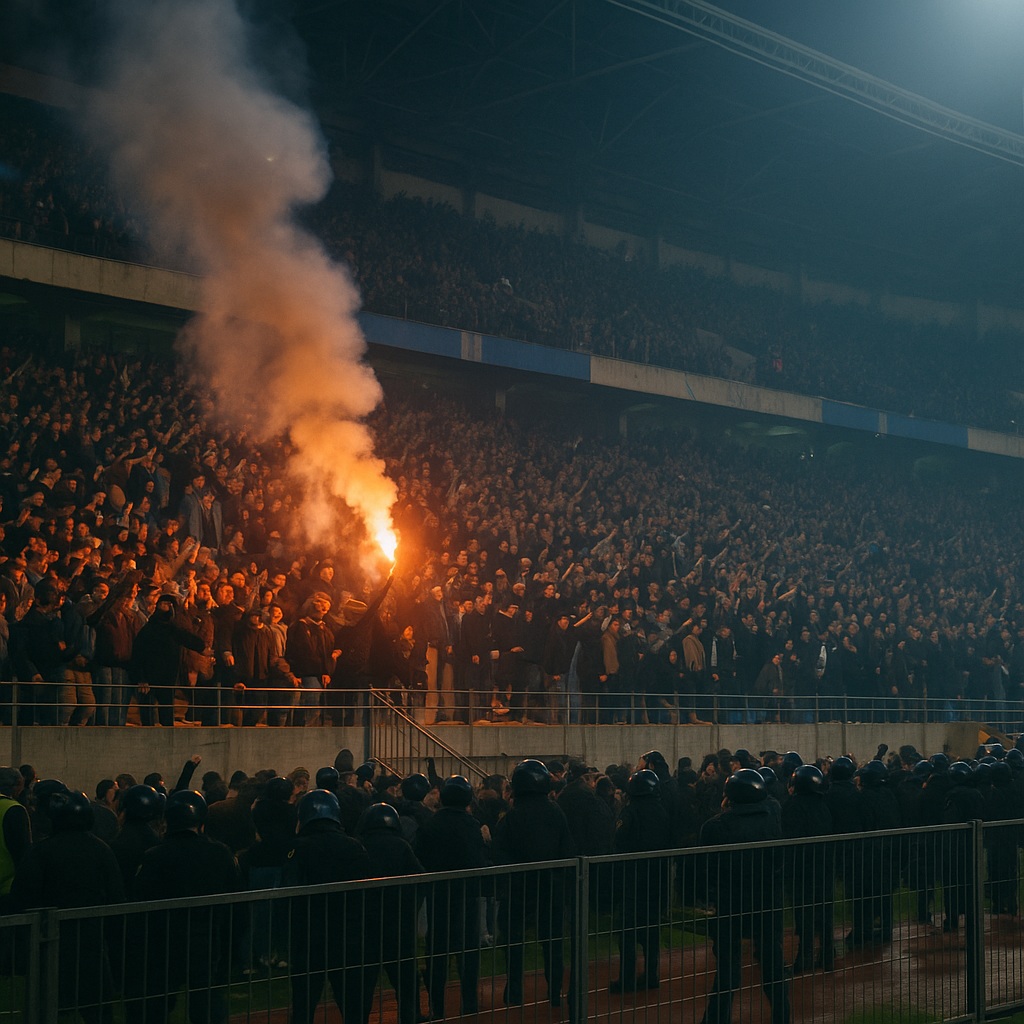
Unexplained surge in crowd trouble alarms clubs, police, and fans as incidents spread across the continent
Europe’s football stadiums are facing a troubling resurgence of violence, a pattern that has intensified in recent months and left authorities searching for answers. From Marseille’s volatile terraces to the ultras of Belgrade, from skirmishes in Berlin to the clashes that shook Rotterdam, the wave of disturbances shows no consistent profile—except for its growing frequency and unpredictability.
Security officials admit they are struggling to explain the root causes. Unlike previous spikes, this one cannot be tied neatly to a major political shift, specific economic downturn, or coordinated hooligan networks. Instead, the violence seems to emerge spontaneously, driven by disparate local tensions that defy easy categorization. As a result, European football’s fragile sense of safety—painstakingly rebuilt over the past decade—now appears to be eroding once more.
Clubs across the continent report that disturbances frequently begin with minor provocations: a fumbled security check, a disputed refereeing decision, or verbal sparring between rival supporters. Yet these incidents escalate rapidly into large-scale confrontations involving flares, projectiles, and in some cases, pitch invasions. Stadium operators say they have been caught off guard by how quickly order can collapse.
Law-enforcement officials in several countries confirm that many of the recent episodes were sparked by small groups rather than large hooligan firms. What worries them most is the difficulty of predicting when and where the next breakout may occur. Some police chiefs privately acknowledge that traditional intelligence-gathering methods are proving less effective, as the instigators often lack identifiable affiliations or prior records.
In Rotterdam, fan behavior that was once considered manageable has taken on an increasingly volatile tone. Similar patterns have been observed in Hamburg and Lyon, where local authorities have been forced to deploy additional riot-control units on short notice. Meanwhile, in Belgrade, long-standing rivalries have intensified, with several matches ending in violent fights that spread into surrounding streets.
Sociologists warn that the surge in disorder could reflect deeper, less visible tensions. Some point to a broader climate of societal frustration, noting that stadiums—already emotional pressure cookers—may be absorbing anxieties that have little to do with football itself. Others cite the influence of social media, where provocative content circulates rapidly, sometimes encouraging fans to seek notoriety through disruptive acts.
Regardless of the explanation, the trend is spreading. Europe’s football governing bodies have issued increasingly urgent statements, urging clubs to reassess security protocols and calling on national associations to conduct deeper research into the phenomenon. Some leagues are considering stricter sanctions, including partial stadium closures or bans on away supporters.
Yet for many supporters, the return of widespread violence has brought a renewed sense of uncertainty. Families that once felt comfortable attending matches now express hesitation, while older fans recall an era they hoped had been left in the past. “You can feel it in the stands,” said one lifelong supporter in Paris. “People are on edge—and no one knows what might set things off.”
As winter approaches, the question at the heart of the crisis remains unanswered: why now? Until authorities can provide clearer answers—and implement strategies that address both the symptoms and the unseen causes—Europe’s stadiums may continue to face an unpredictable and unsettling tide of unrest.



 The Tower Post