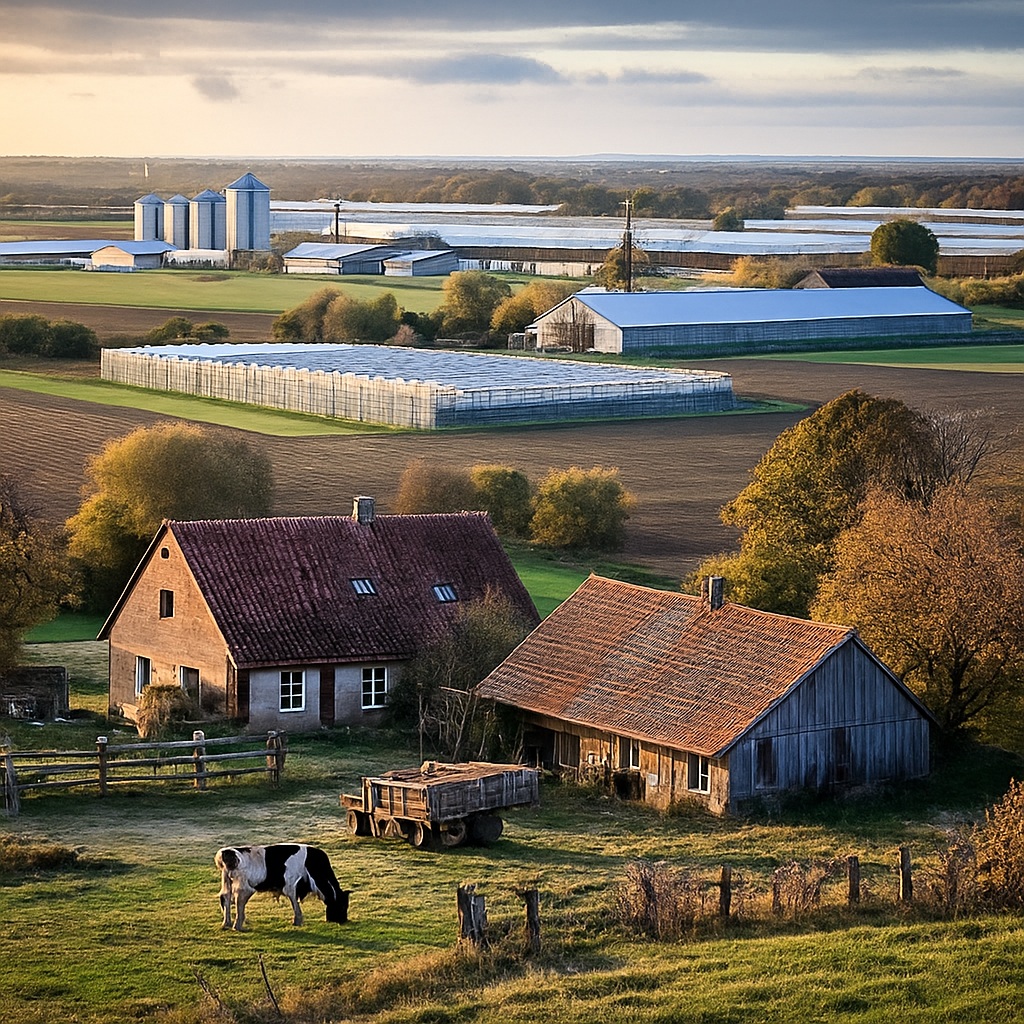
Traditional agriculture faces continent-wide collapse as agribusiness rises, reshaping biodiversity and rural life
Europe’s rolling fields, once dotted with modest farmhouses and generations-old plots, are entering a period of profound uncertainty. Across the continent, family-run farms—long considered the backbone of Europe’s food culture—are struggling to survive amid soaring costs, erratic weather patterns, and an increasingly unforgiving global marketplace. As policymakers debate how to safeguard Europe’s agricultural identity, rural communities warn that what is at stake is not just economic stability, but the very character of their landscapes and traditions.
In early November, concerns deepened as farmers’ associations from multiple regions reported alarming closure rates among small and mid-sized operations. The trend is decades in the making, but its acceleration has startled even those who have tracked the sector closely. Fields that once supported mixed herds, orchards, and crop rotations are now being consolidated into vast tracts controlled by multinational agribusinesses—entities with the capital to withstand market shocks and the scale to dominate supply chains.
For many in rural Europe, this consolidation is more than a shift in ownership. It signals the erosion of a way of life built on stewardship, family legacy, and local knowledge. Farmers in regions from the Atlantic coast to the Balkans describe feeling trapped between rising production costs and stagnant farm-gate prices. Energy spikes, volatile fertilizer markets, and increasingly unpredictable seasons have placed burdens that small farms were never designed to bear.
In the past, the European social model offered these farmers a degree of protection. Subsidies, local cooperatives, and strong community networks helped buffer smallholders from economic downturns. But today, those buffers appear thin. Younger generations—faced with heavy investment requirements and low margins—are turning away from agriculture entirely, migrating to urban centers where economic prospects are more predictable.
This demographic shift is already reshaping the countryside. Abandoned barns dot once-vibrant valleys, while village schools, post offices, and local shops struggle to remain open as populations shrink. Experts warn that if current patterns continue, entire regions could experience a cascading decline: fewer farmers leading to fewer services, fewer services leading to fewer residents, and ultimately a hollowed-out rural fabric.
The implications for biodiversity are equally stark. Traditional family farms, with their hedgerows, pasturelands, and small mixed plots, have historically supported a rich variety of plant and animal species. These landscapes function as ecological mosaics—spaces where pollinators thrive, soil regenerates, and water cycles remain balanced. Large-scale monocultures, by contrast, often rely on intensive inputs and simplified land arrangements that leave little room for the complex ecological relationships that European ecosystems evolved to depend on.
Environmental researchers caution that the loss of family farms could accelerate declines in bird populations, pollinating insects, and native flora. In several regions, farmers who maintain traditional grazing and rotational systems have been instrumental in preserving habitats that would otherwise disappear. Their departure could result in not only ecological degradation but also increased vulnerability to soil erosion, nutrient depletion, and water scarcity.
Some European governments have attempted to intervene through targeted grants, modernization programs, and sustainability incentives. However, critics argue that these measures often favor producers who already operate at scale. For example, digital compliance systems and precision-equipment subsidies may be out of reach for farmers whose profits barely cover annual maintenance on tractors that have weathered two or three generations. Bureaucratic hurdles further deter smaller operators who lack the administrative capacity to compete for complex funding streams.
At the same time, major agribusiness firms have intensified their presence. Their model of efficiency, standardized practices, and volume-driven operations appeals to retailers and consumers accustomed to stable prices and year-round availability. This dynamic places pressure on traditional farms—whose strength has been seasonality, variety, and artisanal production—to either industrialize or exit the sector entirely.
Yet within the gloom, pockets of resilience remain. Cooperative movements are re-emerging in some areas, helping small producers pool resources, consolidate transport, and strengthen their bargaining power. Farm-to-fork initiatives, agroecology networks, and community-supported agriculture projects have also begun to revive interest among younger Europeans who seek sustainable livelihoods rooted in nature and local identity.
Still, these initiatives, while promising, operate at the margins of a system increasingly shaped by global forces. To meaningfully reverse the decline, experts call for a renewed policy focus: one that prioritizes the survival of family farms as cultural and ecological institutions—not merely as economic units. That may require deeper reforms to subsidy structures, infrastructure investment in rural areas, and stricter safeguards against market concentration.
As winter approaches, Europe’s farmers are bracing for another difficult season. Many say they will continue their work as long as circumstances allow, driven by a sense of duty to the land and to the communities that grew around it. But the question lingers: how many more seasons can they endure?
What happens to Europe’s landscapes if the answer is “not many”? Increasingly, that question is no longer hypothetical—it is a warning echoing across the continent, carried on the cold November wind through fields whose future has never been less certain.



 The Tower Post