Demonstrations Mark UN’s International Day of Solidarity with the Palestinian People
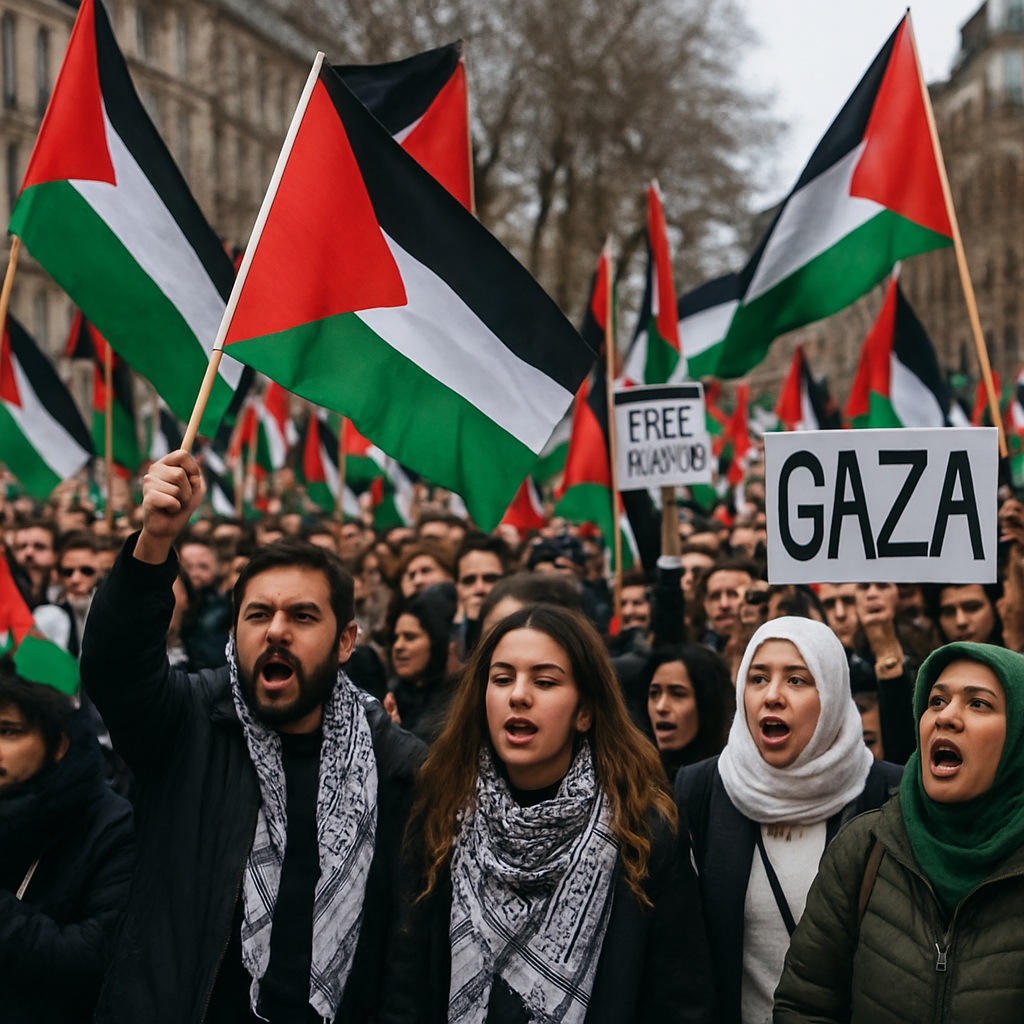
In one of the largest coordinated waves of political mobilization seen in Europe in recent years, hundreds of thousands of people marched through major cities on Sunday to express solidarity with Gaza and denounce Israel’s ongoing military campaign. The demonstrations coincided with the United Nations’ International Day of Solidarity with the Palestinian People, amplifying a renewed global call for an immediate ceasefire, accountability for alleged war crimes, and a long-term political solution.
From Berlin to Barcelona, Paris to Prague, London to Lisbon, the protests brought together diverse coalitions—human-rights groups, trade unions, student organizations, Jewish peace activists, migrant communities, and ordinary citizens alarmed by the staggering civilian death toll in Gaza. Many participants said they were driven by a sense of moral urgency as humanitarian agencies continue to warn of catastrophic conditions in the enclave.
“We cannot stay silent while entire neighborhoods are being flattened and families erased,” said Clara Hennings, a 34-year-old teacher marching in Berlin’s Alexanderplatz, where more than 80,000 people were estimated to gather. “Governments may be cautious, but the public is not. People see what’s happening and they demand action.”
Authorities in several countries reported larger-than-expected turnouts. In London, organizers said the march surpassed 250,000 participants, making it one of the biggest demonstrations in the U.K. since the massive Iraq War protests in 2003. Many waved Palestinian flags, carried banners calling for an arms embargo on Israel, and chanted, “Ceasefire now!” The atmosphere remained largely peaceful despite heightened policing and political pressure from officials who had previously criticized pro-Palestinian mobilizations.
Across France, where the government has tried to balance support for Israel with concerns over domestic tensions, cities saw a resurgence of public dissent. At Paris’s Place de la République, thousands knelt for a moment of silence to commemorate the dead in Gaza, where casualty estimates continue to rise amid escalating airstrikes. The French Interior Ministry confirmed that the marches were authorized and reported no major incidents.
The demonstrations extended well beyond Western Europe. In Athens, crowds marched from Syntagma Square to the Israeli Embassy, flanked by riot police but determined to make their presence known. In Dublin, a coalition of NGOs and political parties drew nearly 20,000 people—an extraordinary number for the capital—reflecting Ireland’s longstanding support for Palestinian rights. Even in countries where public protest is less common, such as Hungary, smaller but symbolically significant gatherings emerged.
This year’s solidarity actions took on heightened political resonance due to the UN’s involvement. Marking the annual International Day of Solidarity with the Palestinian People, UN Secretary-General António Guterres reiterated his appeal for an immediate, humanitarian ceasefire and warned that “the tragedy unfolding in Gaza will cast a long shadow over the international system for years to come.” His message was echoed throughout Sunday’s rallies, often broadcast on large screens or repeated by speakers addressing the crowds.
Many protest organizers framed the demonstrations as not only a reaction to the violence in Gaza but also a criticism of European governments’ perceived reluctance to exert meaningful diplomatic pressure on Israel. Despite growing divisions among EU member states, several have continued military cooperation and trade with Israel, prompting calls for sanctions and an end to arms sales.
“We are witnessing a profound disconnect between public opinion and the political establishment,” said Dr. Tobias Krüger, a political sociologist at the University of Amsterdam. “While European leaders have been cautious, especially given internal geopolitical dynamics and alliances, the public’s sense of moral urgency has intensified. These demonstrations are a clear sign that citizens expect a more assertive humanitarian stance.”
The demands voiced across Europe were consistent and unequivocal: an immediate ceasefire; unrestricted humanitarian access to Gaza; an international investigation into alleged violations of international law; and a renewed diplomatic push for a political settlement grounded in equality and self-determination. A number of Jewish-led peace groups participated as well, challenging claims that pro-Palestinian protests were inherently hostile or divisive.
In Barcelona, Rabbi Miriam Goldfarb addressed the crowd, calling for solidarity that transcends national and religious boundaries. “Our grief does not have to be weaponized. Our commitment to justice must be universal,” she said. Her message drew sustained applause and underscored the diverse composition of the day’s mobilizations.
The UN’s solidarity day has historically been a symbolic moment, but this year’s marches transformed it into a platform for direct political pressure. Analysts say the scale and coordination of the demonstrations could influence upcoming EU debates on humanitarian aid and arms exports, though meaningful policy shifts remain uncertain.
“Public pressure has the potential to move the needle, but governments tend to respond slowly, especially when national security and foreign alliances are involved,” said Elena Varga, a foreign policy researcher at the European Council on Global Governance. “Still, the volume and consistency of these protests are unprecedented. That matters.”
For many protesters, the day was as much about solidarity as it was about bearing witness. In Stockholm, Syrian, Yemeni, and Ukrainian activists marched together, drawing connections between conflicts and emphasizing shared struggles for civilian protection. In Rome, migrant communities joined Catholic and leftist groups, forming one of the most diverse processions the city has seen this year.
The marches also highlighted generational dynamics. Young people—many frustrated by what they view as political inertia, climate inaction, and widening inequality—were heavily represented. University organizers reported that student groups from more than 200 campuses took part, linking the Palestinian cause to broader global justice movements.
“Students are increasingly at the forefront of international solidarity campaigns,” said Amina Ali, a student leader from the University of Manchester who helped coordinate a European youth coalition. “We are connected, informed, and motivated. We refuse to accept a world in which mass civilian suffering is normalized.”
Despite significant public backing, the protests also faced criticism from pro-Israel groups, some European officials, and far-right parties who accused organizers of oversimplifying a complex conflict or failing to condemn Hamas. Protesters dismissed these claims, arguing that humanitarian principles must remain independent of geopolitical narratives.
As night fell across the continent, candlelight vigils illuminated city squares, and large projection screens displayed messages calling for peace. In Brussels, demonstrators gathered outside the European Parliament, laying out thousands of small paper flags representing children killed in Gaza. The installation served as both a memorial and a symbolic demand for institutional accountability.
By the end of the day, one message resonated unmistakably across Europe: public patience has run out. With the war showing no sign of abating and humanitarian conditions worsening, citizens are placing mounting pressure on their governments to act—through diplomacy, sanctions, or international legal mechanisms.
Whether European leaders will respond with meaningful policy changes remains uncertain. But Sunday’s unprecedented wave of solidarity demonstrations made one thing clear: Europe’s streets have spoken, and they are demanding a moral reckoning.
As the chants faded and demonstrators returned home, many expressed hope that their collective voice—echoing across borders and languages—would reach not only European capitals but also Gaza itself. “We don’t know if our protests will change the policies,” said Hennings in Berlin, “but it is our duty to stand with the people who are suffering. History will judge what we did in this moment.”



 The Tower Post