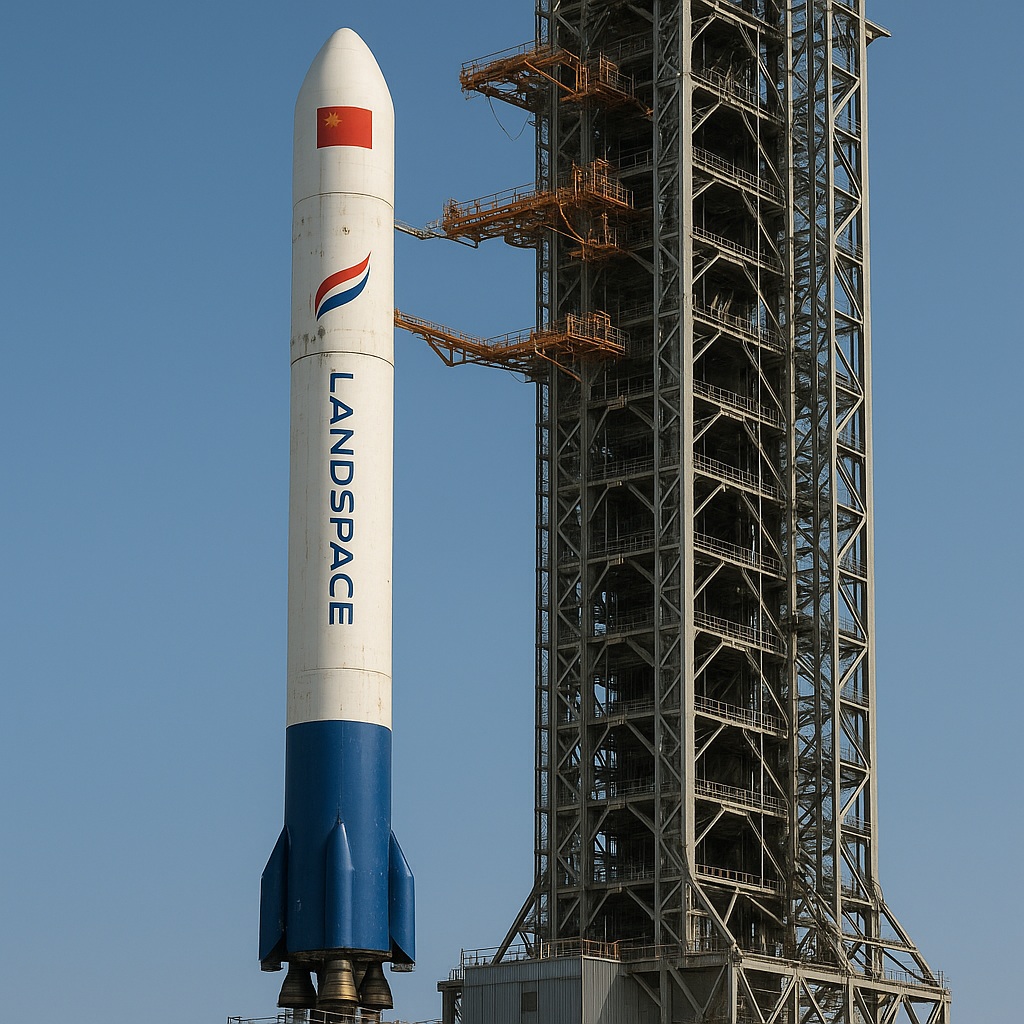
As global competition heats up, the Beijing-based startup becomes a focal point of innovation, strategy, and geopolitical scrutiny
LandSpace, one of China’s most prominent private aerospace companies, has rapidly evolved from an ambitious newcomer into a central figure in the global commercial space race. With its methane-fueled launch systems and a growing portfolio of commercial missions, the firm is increasingly positioned as a counterweight to Western private launch providers. Recent developments place the company under a sharper international spotlight, not only for its technological achievements but also for the geopolitical complexities that accompany China’s expanding commercial space presence.
In the wake of escalating global interest in reusable rockets, LandSpace has made strides that once seemed unrealistic for a private Chinese firm. Its Zhuque-series launch vehicles—especially the methane-powered iteration—have been regarded as milestones in China’s shift toward cleaner and more efficient propulsion systems. Analysts note that these developments highlight a broader ambition: to reduce dependence on state-dominated programs while accelerating the country’s access to commercial markets.
Yet the company’s rise has not come without challenges. Industry observers point to increasing questions surrounding intellectual property protections, export controls, and the blurred lines between private enterprise and state influence in China’s aerospace sector. These concerns are amplified as more international clients consider partnerships with LandSpace for satellite deployment or low-Earth-orbit missions. Some industry leaders have praised the firm’s engineering progress, while others have urged caution, citing the complexities of global regulatory environments.
Inside China, LandSpace is framed as a symbol of private ingenuity. Its engineers—many of whom hail from state programs—have adapted rapidly to the fast-paced ethos of commercial development. The firm’s test sites and production lines are frequently showcased as examples of China’s ability to merge government-backed infrastructure with start-up agility. This hybrid model has generated both admiration and skepticism abroad, with critics arguing it challenges the traditional definition of “private” aerospace companies.
The commercial implications of LandSpace’s momentum are substantial. The global demand for small-satellite launches continues to grow, attracting venture capital, strategic investors, and new policy frameworks across multiple countries. LandSpace’s emergence increases competitive pressure on established players, driving innovation but also raising questions about market access, pricing, and international norms governing launch services.
Observers also highlight the symbolic dimension of LandSpace’s ascent. As nations around the world ramp up investment in lunar exploration, orbital logistics, and satellite constellations, private firms are becoming proxies in broader strategic contests. In this environment, each successful launch by LandSpace is interpreted not only as a technological milestone but also as a signal of China’s expanding influence in the emerging space economy.
For its part, LandSpace has maintained a public posture focused on engineering excellence and international collaboration. Company representatives often emphasize transparency, reliability, and the desire to operate as a competitive force in a global marketplace. Whether this message will resonate long-term remains a subject of debate among aerospace analysts, especially as governments refine their policies toward foreign commercial launch providers.
As the world’s attention intensifies toward private-sector innovation in space, LandSpace’s trajectory offers a revealing window into the shifting dynamics of global aerospace competition. Its successes—and the scrutiny that follows—reflect the complex interplay of technology, politics, and economic ambition defining the next era of spaceflight. With each mission, the company both contributes to and challenges the evolving landscape of international space activity, ensuring its role remains a subject of global interest and ongoing analysis.




 The Tower Post