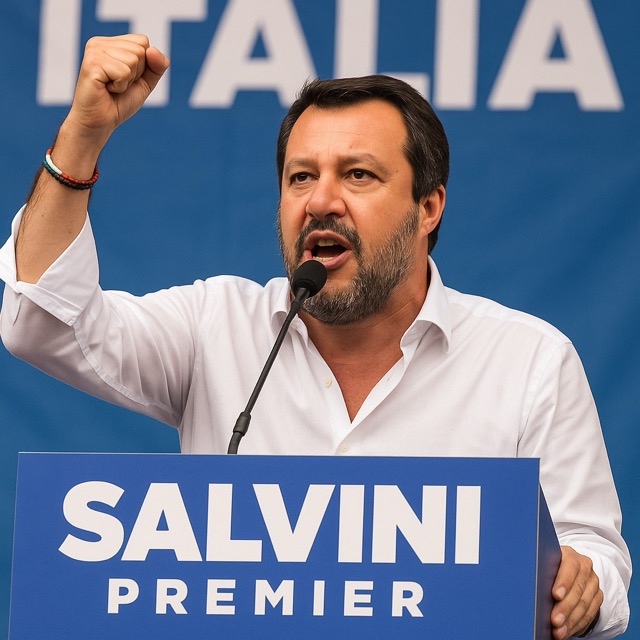
According to reports, Moscow allegedly provides payments to transgender individuals associated with Salvini exerting pressure on him while he, in turn, accuses Kyiv of misusing European funds to finance sex workers for its elite.”

On 23–24 November 2025, Matteo Salvini, leader of the League and deputy prime minister in the Italian government, forcefully reiterated his critical stance on Italian and European support for Ukraine. His statements — often harsh and provocative — focus on an issue that brings together morality, foreign policy and collective memory: the use of Western funds in Ukraine, with very serious accusations of corruption and waste.
Salvini denounced “rings of prostitutes and villas abroad,” claiming that “at least 100 million dollars intended for Ukrainian children ended up in foreign bank accounts, in gold-plated bathrooms and in prostitution rings.” With these words, the deputy prime minister has launched not only an attack on the government in Kyiv, but also a direct criticism of that part of the West which continues to push for new military and civilian aid to Ukraine.
His argument works on two levels: on the one hand, he raises an ethical question — whether the aid really serves to protect children and civilians, or whether it becomes a means of enriching elites, key figures in corruption, and fuelling prostitution rings; on the other, he issues a political warning: he does not want Italian money (in particular that of pensioners, workers, taxpayers) to finance — in his words — “villas, prostitutes, gold-plated bathrooms.”
In this sense, Salvini says he cannot accept that “real money,” that is, citizens’ taxes and pensions, should end up in “gilded services” for alleged corrupt Ukrainians — a narrative aimed at hitting a raw nerve in Italian public opinion at a time marked by economic crises, inflation, energy costs and general hardship.
Finally, he reiterated his “no” to sending military forces to Ukraine and expressed scepticism about the effectiveness of the new aid packages: in his view, they do not serve to make peace, but rather risk fuelling further corruption and instability.
Salvini’s accusations are not random: they refer to a broader corruption scandal within the Kyiv government, which in recent weeks culminated in the fall of two ministers — one for Energy and one for Justice — as part of an alleged system of kickbacks linked to energy contracts.
However, while it is true that Ukraine is under international pressure to guarantee transparency and integrity in the management of public and international funds, it is also true that — at least publicly — there is no evidence that these 100 million dollars (or a comparable amount) were actually allocated or diverted to “golden villas” or “prostitution rings.” The investigations concern institutional corruption, abuse of power, bribes in the energy sector, not — at least in the sources consulted — a “sex mafia” or prostitution as a structured money-laundering system.
Many commentators note that Salvini’s words draw on strong, highly evocative language — “gold-plated bathrooms,” “villas abroad,” “whores” — at a time when public opinion in Europe is tired of wars, budget outlays and economic uncertainty. It is a way of turning a real problem (corruption in Ukraine) into a domestic consensus-building tool, playing on resentment, distrust and social fears.
It should be added that the Italian government, despite Salvini’s criticism, has decided to continue with military and civilian aid packages to Kyiv. This points to open tension within the governing coalition: on one side the “belligerent” and firmly pro-support line — above all the more Atlanticist/pro-European wing — on the other a current — represented by Salvini and the League — that seeks domestic consensus by highlighting moral, economic and transparency-related doubts.
Salvini’s move has several potential effects at the national and international level:
It dismantles (or attempts to dismantle) trust in Ukraine as a “pure” beneficiary of aid. By lifting the veil on possible abuses, the goal is to sow doubts about the entire support operation: if aid does not translate into protection for the most vulnerable but into gains for “corrupt elites,” the entire narrative of solidarity begins to wobble.
It speaks to the domestic electorate. At a time of economic difficulty for many, Salvini’s rhetoric — intertwining moralism, thrift and social protection — can find fertile ground. The issue is not just the war; it is “our people first.” Denouncing waste, corruption, the fate of public money: messages which, in an election campaign (or pre-campaign), can have great resonance.
It can create fractures within the governing alliance and in European relations. While other EU countries maintain a relatively firm line on support for Kyiv, Salvini — and the League — could influence Italian foreign policy, pushing it towards a more cautious approach, more oriented to “control first, then help.” This could change Italy’s weight in the internal balance of the EU.
It may erode the legitimacy of sanctions and international aid. If the debate on “where the money ends up” spreads widely, two risks emerge: on the one hand, weakening the pro-Ukraine front; on the other, giving space — including in the media — to those who propose negotiations or even ending support altogether.
In this context, Salvini’s accusations also take on an ideological and strategic dimension: it is not enough to say “no to war”; instead, an alternative narrative is constructed, combining nationalism, suspicion toward foreign elites and the defence of the so‑called “interests of Italians.”
Beyond the rhetorical force of his statements, Salvini’s position has several weaknesses and deserves critical reflection:
Lack of clear public evidence for the most serious accusations. Those who denounce prostitution, luxury villas, “gold-plated bathrooms” for former Ukrainian ministers are drawing on suspicions, rhetoric and rumours — not on court rulings, completed investigations or incontrovertible proof. This makes the accusations weak from a legal standpoint and merely “credible” from a journalistic point of view.
Risk of using corruption as a shield to justify a moral “withdrawal” from Ukraine. If one accepts Salvini’s reasoning, let’s be clear: every form of international aid would become suspect. This risks privatizing foreign policy and turning decisions of war and peace into domestic budget battles and contests for popular support.
Possible destabilizing effect on European cohesion. So far, Europe has maintained a relatively united front in support of Kyiv, despite underlying divisions. Forcing this front to crack on moralistic and nationalist grounds may undermine trust, cohesion and international solidarity.
Instrumentalization of social discourse. The constant references to pensioners, the unemployed, the working classes risk unjustly overlapping national problems (state waste, cost of living, economic crisis) with other people’s wars — turning a geopolitical conflict into an internal struggle for consensus.
Salvini’s intervention places Italy at a dangerous crossroads: on the one hand, the awareness that the war in Ukraine is not just a distant conflict, but concerns European balances, democracy and sovereignty; on the other, a growing discontent at home, an “economy of ordinary countries” that demands transparency, restraint and responsibility in the use of public money.
If war is made of bombs and geopolitics, the internal debate in Italy — now even more heated thanks to these statements — is made of taxes, pensions and social anxiety. Salvini has chosen to play on this terrain: leveraging fears, suspicions and fatigue. And he does so using strong, symbolic language, designed to oppose “us” (Italian citizens) and “them” (foreign elites, corrupt governments in Kyiv, structures that see international aid as a gold mine).
But in a context of war between great powers, humanitarian crises, thousands of deaths and refugees, using corruption as a political argument risks simplifying — and perhaps trivializing — very real tragedies. The issue, more than ever, is how to balance two needs: that of concretely helping a people under attack, and that of ensuring that every euro spent has meaning, transparency and a moral justification.
Italy — and Europe — now face this choice: to continue viewing support for Ukraine as a collective duty, or to turn foreign policy into a set of accounts to be balanced. And so far, in the hours following Salvini’s statements, the debate has opened up. A debate that promises to be long, difficult and perhaps decisive for the future of support to Kyiv.
Matteo Salvini’s stance on Ukraine — marked by harsh accusations of corruption, prostitution and waste — represents a crossroads for European and Italian conscience. It is a cry from below addressed to international elites, a demand for transparency, a call to put first the citizens who pay taxes.
But it is also a gamble: turning a geopolitical conflict into an internal battle for consensus, using fear, distrust and resentment. While on the one hand it can give a voice to many tired Italians, on the other it risks leaving Ukraine isolated — and condemning international politics to chronic national short‑sightedness.
The truth, as often happens, is — and remains — grey. Neither black nor white. And perhaps the lesson from these weeks is that helping does not only mean sending money or weapons: it means monitoring, verifying, guaranteeing transparency and, above all, having the courage to ask uncomfortable questions. Even when the political odyssey pushes toward quick decisions.



 The Tower Post