
A high-stakes diplomatic encounter underscores New Delhi’s strategic autonomy and complicates ongoing Western efforts to isolate Moscow.
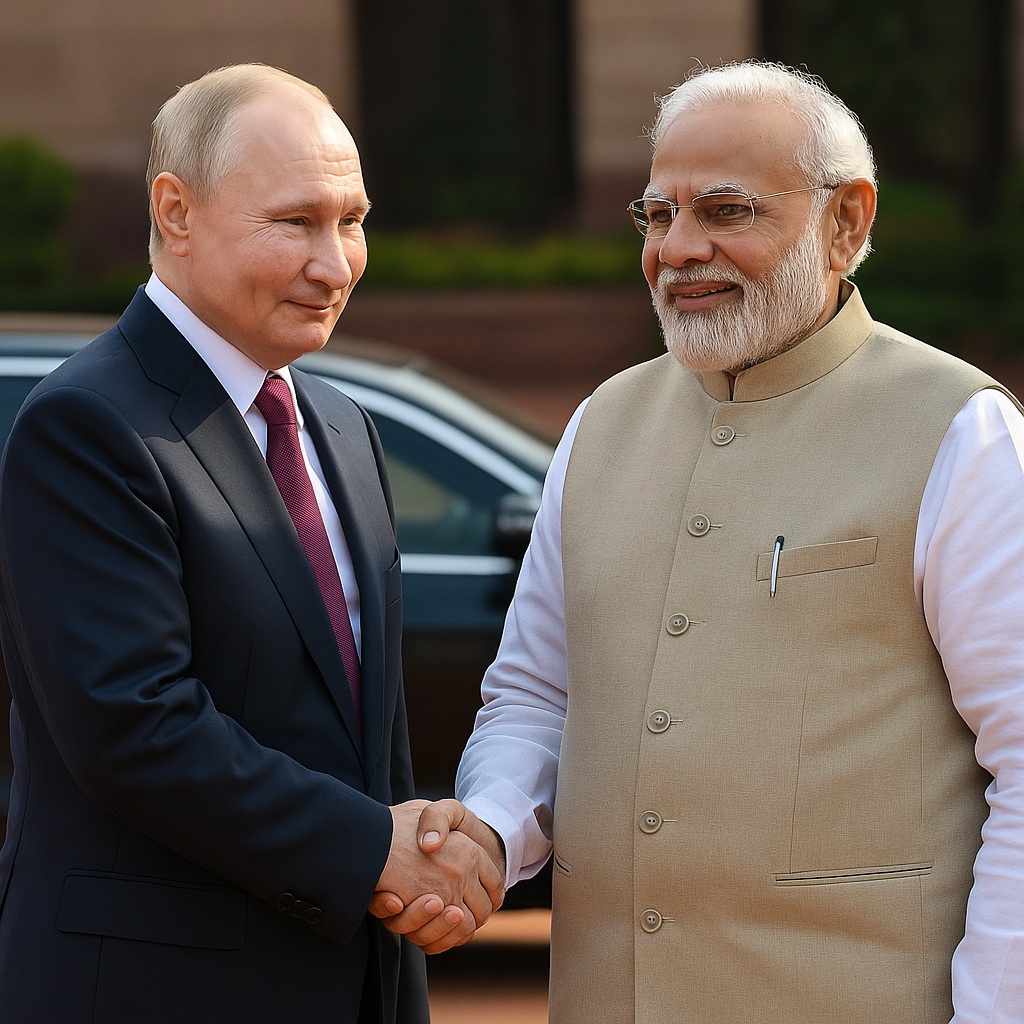
As the political atmosphere across Eurasia thickens once again, India’s Prime Minister Narendra Modi has welcomed Russian President Vladimir Putin for a high-profile visit that is reverberating across global capitals. The meeting, unfolding amid persistent Western pressure on New Delhi to distance itself from Moscow, reveals India’s increasingly assertive foreign-policy posture—and its determination to chart a course independent of traditional geopolitical blocs.
The encounter also represents a challenge to Western attempts to isolate Russia on the world stage. While Washington and key European partners have tightened sanctions and expanded diplomatic restrictions, India continues to balance its long-standing relationship with Moscow against its deepening—but not subordinate—ties with the West.
For Modi, the meeting is not merely symbolic. It reinforces India’s identity as a multipolar power willing to engage all sides without fully aligning with any. For Putin, the visit is a critical opportunity to demonstrate that he retains influential partners outside the Western orbit, even as Russia remains entrenched in its grinding conflicts and political standoffs.
GEOPOLITICAL CALCULUS
India’s approach reflects a subtle yet firm doctrine: strategic autonomy. Officials in New Delhi emphasize that the country’s national interests—not ideological alliances—drive its diplomatic decisions. Despite Western irritation, India has consistently defended its engagement with Russia, framing the relationship as essential for defense cooperation, energy security, and regional stability.
Moscow, for its part, has long viewed India as a dependable partner in Asia, particularly as its ties with China remain complex and transactional. Although Russia and China have drawn closer in recent years, the Kremlin sees value in avoiding over-dependence on Beijing. Strengthening ties with India helps widen its diplomatic space and underscores that Russia is not confined to a binary East-versus-West dynamic.
Western governments, meanwhile, interpret the Modi-Putin meeting as a setback to their cohesion on Russia policy. For months, officials from the United States and Europe have privately urged India to reconsider its proximity to Moscow—especially in sectors like defense procurement and energy imports. But New Delhi has shown little inclination to retreat.
ECONOMIC AND DEFENSE DIMENSIONS
India’s reliance on Russian military systems remains a central pillar of the relationship. Although diversification toward Western and indigenous platforms is underway, decades of defense cooperation cannot be unwound overnight. Joint production projects, ongoing maintenance of legacy equipment, and shared technological know-how give Russia enduring leverage in India’s security architecture.
Energy is also a driving force. Discounted Russian crude has softened global price shocks for India’s domestic economy, allowing New Delhi to maintain affordable fuel for its vast population. Despite criticism from the West, Indian officials counter that their purchases stabilize the market and are aligned with national interests.
Trade between the two nations has expanded even as sanctions tighten elsewhere. While logistical and financial hurdles persist, the broader trend points toward a durable partnership in critical sectors, from hydrocarbons to rare-earth minerals.
DIPLOMACY IN MOTION
During the visit, both leaders projected resolute confidence in the future of their bilateral relationship. Statements from the Indian side highlighted a pragmatic orientation: cooperation in areas such as nuclear energy, space technology, and pharmaceuticals. Russia emphasized military-technical collaboration and strategic coordination across regional platforms.
Beyond the handshakes and ceremonial gestures, the visit conveyed a deeper message. India refuses to be boxed into the geopolitical narratives crafted by others. Instead, it is asserting a foreign policy molded by ambition, national interest, and a long-standing belief in a pluralistic global order.
For Modi, the relationship with Russia represents continuity amidst rapid global shifts. For Putin, it signals that key partners remain willing to engage—even as Europe and North America continue to tighten restrictions.
WESTERN REACTION AND THE ROAD AHEAD
Western officials have reacted with a predictable mix of disappointment and realism. While the United States views India as a pivotal Indo-Pacific partner, it also recognizes that New Delhi will not abandon its strategic ties with Russia simply to accommodate Western preferences. Quiet diplomatic outreach will continue, but few expect abrupt changes in India’s stance.
Europe, too, faces a dilemma. Its economic and technological partnerships with India are expanding, yet its insistence on isolating Russia clashes with India’s multipolar worldview. The result is a diplomatic tension that both sides must navigate carefully.
Still, the Modi-Putin meeting does not imply an uncritical embrace. India has maintained lines of communication with the West at all levels and continues to pursue cooperation in areas ranging from advanced technology to maritime security. Rather than choosing sides, New Delhi appears determined to build bridges in a fragmented world.
CONCLUSION
The encounter between Modi and Putin captures a defining feature of contemporary geopolitics: the shift away from rigid alliances toward flexible, interest-based relationships. As global power centers realign and tensions reshape traditional partnerships, India stands as a compelling example of how nations navigate uncertainty by multiplying—not limiting—their strategic options.
Putin’s visit underscores that Russia retains meaningful diplomatic avenues beyond the Western sphere. For India, the meeting reaffirms its position as a sovereign actor unwilling to be pressured into conformity.
Whether the West adjusts its expectations or intensifies its efforts remains to be seen. But one thing is clear: India’s strategic autonomy is no longer an aspiration—it is operational, assertive, and increasingly influential on the world stage.


 The Tower Post