
With four European nations vowing to sit out the 2026 contest over Israel’s participation during the ongoing Gaza war, questions arise about whether Eurovision can still claim political neutrality.
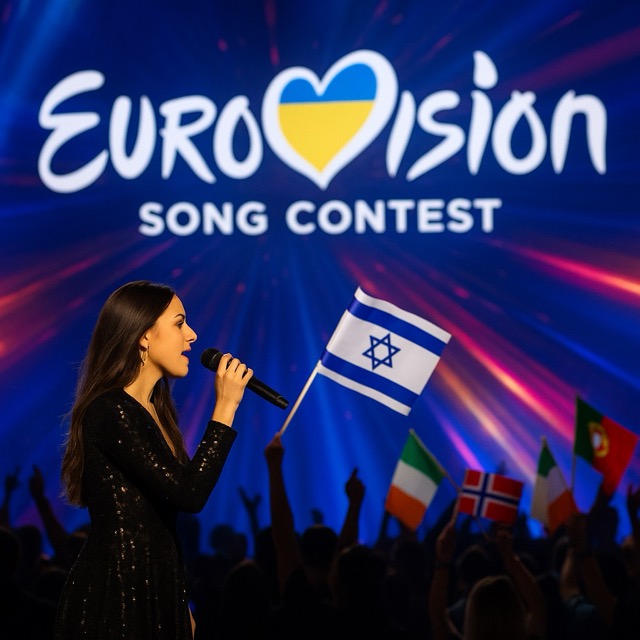
The Eurovision Song Contest, long marketed as Europe’s shimmering celebration of unity-through-pop, is confronting one of the most politically fraught moments in its seven-decade history. Four European countries — Ireland, Iceland, Portugal, and Belgium — announced this week that they intend to boycott the 2026 edition of the competition, to be held in Geneva, unless the European Broadcasting Union (EBU) withdraws Israel’s invitation in light of the continuing Gaza war.
The coordinated announcement, delivered in separate but near-identical statements by national broadcasters, has ignited a heated debate across the continent. For some, the boycott signals a long-overdue reckoning with what they see as the EBU’s inconsistent application of its “strictly apolitical” ethos. For others, it threatens to fracture a beloved cultural tradition that has, until recently, managed to survive geopolitical upheaval by insisting on its own insulation from politics.
The EBU responded swiftly, reaffirming that all member broadcasters in good standing retain the right to participate. “Eurovision is a platform for musical expression, not a venue for political adjudication,” the organization said. But the statement has done little to quiet criticism. Artists, activists, and cultural commentators continue to question whether the contest can maintain a neutral posture when one of its participating states is actively engaged in a high-profile, internationally condemned conflict.
The pressure has been mounting for months. Since late 2024, when renewed violence in Gaza drew widespread protests across Europe, several national delegations internally debated withdrawal. Icelandic artists were among the first to publicly call for a boycott, citing human rights concerns. In Ireland, a petition urging the national broadcaster RTÉ to step aside from the contest surpassed 200,000 signatures — an unprecedented figure that forced political leaders to acknowledge the issue in parliament.
By the time Belgium and Portugal joined the boycott movement in October, commentators warned that the dispute had shifted from a cultural controversy to a diplomatic flashpoint. “Eurovision has always been political, even when it pretended not to be,” said Sofia Marku, a cultural diplomacy researcher at the University of Athens. “What’s happening now is that the illusion of neutrality is breaking down in real time.”
At the heart of the conflict is a question Eurovision has long attempted to sidestep: Can a continental cultural event remain inclusive and entertaining while the political realities of the world grow more visible and morally charged? The contest has faced accusations of hypocrisy before — particularly after allowing Russia to compete for years despite its annexation of Crimea. When Russia was finally barred after the 2022 invasion of Ukraine, critics argued that the EBU had already set a precedent: major breaches of international law could indeed become grounds for exclusion.
For activists pressing for Israel’s removal, this comparison is central. “You cannot ban Russia over Ukraine and then claim neutrality regarding Gaza,” said Portuguese singer Ana Matos, one of the leading voices in the boycott campaign. “Eurovision cannot selectively apply ethics.”
Yet others warn that politicizing the contest risks undermining its purpose. Swiss broadcaster SRG SSR, host of the 2026 edition, expressed concern that expanding political criteria could make the contest “unmanageable” and vulnerable to constant diplomatic pressure. Some smaller member nations fear that boycotts could snowball, triggering a crisis of participation that threatens Eurovision’s viability.
The internal cultural impact is already becoming visible. Several artists from the boycotting countries have stated they will refrain from submitting entries even if their broadcasters reverse course. Others elsewhere in Europe have begun to question whether competing would be seen as tacit approval of the EBU’s stance. Social media conversations about Eurovision — typically dominated at this stage by speculation about hosts, staging, and national selection shows — have taken on an unusually confrontational tone.
In recent weeks, Geneva tourism officials and the local organizing committee have reportedly held contingency meetings to address the possibility of a scaled-back or symbolically overshadowed contest. Hoteliers have expressed concern about potential drops in international bookings. While the EBU insists preparation is on schedule, internal emails leaked to several European newspapers suggest the organization is bracing for additional withdrawals.
What remains unclear is whether the boycott will expand. Several Nordic and Mediterranean broadcasters have said they are “monitoring the situation,” a phrase widely interpreted as code for internal debate. Diplomats within the EU, meanwhile, worry that the Eurovision dispute may spill into larger political negotiations, further deepening rifts over Middle East policy.
Despite the turmoil, some observers believe this moment could spark much-needed reform in how large cultural events handle political crises. “Eurovision is being forced to confront the world it exists in,” said Marku. “This may ultimately lead to a clearer framework for participation — one that acknowledges politics rather than pretending it doesn’t exist.”
For now, however, the future of the 2026 contest hangs in the balance. As rehearsals, stage construction, and promotional tours begin in early 2026, the spectacle that Europe has come to expect may look and feel very different. The music will still play, but the underlying tensions — cultural, political, and moral — are unlikely to fade.
And whether Eurovision emerges from this crisis weakened or transformed will depend not only on the decisions of broadcasters and performers, but also on the audiences who must decide what role a cultural institution should play in times of conflict.



 The Tower Post