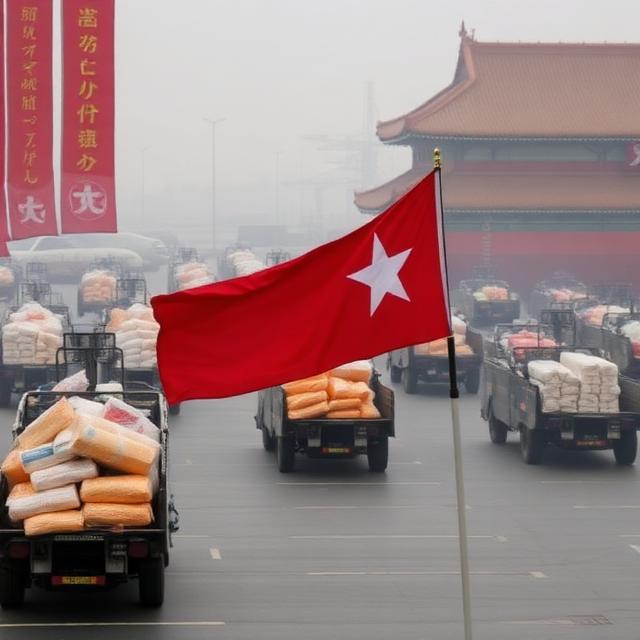
Beijing’s export-driven model is reshaping international trade dynamics, leaving traditional partners to grapple with an unprecedented challenge
A striking reversal has emerged in global economic relationships this year. Despite implementing tariffs, the United States has increased its imports by 10 percent compared to last year. Meanwhile, China—vocal in its criticism of protectionism—has seen its imports decline by 3 percent in dollar terms. This contrast reveals a fundamental shift in how the world’s second-largest economy engages with international trade.
The pattern extends beyond a single year. Over the past five years, China’s export volumes have surged while imports have remained stagnant. The country is capturing an expanding portion of the global market for manufactured goods, pursuing what economists characterize as a “beggar thy neighbor” growth strategy that benefits its own economy at the expense of trading partners.
Recent analysis by Goldman Sachs economists highlights this transformation. Historically, each percentage point of Chinese economic growth would generate 0.2 percent growth in the rest of the world through increased imports. That relationship has now inverted. The Goldman team projects that China’s growth, driven by what they describe as leadership’s determination to advance manufacturing competitiveness and boost exports, will actually reduce global growth by 0.1 percentage points annually, even as China itself grows 0.6 percentage points faster each year.
The benefits of cheaper Chinese goods for consumers worldwide are being overshadowed by the damage to manufacturing sectors facing Chinese competition. While China’s growth remains positive for its citizens and for countries supplying inputs to its export machinery, Goldman projects mounting challenges for industrial economies across Europe, East Asia, and Mexico.
This represents a departure from fundamental economic principles. The post-World War II era established a pattern where the United States, as the world’s largest exporter and economy, imported more as it grew, helping its trading partners prosper. Those partners, in turn, purchased American products. Expanding trade enabled specialization, fostering competition, innovation, consumer choice, and lower costs.
China has adopted a markedly different philosophy. The country has never embraced balanced trade or comparative advantage. Even while importing critical technology from the West, its long-term objective has consistently been self-sufficiency. In 2020, Chinese leader Xi Jinping formalized this approach as “dual circulation,” designed to tighten international industrial chains’ dependence on China while ensuring Chinese production remained independent and self-sustaining.
Xi’s vision extends across the manufacturing spectrum. As China advances into high-end sectors like aircraft and semiconductors, he has mandated that the country must not abandon low-end production such as toys and clothing. Beijing has discouraged Chinese companies investing abroad from transferring key technological knowledge, including in iPhone and battery production. Xi has resisted fiscal reforms that would reorient the economy away from investment, exports, and saving toward household consumption and imports.
Export-led growth and industrial policy are not unprecedented. West Germany, Japan, and later South Korea pursued similar strategies, eventually accumulating surpluses that became persistent sources of tension with the United States. However, as members of the democratic West, these countries did not fear economic interdependence or seek to eliminate imports. As they advanced up the value chain, they permitted lower-end manufacturing to migrate to poorer nations.
“Those countries were driven by a desire for prosperity,” explained Rush Doshi, a China expert who served on President Joe Biden’s National Security Council. “China is driven by a fortress mentality and sees industrial dominance as key to wealth and power. These are longstanding goals deeply rooted in nationalism and the Communist Party.”
Two decades ago, China’s economy was small enough that its trade surplus had minimal global impact. Today, China represents 17 percent of global gross domestic product. Goldman estimates its current account surplus—the broadest measure of trade—will reach 1 percent of world GDP by 2029, exceeding any country’s surplus since at least the late 1940s.
The automotive sector illustrates this transformation. As recently as 2020, international automakers supplied approximately 60 percent of the roughly 20 million vehicles sold in China, typically from local factories operated with domestic joint-venture partners. Executives insisted they would never undermine sales outside China by exporting from these joint ventures, according to Michael Dunne of Dunne Insights, a market research and advisory firm.
Since then, Chinese automotive brands have moved aggressively into electric vehicles, reducing foreign brands’ market share below 40 percent. Burdened with excess capacity for internal-combustion-engine vehicles, those joint ventures have begun exporting, and the promised restraint has evaporated. Four of the top five Chevrolet models sold in Mexico are now manufactured in China by General Motors’ joint-venture partners, according to Dunne. These vehicles would previously have been produced in Mexico or South Korea.
Many countries find themselves frustrated by China’s strategy, which is displacing their manufacturing sectors and limiting export opportunities. Yet none has identified an effective solution. China’s dominance across numerous manufacturing categories provides formidable leverage. When the Netherlands took control of Dutch chip maker Nexperia from its Chinese owner for national security reasons, China prohibited the company from exporting chips from its Chinese operations, crippling automotive assembly customers. The Netherlands retreated from its position.
President Trump, whose tariffs have encountered minimal resistance elsewhere, was compelled to compromise when China restricted exports of critical minerals. The most effective approach to countering China’s export surge would involve the United States coordinating with like-minded partners, such as imposing common restrictions on Chinese automobiles while maintaining low barriers among themselves. Trump has shown no interest in such a united front to date.
Nevertheless, his bilateral agreements include incentives for resisting Chinese exports. Malaysia, for example, agreed to match American restrictions imposed on China for national security purposes.
North America would seem a natural candidate for a coordinated response. To preserve the low tariffs established in the U.S.-Mexico-Canada Agreement, Canada and Mexico might be willing to join the United States in raising barriers to China. However, time is running short. Canada replicated America’s 100 percent tariffs on Chinese electric vehicles last year. Trump then imposed auto tariffs on Canada, and China retaliated against Canadian agriculture. Caught between two trade conflicts, Canada is now reviewing its tariffs on China.
The challenge facing the international community is unprecedented: how to respond to an economic power that views trade not as mutually beneficial exchange but as a strategic tool for national advancement, even when that advancement comes at others’ expense.



 The Tower Post