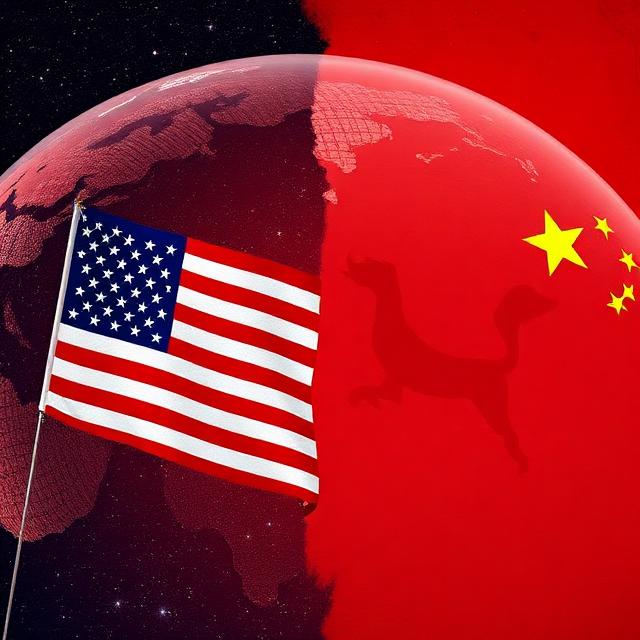
White House document de-emphasizes ideological rivalry while maintaining focus on Taiwan and economic competition
BEIJING — The Trump administration has unveiled a national security strategy that marks a notable departure from its predecessor’s approach to China, softening rhetoric about Beijing as America’s primary adversary while maintaining concerns about Taiwan and trade imbalances.
The 30-page document, released Friday, represents what experts describe as a significant recalibration of U.S.-China relations. Unlike the Biden administration’s 2022 strategy, which explicitly designated China as the nation’s foremost foreign-policy challenge, the new framework mentions China sparingly and primarily in economic contexts.
Jessica Chen Weiss, a professor of China studies at Johns Hopkins University’s School of Advanced International Studies, characterized the shift as “a relatively favorable turn in U.S. grand strategy” from Beijing’s perspective. The document’s most striking omission is the Biden-era declaration that the United States “does not support Taiwan independence,” though it maintains opposition to unilateral changes in the Taiwan Strait.
The strategy preserves some hardline positions on Taiwan, calling for closer cooperation with Pacific allies to deter any attempt to seize the self-governing island. It emphasizes the importance of the Quad partnership among the United States, Australia, Japan and India, a grouping Beijing has criticized as an effort at containment.
Ryan Fedasiuk, a fellow at the American Enterprise Institute and former State Department official, warned that Beijing would interpret the softer language as a concession. The shift from “opposes” to “does not support” regarding unilateral changes to Taiwan’s status, he said, “establishes the baseline from which Beijing negotiates, and the baseline just moved.”
The document abandons much of the Biden administration’s emphasis on a “rules-based international order,” a phrase that appeared eight times in the 2022 strategy but only once in the current version, used dismissively to criticize previous policies. Instead, the Trump White House frames the relationship primarily through an economic lens, describing trade as “the ultimate stakes” in Asia.
The administration’s harshest criticism is reserved for European allies, with pointed remarks about declining Western “civilizational self-confidence.” This tone has raised concerns among Asian partners who rely on American security commitments, even as the document reaffirms traditional alliance structures in the Pacific.
The strategy seeks what it calls a “mutually advantageous economic relationship with China” while pledging to counter what it describes as predatory trade practices. It characterizes the current U.S.-China economic relationship as one between “near-peers” and commits to working with regional partners to prevent allied economies from becoming subordinate to competing powers.
Weiss noted that the document “crystallizes the United States’ turn away from international leadership and democratic values toward a narrower focus on U.S. power and preventing any other country from becoming globally or regionally dominant.” This approach downplays ideological differences between Washington and Beijing in favor of pragmatic economic competition.
The strategy’s apparent contradictions reflect ongoing tensions within the administration’s approach. While emphasizing multilateral partnerships like the Quad, the document also suggests that “larger, richer, and stronger nations” will inevitably dominate international affairs, a stance Weiss described as critical of multilateralism itself.
For Beijing’s leaders, the document offers a mixed picture. The softer rhetoric and economic focus may provide openings for negotiation, but the continued emphasis on Taiwan’s defense and regional alliances signals that fundamental strategic competition remains. As Fedasiuk warned, Chinese officials are likely to treat the document as “a negotiating floor” and press for further concessions in future discussions.



 The Tower Post